 Client Login
  Retirement assessment
  Book a call
  0117 990 2602


How to save for retirement in your 40s in the UK in 2026

Quick Answer: By your mid-40s, a common rule of thumb is to have around 1.5 to 3 times your annual salary saved for retirement. But for higher earners, that rule of thumb only tells part of the story. The bigger issue is whether you are using your highest-earning years properly.
In your 40s, you may be able to pay up to £60,000 a year into pensions in 2026/27 and receive tax relief. You may also be able to carry forward unused pension allowances from the previous three tax years. For those earning over £100,000, pension contributions can be especially valuable because they may help recover the personal allowance and reduce the impact of the effective 60% tax rate.
So, how should you save for retirement in your 40s? Start by checking whether your current pension is on track, then make full use of available allowances, employer contributions, tax relief, and any bonuses or surplus income. Your 40s are often your best opportunity.
Why your 40s decide the shape of your retirement
Your 40s tend to be the decade everything competes for the same pound. You are in your 40s, earning well, and the pension has quietly slipped down the list behind the mortgage, the school fees, and everything else that wants your money first. The nagging question is whether you have saved enough, and whether there is still time to fix it if you haven’t.
The honest answer is yes, there is still time, but this is the decade it matters most. Money invested at 42 has more than two decades to compound before a typical retirement. Money found at 58 does not. The choices made now set the ceiling on the options available later.
The encouraging part is that your 40s are usually when income peaks. A higher salary and a more settled career mean the capacity to contribute is often at its highest at exactly the point it counts for the most.
How do you save for retirement while paying a mortgage and raising kids?
Saving for retirement while paying a mortgage and raising children is difficult because your money is already being pulled in several directions. The mortgage, childcare, school costs, family holidays, home repairs and day-to-day spending can all feel more urgent than a pension you may not touch for another 20 years.
That is exactly why retirement saving needs to be built into the monthly budget, not treated as whatever is left over. The common mistake is waiting until the mortgage is gone or the children are financially independent before taking pension saving seriously. It feels logical, but it can be expensive. By then, you may have more spare income, but you will have less time for your investments to compound.
A better approach is to fund both goals at the same time. That does not mean over-stretching yourself or ignoring the cost of family life. It means protecting a realistic pension contribution each month before discretionary spending takes over. Even if the contribution is modest at first, the habit matters. You can then increase it when childcare costs fall, school fees end, the mortgage reduces, or your income rises.
Is it too late to start a pension at 40?
Most people still have 20 to 30 years until retirement, which gives their investments time to grow. The key difference is that, with less time available, contributions often need to be higher than they would have been if saving had started earlier.
One of the most effective approaches is to increase pension contributions whenever your income rises. Redirecting bonuses, pay increases, tax refunds or other unexpected money into your pension can help build your retirement savings much faster without affecting your existing lifestyle.
You may also benefit from employer contributions and tax relief, which can significantly increase the value of the money you invest.
The most important step is getting started. Even if you’ve delayed saving for retirement, regular contributions over the next two or three decades can still build a substantial pension fund.

How much pension should I have at 40?
What pension should you have at 40 based on your salary?
A common guideline is a pension pot worth one and a half to three times your annual salary by your mid-40s. On a £100,000 salary, that means roughly £150,000 to £300,000.
These benchmarks serve as guidelines, not targets. Two people on the same salary can need very different pots depending on when they want to stop working, what they want retirement to look like, and what other assets they hold.
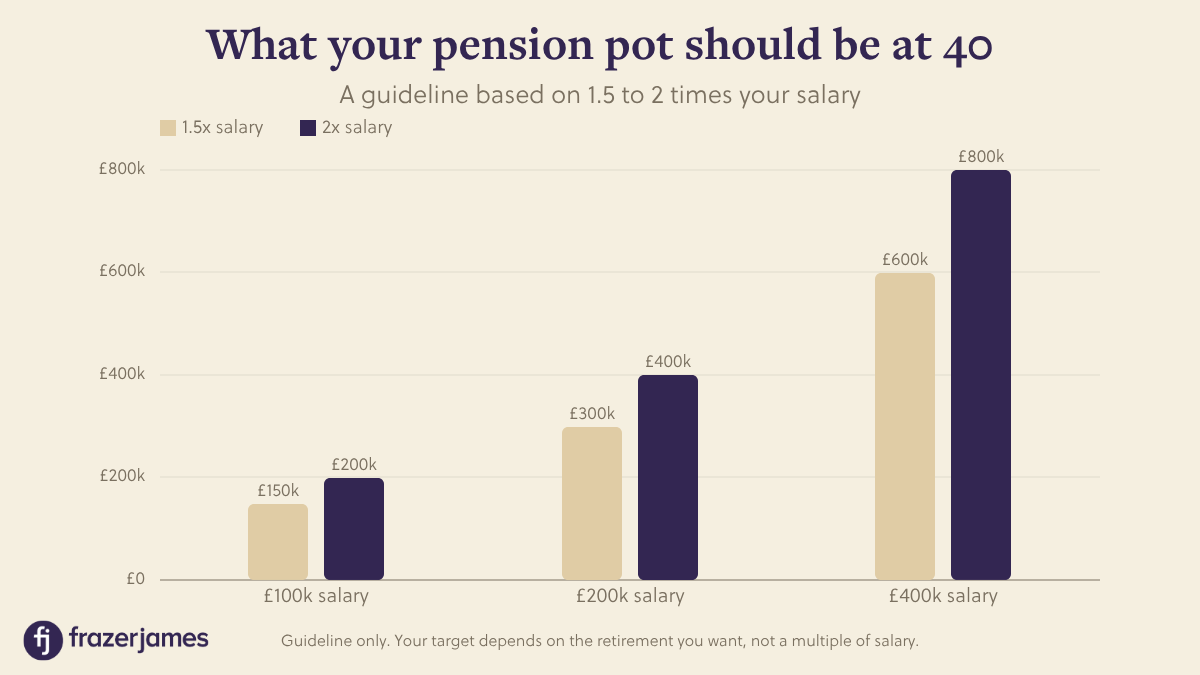
How much pension do you need at £100k, £200k or £400k?
Applying the same 1.5-3x multiple consistently across income levels:
| Annual salary | Guideline pot in your mid-40s (1.5–3x) |
| £100,000 | £150,000 – £300,000 |
| £200,000 | £300,000 – £600,000 |
| £400,000 | £600,000 – £1,200,000 |
Higher earners should treat these figures as a floor, not a goal. The realistic number depends on the kind of retirement you are aiming for, and that’s the subject of the next section, along with the tax-free allowance that shapes how fast you can build your pot.
Understanding your pension allowance and tax relief
Tax relief is one of the most valuable things about pension saving, and it’s worth understanding properly rather than as an afterthought. Higher-rate tax relief means a £10,000 contribution can cost a 40% taxpayer as little as £6,000, because the government adds back the tax you would otherwise have paid on that income.
There is also a yearly cap on how much you can pay into a pension tax-free, known as the annual allowance. For most people in 2026/27, this is £60,000. If your income is high enough, this allowance tapers down, reducing the amount you can contribute with full tax relief. Once your income is high enough to be affected, this cap can limit how fast you can build your pot, so it pays to plan around it early, including by using carry forward of unused allowance from the previous three tax years.
What is a good pension pot at 40?
What is the average pension pot at 40 in the UK?
For context, the median private pension pot for 35–44 year-olds in the UK is around £39,500, according to ONS data published in January 2025. Most affluent professionals will be well ahead of that figure, which is precisely why the national average is the wrong yardstick. It describes the population, not the retirement being planned for. The more useful question is not “how do I compare?” but “what income will this pot actually produce, and is that the life I want?”
How much do you need for a comfortable retirement?
A couple needs around £62,700 a year for a comfortable retirement and £45,400 for a moderate one, according to the Pensions and Lifetime Savings Association‘s 2025 figures. Its three retirement living standards for a couple are:
- Minimum: £22,500 a year
- Moderate: £45,400 a year
- Comfortable: £62,700 a year
A single person needs around £45,400 a year for a comfortable retirement and £32,700 for a moderate one, according to the Pensions and Lifetime Savings Association’s 2025 figures. The full new State Pension is £12,547.60 a year in 2026 (Source GOV.UK, Your new State Pension explained). That covers only part of even a minimum standard of living for a single person, which is why private provision does the heavy lifting.
Rather than asking whether your pension looks good on paper, ask what income it could realistically provide. Once you know the retirement lifestyle you want, you can work backwards to the pension pot, savings rate and investment strategy needed to support it.
Steps to grow your pension in your 40s
Maximise workplace pension contributions
If an employer matches contributions, contributing below the match leaves guaranteed money unclaimed. Where an employer matches up to 5%, contributing at least 5% effectively doubles that portion of saving before any investment growth.
Consider a SIPP
A Self-Invested Personal Pension offers flexibility and control over how the money is invested, with the same tax relief as other pensions. It can be particularly useful for the self-employed, company directors, or anyone consolidating multiple old workplace pensions into a single place.
Increase your contributions and claim your relief
Small increases compound. Raising contributions by even 2% of salary makes a meaningful difference over two decades, and automating it removes the monthly decision. Higher and additional-rate taxpayers should also make sure they claim the full tax relief due, often through Self Assessment. It is one of the most overlooked levers available.
Investing smartly for retirement in your 40s
Reviewing your investment portfolio
Reviewing your pension investments in your 40s matters because the fund you started with may no longer be the right one. Many workplace pensions are invested in a default fund unless you actively choose otherwise. Default funds are designed to be broadly suitable for lots of people, but not specifically suitable for you. They may not reflect your retirement age, risk tolerance, other assets, or how you plan to draw income later.
One issue is “lifestyling,” sometimes called a glidepath. This is where the pension gradually moves into lower-risk assets as you approach a selected retirement age. That can be useful if you plan to buy an annuity or take benefits at that exact date. But it can be unhelpful if you plan to stay invested, draw income flexibly, or retire earlier or later than the scheme assumes. A pot left in a default fund for fifteen years can easily drift away from the strategy you actually need. A portfolio balanced across assets, and reviewed periodically, keeps your investments matched to your goal rather than shaped by neglect.
Taking advantage of compound growth
Compounding rewards time in the market. With twenty or more years until retirement, even contributions started in your 40s have room to grow substantially, as the returns themselves begin to generate returns.
Diversifying beyond your pension
A pension is tax-efficient but not the only tool. ISAs offer tax-free flexibility and earlier access, and other assets can add stability or income. A mix of wrappers gives more control over how and when retirement income is drawn, and how it is taxed.
Overcoming the common obstacles
Managing debt while saving
Managing debt while saving for retirement is a balancing act. High-interest debt, such as credit cards or expensive personal loans, usually deserves priority because the interest cost can outweigh the likely return from investing. But stopping pension contributions completely can be costly too. You may lose employer matching, tax relief, and the habit of saving consistently.
For higher-rate taxpayers, pension contributions can be especially valuable because the tax relief does part of the work for you. A sensible approach is to separate expensive debt from manageable debt. Expensive debt should usually be cleared quickly. But lower-cost borrowing, such as a mortgage, does not always need to be eliminated before you save for retirement.
Avoiding lifestyle inflation
As income rises, spending tends to rise with it. A bigger salary can quickly become a bigger mortgage, better holidays, nicer cars, more eating out and a generally more expensive lifestyle. None of those things are wrong, but they can quietly absorb the income that could have closed your retirement savings gap.
One useful approach is the “save more tomorrow” principle. Instead of making painful cuts today, commit in advance to saving more when your income increases. For example, you might direct half of every pay rise, bonus or profit distribution into your pension before it becomes part of normal spending.
Directing future pay rises into pension contributions is one of the most effective ways to increase retirement saving without it feeling like a sacrifice. It turns higher earnings into long-term financial independence, rather than simply a higher cost of living.
Planning for the unexpected
Planning for the unexpected matters because life rarely waits for a convenient time. A boiler breaks, a car needs replacing, income changes, or a family cost appears without warning. Without accessible cash, these costs can force poor financial decisions. You may need to use expensive borrowing, pause pension contributions, or withdraw from investments at the wrong time.
An emergency fund gives your retirement plan breathing room. As a rough guide, holding three to six months of essential expenses in accessible cash can help you absorb short-term shocks without disrupting long-term savings.
The right amount depends on your circumstances. Someone with stable employment, strong cash flow and good insurance may need less. A business owner, contractor or single-income household may need more. The point is not to hold excessive cash forever. It is to keep enough available so that an unexpected cost does not derail the bigger plan.

Get Expert Pension Tax Advice
Your 40s are a crucial decade for retirement planning. You may still have 20 years or more until retirement, but the decisions you make now can have a significant impact on the income, flexibility and choices available to you later.
A pension benchmark can tell you roughly where you stand. It cannot tell you whether you are on track for the retirement you want, how much you should be saving, or whether you are using pensions, ISAs, tax relief and allowances in the most effective way. That is where financial planning helps. We can help you understand what you have, what you need, and what to do next.
Schedule Your Initial Consultation
Financial Advisor Bristol and Pension Advisor Clifton
Frazer James Financial Advisers is an Independent Financial Advisor in Bristol, Clifton. We provide independent financial advice, including pension advice, investment advice, inheritance tax planning and insurance advice. If you want to speak to a Financial Advisor, we offer an Initial Consultation without cost or commitment. Meetings are held either at our offices, by video or by telephone. Our telephone number is 0117 990 2602. Frazer James Financial Advisers is located at Square Works, 17 — 18 Berkeley Square, Bristol, BS8 1HB. This article provides information about investing but not personal advice. If you’re not sure which investments are suitable for you, please request advice. Remember that investments can go up and down in value; you may get back less than you put in.