 Client Login
  Retirement assessment
  Book a call
  0117 990 2602


How can business owners reduce tax when selling their company in the UK?
Quick answer: The most effective ways for UK business owners to reduce tax when selling their company are to plan at least 3-5 years ahead, structure share ownership to qualify for Business Asset Disposal Relief (BADR), which reduces Capital Gains Tax to 18% on gains up to £1 million per person, make consistent pension contributions, and retain surplus profits inside the company. The key is timing: most of the available tax relief closes before any sale process begins.
Most business owners think about selling their company far too late. By that point, the most valuable planning window has already gone. If you’re growing, profitable, and an exit is somewhere on the horizon, the good news is there’s still time to get this right.
Picture this. A founder gets an unexpected call from a competitor interested in buying the business. Exciting. After a few conversations, the interest is serious and an offer is coming.
The founder calls their accountant. First question: can the shares be transferred to a spouse before the sale completes, to use their Business Asset Disposal Relief allowance? The accountant pauses. To qualify, a spouse needs to have held at least 5% of the shares and been an officer of the company for two continuous years. The offer arrives in six weeks. It’s too late. That’s potentially £100,000 of tax relief gone before the deal has even been signed.
This isn’t a cautionary tale from a textbook. It’s a version of a conversation that happens regularly.
The decisions that make the biggest difference aren’t made at the point of sale. They’re made, or missed, in the years before.

Wondering where to start? Book a free consultation – no agenda, just an honest conversation.
Why do most business owners leave exit planning too late?
What is Business Asset Disposal Relief and how does it work?
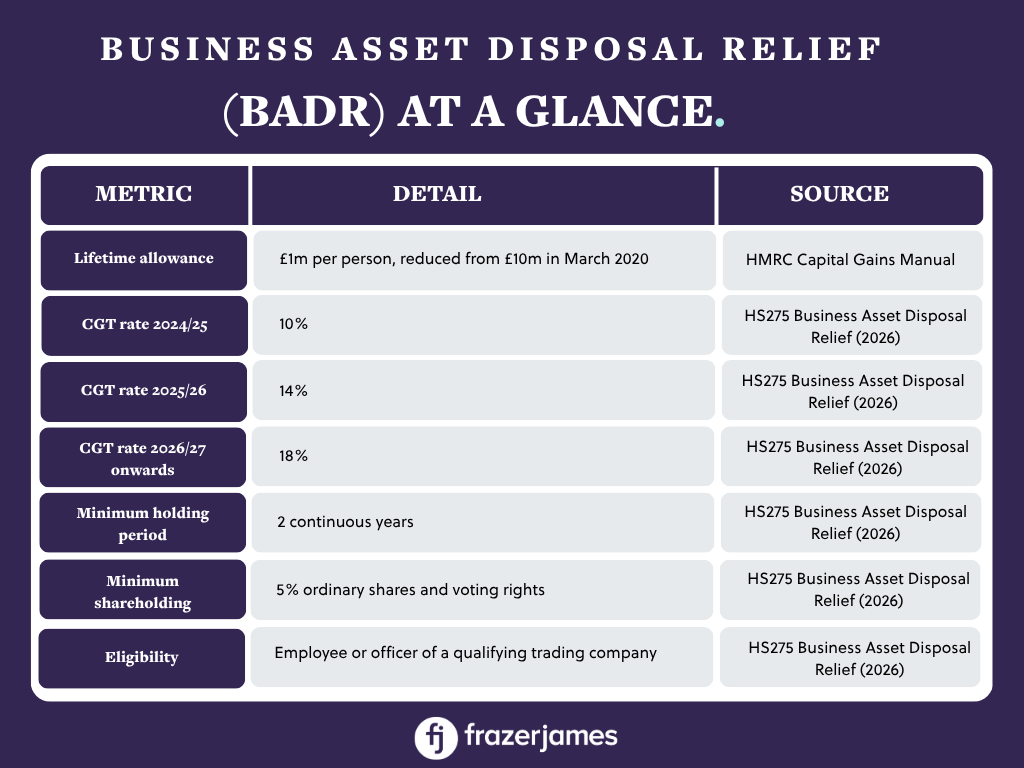
Business Asset Disposal Relief (BADR), previously known as Entrepreneurs’ Relief, is a tax relief that reduces the rate of Capital Gains Tax payable when selling shares in a qualifying business. Capital Gains Tax (CGT) is the tax applied to the profit made on a sale, not the total proceeds. So if shares were originally worth £500,000 and the business sells for £2 million, the taxable gain is £1.5 million, and BADR affects how much tax is paid on that gain.
Where BADR applies, CGT is charged at 18% (the rate since 6 April 2026) rather than the standard 24% rate.
What the allowance is worth, and what it isn’t
BADR reduces the tax rate on qualifying gains, but only up to £1 million per person, per lifetime. For businesses worth more than that, it’s one useful element of the plan, not the whole plan.
- The lifetime limit is £1 million per individual: not per business, not per sale
- A spouse or civil partner with qualifying shares can each claim up to £1 million separately
(Source: GOV.UK, Capital Gains Tax rates)
For any business, regardless of size, BADR is one part of a broader exit strategy. Treating it as the plan, rather than a component of one, is one of the most common mistakes business owners make.
The rates themselves have shifted significantly in recent years, and the direction of travel matters for timing decisions.
- 10% – the rate that applied from 2010 to April 2025
- 14% – the rate for qualifying disposals from April 2025 to April 2026
- 18% – the rate for qualifying disposals from April 2026 onwards
At the current 18% BADR rate, a £1 million qualifying gain costs £180,000 in tax. Without relief, the same gain would cost £240,000. That’s a £60,000 difference.
(Source: GOV.UK, HS275 Business Asset Disposal Relief)
Eligibility and share structure: what to check early
Two of the most valuable aspects of BADR require years of advance planning to be effective. Getting them wrong, or leaving them too late, is where most of the money is lost.
BADR has to be actively claimed, and the qualifying conditions are specific. The rules catch people out after restructures, share dilutions, or where the nature of the business has changed over time. Where BADR applies, CGT is charged at 18% (the rate since 6 April 2026) rather than the standard 24% rate.
(Source: GOV.UK, HS275 Business Asset Disposal Relief)
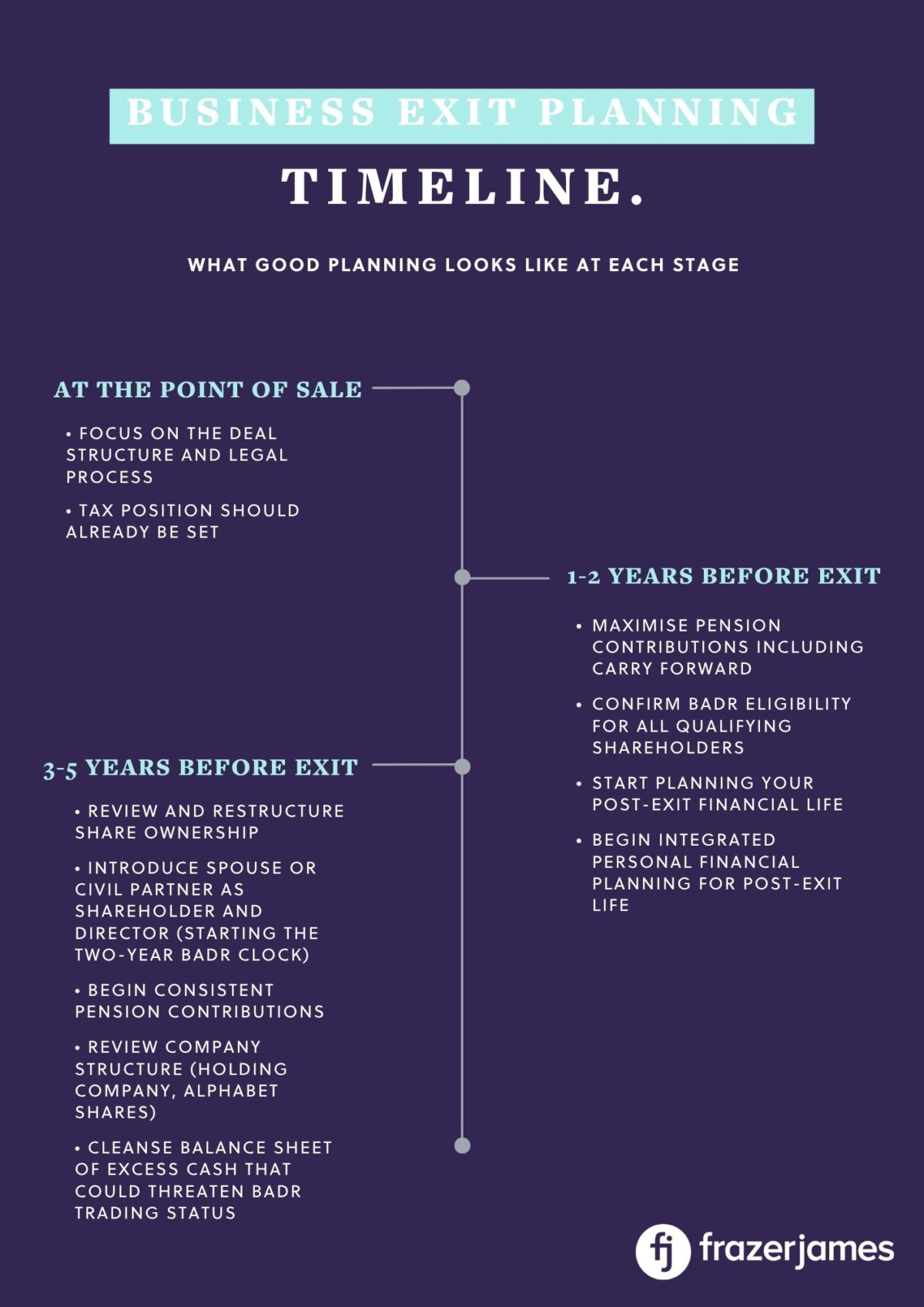
Verifying eligibility at least three years before an intended sale leaves time to fix problems. Verifying it after an offer has been received usually doesn’t.
Where both partners independently qualify, the combined allowance can shelter up to £2 million of gains at the reduced rate. It’s one of the most consistently overlooked opportunities in exit planning.
- Each person must independently meet all the qualifying conditions
- This needs to be put in place years ahead of any sale to be effective
Done properly and early, this can make a material difference to the overall tax position. Done at the last minute, it achieves nothing and may attract scrutiny.
BADR reduces tax on what you’ve already built. A financial planner’s job is to help you build the position, in the years before a sale, that makes the most of it.
Not sure whether BADR applies, or whether a spouse or civil partner should be involved? Get in touch – it’s a straightforward conversation to have early.
How can business owners build wealth tax-efficiently before a sale?
The business owners who end up in the strongest position financially tend to have been doing something different for years before any sale becomes relevant. They’ve been building wealth outside the business, consistently, so that by the time a deal comes along they’re negotiating from a position of security rather than necessity.
Pension contributions: the most underused lever available to most business owners
Company pension contributions are among the most tax-efficient ways to extract profit from a business, and one of the most consistently overlooked.
- Many business owners are sitting on years of unused allowance without realising it
- Employer pension contributions reduce taxable profit before corporation tax is applied, so the money going into the pension effectively costs the business less than it would if taken as salary or dividend
- At the current 25% corporation tax rate, every £10,000 contributed saves £2,500 in corporation tax
- Money grows inside the pension free of Capital Gains Tax
- The pension becomes accessible from age 55 (rising to 57 from 6 April 2028)
- The standard annual allowance is £60,000 per tax year – the maximum that can be contributed with tax relief in a single year
- Carry forward allows unused allowances from the previous three tax years to be used in a single year, often enabling a much larger one-off contribution
(Source: GOV.UK, Pension annual allowance and carry forward)
Done consistently over a number of years, pension contributions can build substantial personal wealth outside the business – and reduce how much financial pressure sits on the eventual sale.
Retaining and investing surplus profits inside the company
Not every pound of profit needs to be extracted immediately as salary or dividend. A company investment account holds a portfolio of assets in the company’s name rather than personally. Surplus profits can be retained there and drawn down gradually over time, tax-efficiently, rather than arriving as one large concentrated payment at exit.
(Source, GOV.UK, Corporation Tax)
- A company investment account can hold a diversified portfolio growing alongside the business
- Drawing down gradually after a sale spreads the tax position rather than concentrating it
- It also reduces financial pressure during the sale process itself, which tends to give business owners more negotiating flexibility
- Unlike pension contributions, the funds remain accessible to the company before a sale if needed
The goal is having enough financial resilience that the sale of the business becomes a choice, not a deadline.
A proper conversation about pension strategy and profit extraction is worth having sooner rather than later. Here’s how Frazer James works with business owners.
Why the goal isn’t less tax – it’s more choice
Framing the whole exercise as “reducing tax when selling” is understandable. But it tends to lead to the wrong decisions, because it treats the sale as the destination rather than one moment in a much longer financial story.
From needing to sell to choosing to sell
Tax reduction is a means to an end. The real goal is personal financial security – enough of it that the sale of the business becomes a strategic decision rather than a financial one.
That shift changes everything. It determines which buyers to engage with, which offers to walk away from, and whether the timing serves the business owner’s life or someone else’s deal timeline. The founders who do this well aren’t just minimising their tax bill. They’re building enough financial independence that they can afford to wait.
Getting there means connecting business decisions – profit extraction, surplus cash, ownership structure – to a personal financial plan that runs alongside the business for years, not just the months before an exit. Not a tax strategy bolted on when an offer arrives. A plan that makes the exit the natural conclusion of considered, long-term preparation.
A few honest questions worth sitting with
Before speaking to anyone, it’s worth taking stock of where things actually stand:
- How much wealth sits outside the business right now, versus inside it?
- Have pension contributions been made consistently and at a meaningful level in recent years?
- Do both partners in a marriage or civil partnership hold shares – and would both qualify for BADR?
- Has the share structure ever been reviewed with an eventual exit in mind?
- Is there a realistic picture of what financial life looks like after a sale?
If any of those don’t have a clear answer, that’s a useful place to start.
Frazer James works with business owners at every stage – from growing quickly to planning an eventual exit. Find out how.
Key takeaways
- Start before it feels necessary. That’s the part most business owners get wrong. By the time an exit feels imminent, most of the options have already closed.
- Business Asset Disposal Relief still matters – but it’s not the plan. The lifetime allowance is £1 million per person, the rate is rising, and qualifying isn’t automatic. One tool among several, not a strategy in itself.
- Build wealth outside the business. Pension contributions and company investment accounts reduce dependence on a single exit event – and put business owners in a stronger negotiating position when a deal arrives.
- Most founders spend thousands of hours building a business and very little time thinking about how to keep the proceeds. That ratio is worth reversing.
- The goal isn’t less tax. It’s more choice. Enough financial security to sell on your own terms, to the right buyer, at the right time.
Get Expert Business Exit Advice
Structure your exit from your business as efficiently as possible with expert guidance.
Schedule Your Initial Consultation
Financial Advisor Bristol and Pension Advisor Clifton
Frazer James Financial Advisers is an Independent Financial Advisor in Bristol, Clifton. We provide independent financial advice, including pension advice, investment advice, inheritance tax planning and insurance advice. If you want to speak to a Financial Advisor, we offer an Initial Consultation without cost or commitment. Meetings are held either at our offices, by video or by telephone. Our telephone number is 0117 990 2602. Frazer James Financial Advisers is located at Square Works, 17 – 18 Berkeley Square, Bristol, BS8 1HB. This article provides information about investing but not personal advice. If you’re not sure which investments are suitable for you, please request advice. Remember that investments can go up and down in value; you may get back less than you put in.
This article is for general information purposes only and does not constitute financial or tax advice. Tax rules may change and their application depends on individual circumstances. Independent professional advice should be sought before acting on anything in this article. Frazer James Financial Advisers is authorised and regulated by the Financial Conduct Authority.