 Client Login
  Retirement assessment
  Book a call
  0117 990 2602


Modified on: September 2026
The £100k mistake business owners make when exiting their business

The £100k mistake business owners make when exiting their business
You’re a business owner who’s done the hard part. The company is profitable. The team works. And for the first time, there’s actual cash left over at the end of the year. But something doesn’t feel quite right. You’re not sure if the money is in the right place. You don’t know if you’re paying more tax than you need to. And you haven’t really thought about what happens when you eventually sell.
Most business owners growing past £150k in annual profit make the same three financial mistakes: they let cash pile up without a plan, they build everything inside the business and nothing outside it, and they leave exit planning so late it barely qualifies as planning at all. This article breaks down each one and what to do instead.
You’ve reached a point where the company is doing well. Revenue is up, profit is real, and the chaos of the early years is behind you. What most business owners do not realise is that growing a successful business and building lasting personal wealth are two entirely different things. And the gap between them is where most of the money quietly disappears.
These are the three mistakes that show up, again and again, in businesses that are otherwise very well run.
What are the 3 mistakes that cost business owners £100k before exit?
| Mistake | What’s actually happening | What it costs you |
| Cash sitting idle in the company |
|
|
| No wealth built outside the business |
|
|
| No joined-up plan |
|
|
Mistake 1: What does leaving surplus cash sitting in your company actually cost you?
Inflation and corporation tax create a quiet drag.
Many profitable UK business owners leave significant cash balances sitting in low-interest or zero-interest business accounts. It feels safe. In practice, it creates two invisible but costly problems.
First, inflation. If your cash earns 0–1% but inflation runs at 2–5%, the real value of those retained profits falls year after year.
Second, corporation tax drag. Unlike pension contributions (which are allowable expenses), cash retained as profit is subject to corporation tax at 19–25% (Source: GOV.UK Contributions: tax relief for employers: introduction). You’ve already paid HMRC their share. Then inflation eats yours. That’s a double hit.

No company investment strategy.
A related but distinct mistake is failing to invest surplus company funds within the business wrapper itself. Many profitable business owners retain profits in cash because they assume company funds cannot be invested tax-efficiently. That is not correct. Most business owners ask: “How can I best withdraw the money?” But that’s the wrong question. The better question is: “How can I best invest the money – inside or outside the company – so it works for me now, not just at exit?”
Through a Self-Invested Personal Pension (SIPP) or a Small Self-Administered Scheme (SSAS), a company can invest pension contributions into diversified portfolios, including commercial property such as your own business premises. Surplus cash held inside the company can also, with appropriate structuring, be invested in passive funds, bonds, or other income-generating assets.
Without that strategy, your retained profits are not compounding. They are standing still, losing real value to inflation, while your core operating business remains the only engine of growth.
Mistake 2: Why is having all your wealth tied up in the business a problem?
The single biggest financial risk most business owners face is having almost everything tied up in a single illiquid asset – your company.
Ask any business owner where their wealth is. The answer is almost always: the business. That makes sense in the early years. But at a certain point, that concentration stops being a growth strategy and starts being a vulnerability.
Businesses do not always sell when you want them to. Buyers come and go. Valuations shift. Market conditions change. The owner who arrives at exit with the company as their only meaningful asset is entirely at the mercy of circumstances they cannot control.
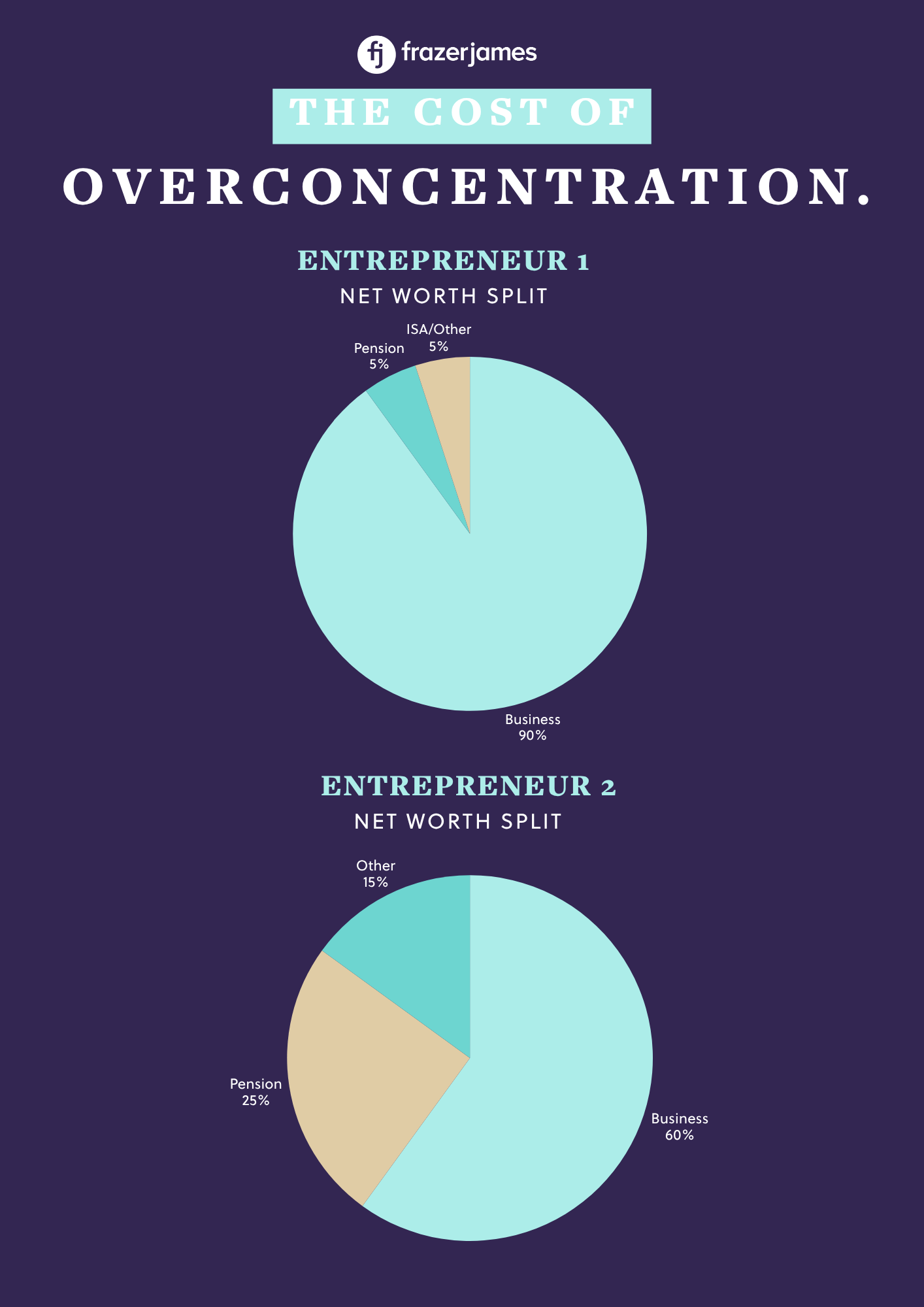
Overconcentration: When your business is your only plan
When a single business represents the majority of your net worth, you have a concentration risk problem. If the business faces a downturn, an industry-specific shock, or you become unable to work, your entire financial position takes a hit.
Many business owners reinvest everything back into the company because that is what has driven growth so far. But that strategy creates a hidden vulnerability. A financially resilient exit plan requires building wealth outside the operating business, through pensions, ISAs, or other investment vehicles that sit legally and financially separate from your trading entity.
Reducing concentration risk does not mean slowing your business growth. It means systematically extracting and allocating profits to wealth outside your company while you still have time, choice, and favourable tax treatment on your side.
Underfunded pensions and ISAs: two wrappers, two different jobs
Even among business owners who do use pensions, many still underfund them relative to their profit levels. The same applies to ISAs. Both are tax-efficient wrappers, but they serve different purposes and are often neglected in favour of retaining cash inside the company or taking higher dividend withdrawals.
Pensions offer tax relief on the way in. Contributions reduce your corporation tax or attract income tax relief, and the funds grow largely free of UK tax. ISAs offer no upfront tax relief, but they provide completely tax-free growth and tax-free withdrawals at any point, with no lifetime limits. (Source: GOV.UK, Individual Savings Accounts)
Here’s the crucial distinction most owners miss: you cannot touch a pension until age 55 (rising to 57). ISAs are accessible any time. And while pensions give you 25% tax-free lump sum, the rest is taxable on withdrawal. ISAs give you 100% tax-free, always
They are not alternatives. They are a duo. The pension is your long-term core. The ISA is your bridge, accessible money that sits between today and retirement. Business owners who fund only one are building a wealth plan with one hand tied behind their back.
A common oversight is funding one but not the other, or contributing too little to either. Over a 10 to 20-year horizon, the compounding effect of tax-free growth inside these wrappers is substantial. Business owners who leave pension and ISA allowances unused each year are not saving tax. They’re simply leaving that growth potential with HMRC and inflation rather than capturing it for themselves.
No pre-exit diversification
Many business owners run their company aggressively for growth right up until the point of sale. Then, overnight, they convert that single concentrated asset into cash, often a seven- or eight-figure sum, and suddenly face an entirely new set of risks: market risk, inflation risk, and the pressure to reinvest a large lump sum wisely.
The mistake is leaving all the de-risking until after the exit. A more measured approach is gradual pre-exit diversification. In the three to five years before a planned sale, you can systematically extract profits through tax-efficient routes, including pensions, ISAs, and dividend planning, and build a balanced portfolio outside the business. That way, when the business does sell, a meaningful portion of your total wealth is already diversified and working elsewhere.
The decision to build personal wealth alongside the business has to be a conscious one. The business will always have somewhere to put money. Personal wealth does not build itself.
Thinking about how to structure the next few years before exit? This is exactly what we help business owners work through.
Mistake 3: Why do most business owners end up paying more tax than they should at exit?
The most expensive mistake is the absence of a strategic view that connects the business, personal finances, and exit into one coherent picture.
Most business owners have an accountant. Some have a financial adviser. Almost none have someone looking at all three together, over a meaningful time horizon. So each adviser does their job well in their lane, and nobody is driving the whole car.
Accountant-led, not strategy-led: optimising for the wrong number
Many profitable business owners take their tax advice exclusively from their accountant. Accountants are essential for compliance, filings, and annual returns. But their focus is often myopic, centred solely on the current tax year: minimising this year’s corporation tax or income tax liability, then repeating the process twelve months later.
Think of it this way: your accountant looks in the rear-view mirror, what happened last year, what tax is owed now. A financial planner looks through the windscreen, where you want to be in ten years, and how your business gets you there. You need both. But most owners only have the first one.
A lifetime tax strategy considers not just what you pay this year, but what you pay across the entirety of your ownership, exit, and retirement. A decision that minimises corporation tax today might lock value inside the business in a way that triggers a much larger capital gains tax bill on sale. Taking more taxable income now might feel inefficient but could reduce your overall lifetime tax by lowering the eventual exit proceeds subject to higher rates.
The fix is not to replace your accountant. It is to supplement annual compliance with strategic advice that connects business structure, personal wealth, and exit timing. Without that joined-up view, you optimise for the short term and often pay a significant long-term price when you finally sell.
See how we helped business owners Paula and Andrew find financial freedom:
No exit timeline: when “someday” becomes a strategy
A significant number of profitable business owners can’t answer a simple question: When do you want to exit, and what does that look like? They know they will sell someday, but there is no defined target year, no estimated valuation, and no plan for what life after exit actually requires financially.
That question leads to an even more important one: what’s your number? Not a vague “as much as possible.” The actual figure you need invested to maintain your lifestyle without working. Work backwards from there. If your number is £3m, and your business is worth £2m today, you know exactly what needs to happen, and by when.
Without an exit timeline, two things drift out of alignment. First, business growth becomes an abstract goal. More revenue, more profit, but without a deadline there is no pressure to professionalise systems, reduce dependency on you personally, or build the kind of predictable earnings that attract premium buyers. Second, personal goals such as school fees, mortgage clearance, and retirement lifestyle continue in parallel but never connect to the business. You might be working five years longer than you need to, or selling two years too early, because you never modelled the gap.
An exit timeline does not need to be precise to be useful. Even a five-year window creates accountability. It forces the question: If I want to sell in 2031, what needs to be true about the business in 2026? Without that forcing mechanism, your business growth and your personal goals run on separate tracks, and exit becomes an event you fall into rather than one you design.

Where does this leave you?
These three mistakes cost business owners hundreds of thousands of pounds, not through bad decisions but through a lack of joined-up thinking at the right time.
The missing piece is integration. Someone who understands the business, the personal picture, and where you actually want to end up, and who can join those three things into a plan that moves you towards it.
That’s the whole game: marrying your personal situation with your business to create financial planning that actually connects.
If you are growing, profitable, and starting to think seriously about what the next chapter looks like, the window to act properly is now, not six months before you go to market.
We work with business owners at exactly this stage. Not just on investments, but on the whole picture: business structure, personal wealth, and what you are actually building towards.
Get in touch if that sounds like a conversation worth having.
Key takeaways
Mistake 1: Cash sitting idle in the company
Employer pension contributions are one of the most tax-efficient ways to extract profit from your company. Every £10,000 contributed saves up to £2,500 in corporation tax at the main rate. The annual allowance is £60,000, but carry forward rules can allow a contribution of up to £240,000 in a single year. Cash left in a low-interest account is already taxed, and then eroded by inflation on top. If your retained profits are not deployed into a pension, a SIPP, a SSAS, or another structured vehicle, they are working against you.
Mistake 2: No wealth built outside the business
If your business is your only meaningful asset, your entire financial position depends on one illiquid thing selling at the right time for the right price. That’s a fragile place to be. Funding your pension and ISA allowances consistently, and starting pre-exit diversification at least three to five years before any planned sale, means you arrive at exit with options rather than pressure.
Mistake 3: No joined-up plan
Annual tax compliance and lifetime tax strategy are not the same thing. A decision that saves you £20,000 this year can cost you £200,000 at exit if it is made without the full picture in view. None of this can be fixed in the final weeks of a deal.
The through-line across all three is straightforward: the owners who build the most wealth from their business are the ones who treat personal financial planning as seriously as they treat business growth, and who start early enough to have real choices.
Get Expert Business Exit Advice
Structure your exit from your business as efficiently as possible with expert guidance.
Schedule Your Initial Consultation
Financial Advisor Bristol and Pension Advisor Clifton
Frazer James Financial Advisers is an Independent Financial Advisor in Bristol, Clifton. We provide independent financial advice, including pension advice, investment advice, inheritance tax planning and insurance advice. If you want to speak to a Financial Advisor, we offer an Initial Consultation without cost or commitment. Meetings are held either at our offices, by video or by telephone. Our telephone number is 0117 990 2602. Frazer James Financial Advisers is located at Square Works, 17 – 18 Berkeley Square, Bristol, BS8 1HB. This article provides information about investing but not personal advice. If you’re not sure which investments are suitable for you, please request advice. Remember that investments can go up and down in value; you may get back less than you put in.
About The Author

About The Author

Frequently Asked Questions About Business Exits
How much cash should I leave in my business account?

I'm young. Should I still put money into a pension instead of keeping it accessible?
At what profit level should I start thinking about exit planning?
Can I sell my business if I don't have an exit timeline yet?
Can I really invest my company's surplus cash without a tax nightmare?
How do I find a financial planner who actually understands business owners?
How do I know when I'm ready to sell?
Related news











Get in touch
Schedule a free consultation with one of our financial advisers, or give us call.
0117 990 2602