Client Login
  Retirement assessment
  Book a call
  0117 990 2602



Financial Planning in Bristol: A Guide for Professionals & Business Owners
You’ve built a successful career or business in Bristol – but when it comes to your own financial future, you’re not entirely sure whether you’re on track, ahead, or quietly falling behind. That uncertainty is more common than you’d think, even among people who are objectively doing well.
The problem isn’t a lack of money. It’s a lack of a plan. Most Bristol professionals and business owners we speak to have accumulated pensions, investments, and business assets across years of hard work – but no single, joined-up picture of what it all means for their future.
This guide will show you exactly what financial planning delivers in practice, how to identify a genuinely qualified adviser, and what the process looks like from first conversation to long-term plan. Specifically, you’ll learn what separates a Chartered Financial Planner from a standard adviser, why independent advice matters for business owners in particular, and how the right financial plan can give you complete peace of mind about your financial future.
If you’re a Bristol business owner or professional ready to take that first step, you can book a free consultation with our team to see what’s possible.
What financial planning in Bristol actually involves (and what it doesn’t)
Financial planning is not the same as investment management, and it’s not simply about picking the right pension fund. It’s the process of mapping where you are today against where you want to be — and building a clear, structured route between the two.
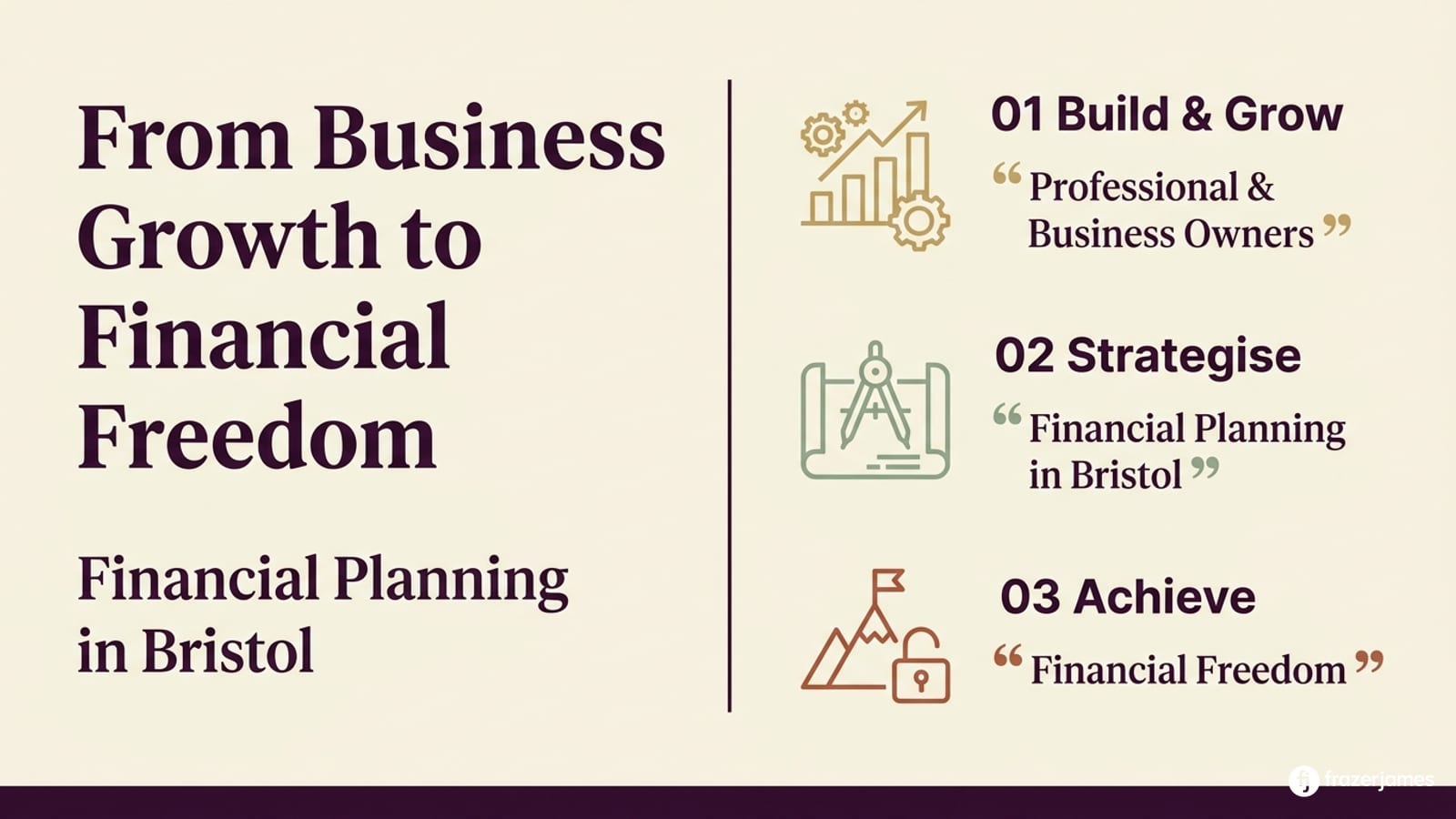
For Bristol professionals and business owners, that typically means bringing together pensions, investments, business assets, property, tax planning and protection into one coherent strategy. The goal is not to maximise returns in isolation. It’s to make sure every financial decision you take is working towards the life you actually want to live.
What it doesn’t involve is generic advice that could apply to anyone. A good financial planner asks what you want your retirement to look like, what your business exit might mean for your personal wealth, and what would happen to your family if something went wrong. The answers to those questions shape everything else.
One client of Frazer James described exactly this shift: “I had been fixated on reaching a particular pension number — without really knowing whether that number was enough, too much, or what it would actually mean for our retirement. Rather than focusing solely on investment performance, James asked my wife and me what we actually wanted our retirement to look like.” That reframing — from a number to a life — is what genuine financial planning delivers.
Who benefits most from working with a Bristol financial planner?
Not everyone needs a financial planner at every stage of life. But there are specific situations where the value of professional advice becomes significant – and for Bristol’s professional and business owner community, several of those situations tend to arrive at once.
Business owners face a particular set of challenges. You’re building personal wealth through a vehicle that also carries risk, tax complexity, and an eventual exit. Managing surplus cash in the business, extracting income tax-efficiently, and planning for a sale or succession all require specialist guidance that goes well beyond standard financial advice. Our dedicated service for business owners addresses exactly these challenges at every stage of growth.
Professionals – lawyers, doctors, senior executives, engineers – often accumulate multiple pension pots, receive equity or bonus income, and face high marginal tax rates that make planning genuinely valuable. One client, a lawyer at a leading international law firm, put it simply: “You help me save money and make money, but by far the biggest thing I get from you as my financial adviser is peace of mind. Someone in my corner taking care of all aspects of my financial life.”
Those approaching retirement also benefit enormously. The decisions made in the five to ten years before you stop working – around pension drawdown, tax-free cash, investment risk, and state pension timing – have a disproportionate impact on the quality of your retirement. Getting them right matters.
The difference between a financial adviser and a Chartered Financial Planner – and why it matters
The title “financial adviser” is broad. Anyone authorised by the Financial Conduct Authority (FCA) can use it. A Chartered Financial Planner, by contrast, holds the highest professional designation awarded by the Chartered Insurance Institute (CII) — requiring advanced examinations, demonstrated experience, and a commitment to ongoing professional development.
Certified Financial Planner status, awarded by the Chartered Institute for Securities & Investment, carries similar weight. Both designations signal that the person advising you has gone significantly beyond the minimum regulatory requirements. At Frazer James, our team holds both Chartered and Certified Financial Planner status — the highest credentials available in UK financial planning.
You can verify any adviser’s qualifications and authorisation through the FCA register. If you’d like to speak with our team directly, you can book a free consultation to find out whether we’re the right fit for your situation.
Is independent financial advice better than restricted advice?
This distinction matters more than most people realise. An independent financial adviser can recommend products and solutions from across the entire market. A restricted adviser — including some of the largest and most recognisable names in UK financial services — can only recommend from a limited range, often their own.
For business owners and high-net-worth professionals, this difference is particularly significant. Your financial situation is complex. You need an adviser who can find the best solution for your specific circumstances, not the best solution within a constrained product set. Restricted advice isn’t necessarily bad advice — but it is, by definition, limited advice.
Choosing an independent adviser means their focus stays on your goals — not on product relationships or internal targets. When the decisions matter, that freedom is worth having.
What to expect from the financial planning process: from first conversation to long-term plan
What should I bring to my first meeting with a financial adviser?
The first meeting with a financial planner should feel like a conversation, not an interrogation. A good adviser will want to understand your current position – income, assets, pensions, debts, protection – but more importantly, they’ll want to understand what you’re trying to achieve and what’s keeping you up at night.

It helps to bring a rough summary of your pension arrangements, any investment accounts, details of your business structure if relevant, and a sense of your timeline. You don’t need everything perfectly organised. The point of the first meeting is to establish whether there’s a good fit and to identify the areas where planning will add the most value.
From there, a financial planner will typically build a detailed financial plan – a document that models your current trajectory, stress-tests it against different scenarios, and sets out a clear strategy for achieving your goals. That plan is then reviewed regularly as your circumstances change.
One client, who came to us with her husband for help with tax and retirement planning, described the experience: “We came armed with a lot of questions, and the team has been endlessly patient with us – answering everything thoroughly, testing our hypotheses, and never making us feel rushed or silly for asking. We now have a clear, structured plan for our taxes, pensions and investments, and honestly, the peace of mind that comes with that is priceless.”
Financial planning for Bristol business owners: turning business success into personal wealth
This is where financial planning in Bristol has a genuine gap in the market. Most location pages from national firms list services without addressing the specific financial reality of running a business in Bristol’s professional and SME community. The challenges are real and specific.
One couple are a good example. Their business had generated significant surplus cash, but they had no clear strategy for managing it – and real concerns about inflation eroding its value. Working with Frazer James, they established a clear financial strategy to manage that surplus effectively and build long-term financial security beyond the business itself. The business had created wealth; the plan made sure that wealth worked for them.
For business owners thinking about exit, the planning needs to start earlier than most people expect. Tax reduction strategies on a business sale – including Business Asset Disposal Relief (formerly Entrepreneurs’ Relief), which can reduce Capital Gains Tax to 18% on qualifying gains – require careful structuring well in advance of any transaction. Our guide to reducing capital gains tax on a business sale covers this in detail.
Another couple worked with Frazer James from the early days of their business, receiving ongoing guidance that helped them make smart financial decisions as they grew – building long-term wealth and financial security for their family while successfully scaling the business. The key was starting the planning early, not waiting until exit was imminent.
One client, the managing director of a commercial cleaning business, captured the broader impact well: “Since working together, I feel more organised, more secure and more positive about the future. Your advice has been exceptionally valuable financially, professionally and personally.”
For business owners who want to explore what a structured financial plan could mean for their situation, our financial planning service page sets out how we approach this work.
Retirement planning in Bristol: how to know if you’re on track
When should I start financial planning?
The honest answer is: earlier than you think. The compounding effect of good financial decisions made in your forties is significantly greater than the same decisions made in your fifties. But the more useful question is not when to start — it’s whether your current trajectory will actually deliver the retirement you want.
Most people approaching retirement have a rough sense of their pension value but no clear picture of what that translates to in annual income, how long it will last, or how it interacts with the state pension, tax, and any other assets they hold. That uncertainty is uncomfortable — and unnecessary.
One couple came to Frazer James wanting to explore early retirement. They weren’t sure it was possible. With a clear financial plan in place, they discovered it was — and they’re now living their dream of sailing around the Mediterranean. The plan didn’t create the money; it revealed what was already there and showed them how to use it.
One client, who came to us ahead of her own retirement, described a similar experience: “Their assessment, recommendations and advice has given me peace of mind about my financial future and the changes we’ve made to my pension pot investments have given excellent results.”
If you’re within ten years of your target retirement date, our retirement planning service sets out how we help people at exactly this stage — and our retirement assessment tool is a useful starting point for understanding where you stand.
How to choose the right financial planner in Bristol: five questions worth asking
The Bristol market has a range of financial planning firms, from large national networks to boutique independents. These five questions will quickly help you find the right fit.
Start by asking whether the adviser is independent or restricted. As covered above, this determines whether they can access the full market or only a limited range of products. For complex situations, that distinction matters.
Next, ask about qualifications. Look for Chartered Financial Planner or Certified Financial Planner status — the highest professional designations in UK financial planning, and a genuine signal of expertise beyond the minimum regulatory requirements.
It’s also worth asking who they typically work with. A planner who specialises in business owners will understand the specific challenges of extracting wealth from a business, planning for exit, and managing the tax implications. A generalist may not.
Ask how they charge. Fee transparency is a basic requirement. You should understand exactly what you’re paying and what you’re getting in return before you commit to anything. MoneyHelper has useful guidance on understanding financial advice fees.
Finally, ask what the ongoing relationship looks like. Financial planning is not a one-off transaction. The value builds over time through regular reviews, proactive adjustments, and a planner who knows your situation well enough to spot opportunities and risks before you do. One client, a company director at a technology company, described this well: “Great team, very supportive, and answer any queries very quickly. Very thorough explanations. Enjoying our long-term working relationship.”
One client, who came to us after 45 years in the corporate world to move his retirement portfolio to Frazer James, put it plainly: “Frazer James have reset the bar for financial service. I have the sense that we are more like part of their wider team than just a client.”

About The Author