 Client Login
  Retirement assessment
  Book a call
  0117 990 2602


Modified on: August 2026
Time in the Market Beats Timing the Market: The Evidence
Why market timing is a dangerous game
Unfettered access to information can be a dangerous thing. Consider someone experiencing troubling medical symptoms who spends an evening searching online. By midnight, the sheer volume of unfiltered information leads them to fear the worst.
A visit to the doctor tells a different story. The physician asks pertinent questions, runs straightforward tests, and delivers a verdict: reassurance and education. Not surgery. Not drugs. Just a clear understanding of the situation.
Investing works in much the same way. Without expert guidance, it is easy to misread the signals and make decisions that cause real harm to your financial health.
The cost of missing the market’s best days
Many investors believe that stepping out of the market during turbulent periods is prudent. The evidence says otherwise.
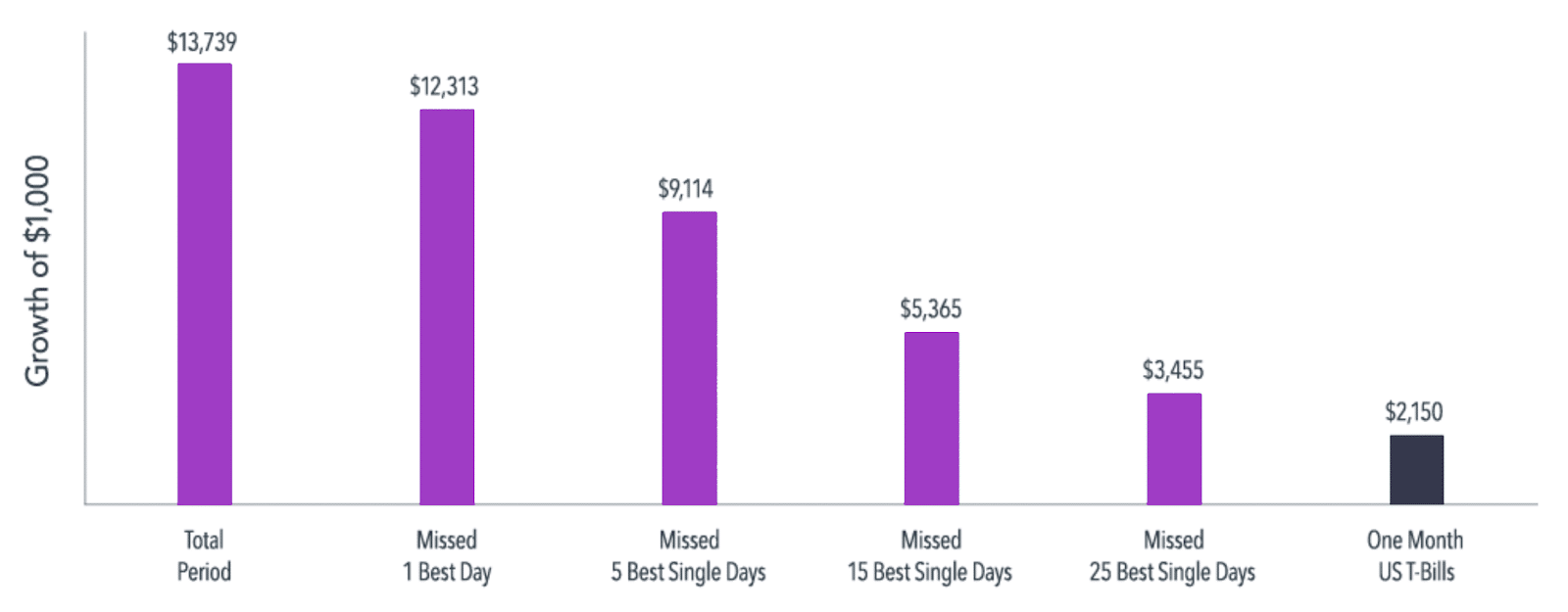
An investor who missed just the 25 single best days in the S&P 500 between 1990 and the end of 2017 would have seen their annualised return fall from 9.81% to 4.53%. There is no reliable way to predict when those best days will occur. More often than not, they cluster around periods of peak uncertainty, precisely when nervous investors are most tempted to sell.
(Source: Dimensional)
The evidence against picking winning funds
Global financial markets process millions of trades worth hundreds of billions of pounds every day. Every trade reflects the collective judgement of buyers and sellers. Attempting to outguess that collective wisdom is an uphill task.
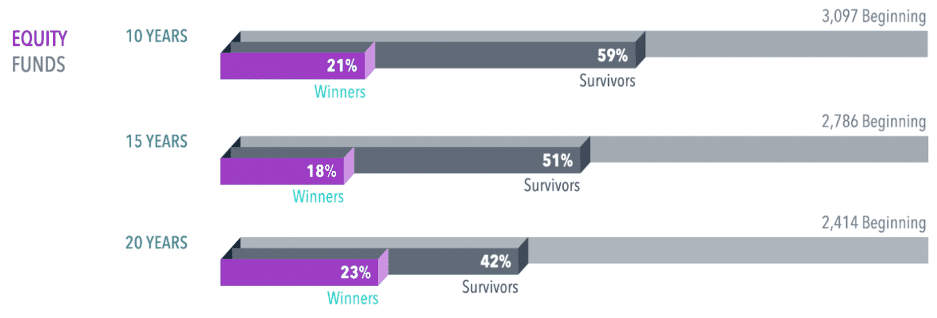
Research into US investment funds makes the challenge plain:
- Only 42% of investment funds remained open after 20 years.
- Only 23% managed to outperform the market over that same period.
(Source: Dimensional)
Past winners rarely stay winners
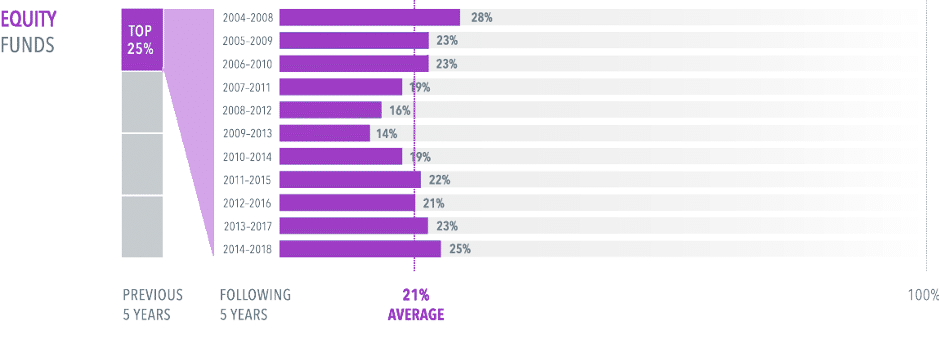
Suppose you identify one of the rare funds that survived and outperformed. Does it continue to outperform? Probably not. Research shows there is only a 21% chance that a top-performing fund will repeat that performance in the following period.
Picking yesterday’s winners is like driving whilst only looking in the rear-view mirror. Past performance offers no guarantee of future results.
(Source: Dimensional)
Focus on what you can control
The Taoist concept of wei wu-wei, meaning “do without doing”, captures something important about investing. Greater activity does not automatically produce better results. In fact, trading too much, chasing past performers, and reacting to news events frequently leads to poorer long-term returns.
Financial science points to a more productive approach: direct your energy towards the things you can actually control.
Get the right mix of assets
The most important decision any investor makes is how to split their portfolio between stocks and bonds.
- Stocks carry higher risk but tend to deliver higher returns over the long term.
- Bonds carry lower risk but typically produce more modest returns.
If you can tolerate significant short-term falls in value, a higher allocation to stocks is likely to serve you well over time. If you need a smoother ride, a greater weighting towards bonds makes sense. Neither choice is right or wrong in isolation; what matters is that it fits your circumstances.
Diversify broadly
It is practically impossible to predict which type of investment will perform best from one year to the next. Emerging market stocks, for example, sat at the bottom of the performance table in 2015, then topped it in both 2016 and 2017.
Spreading investments across different asset classes, geographies, and sectors smooths the inevitable ups and downs without necessarily reducing your overall return. Diversification is one of the few genuine free lunches in investing.
Rebalance with discipline
Maintaining your chosen asset allocation requires periodic rebalancing: moving money away from assets that have grown strongly and back towards those that have lagged. This is a deliberate, premeditated activity. It is the opposite of reflexively following trends or chasing whatever the financial media is excited about today.
The behaviour gap: why investor returns lag investment returns
We are all human. When portfolios fall sharply, the instinct is to sell. When they rise strongly, the instinct is to buy more. Acting on those instincts consistently means buying high and selling low, which is precisely the wrong sequence.
This is why the average investor return tends to be lower than the average investment return. The gap between the two is sometimes called the behaviour gap, and it represents a real and measurable cost.
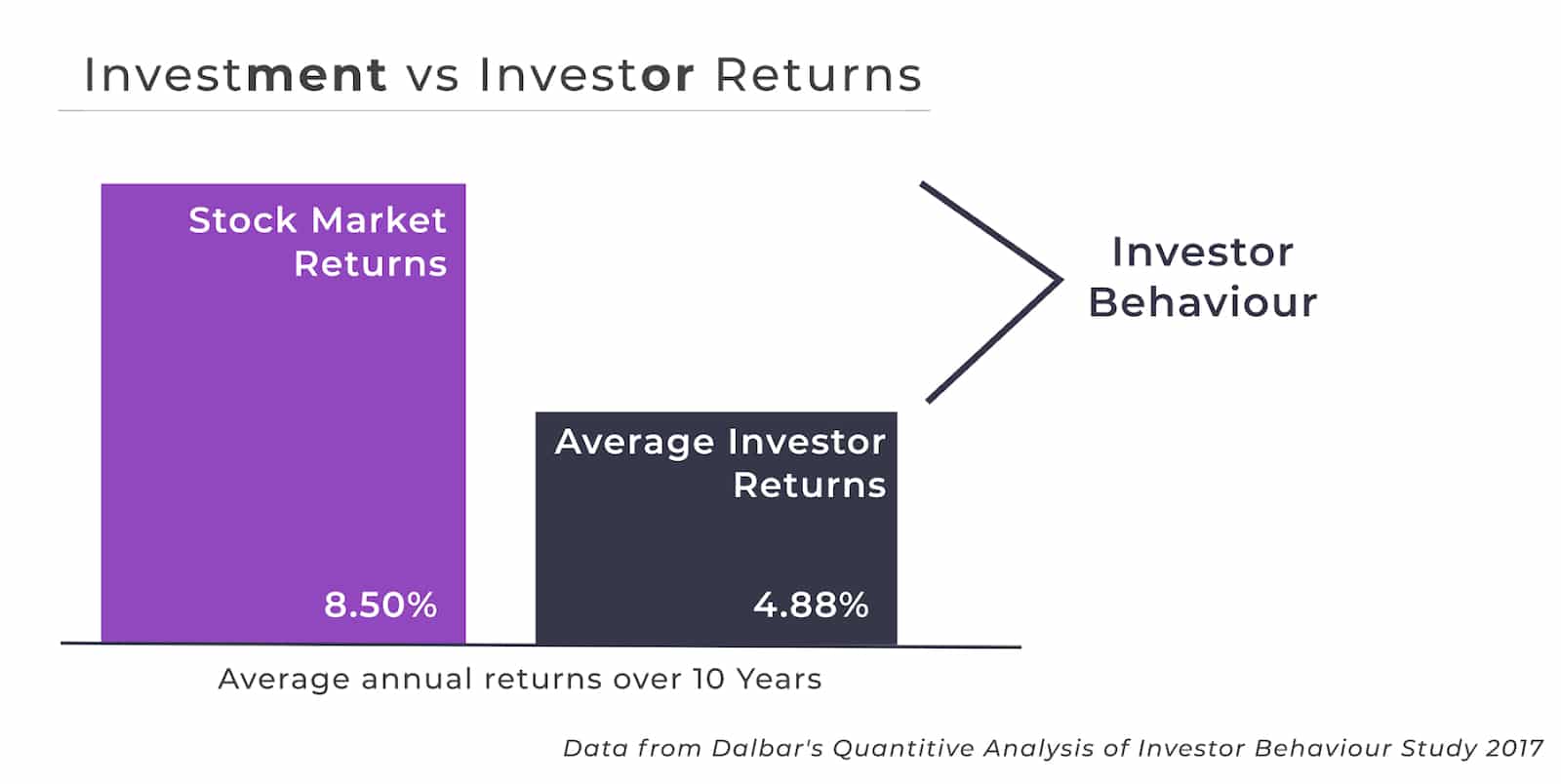
The best investors understand that emotions affect their decisions. They work with a trusted adviser to stay the course and avoid expensive reactive choices. As the research on adviser value shows, a good adviser helps clients pursue their financial goals and maintain a positive experience along the way.
The role of a financial adviser
A good financial adviser does for your portfolio what a good doctor does for your health. They begin by understanding your full situation. Once a plan is in place, their role is to:
- Monitor progress and check the plan remains appropriate.
- Provide reassurance when markets are unsettling.
- Help you maintain the discipline the plan requires.
One client put it simply: knowing there was someone to call when markets fell sharply meant they never made a panicked decision they later regretted.
Without that support, the self-directed investor risks overreacting to short-term volatility, selling at the wrong moment, and missing the recovery that follows. The self-diagnosing patient who moves straight to self-medication can cause real harm. The same is true of the self-directing investor.
A practical investment checklist
Evidence-based investing comes down to three disciplines:
- Choose the right balance between stocks and bonds for your circumstances and risk tolerance.
- Diversify broadly across asset classes and geographies.
- Avoid reactive decisions driven by emotion or short-term noise.
For those who want to go further, our 7 Simple Steps to Investment Success sets out a proven, evidence-led process in full. It also covers how to protect your money from inflation and what investment performance really depends on.
Talk to us
If you are a professional or business owner thinking about how to put your wealth to work more effectively, we would be glad to help. We offer a free initial conversation with no obligation.
Book a free initial consultation and let us show you what evidence-led financial planning looks like in practice.
This article provides information about investing but not personal advice. If you are unsure which investments are right for you, please request advice. Investments can go up and down in value; you may get back less than you put in.
About The Author

Related news











Get in touch
Schedule a free consultation with one of our financial advisers, or give us call.
0117 990 2602