 Client Login
  Retirement assessment
  Book a call
  0117 990 2602


Modified on: October 2026
The £100k Tax Trap: What It Costs an Owner-Director, and Three Ways Out
Earning £110,000 a year sounds like a milestone. But for many UK professionals, the slice of income above £100,000 is effectively taxed at 60%.
This page is for owner-directors and senior professionals whose adjusted net income is heading past £100,000.
At a glance
- Between £100,000 and £125,140, your personal allowance is withdrawn, so each extra pound is taxed at an effective 60%.
- It is your adjusted net income that counts, and pension contributions reduce it.
- Parents above £100,000 can also lose Tax-Free Childcare and 30 hours of funded childcare.
- Owner-directors have three ways out that employees do not.
- Most fixes must happen before 5 April in the tax year concerned.
If you’ve recently crossed the £100,000 income threshold and noticed your take-home pay doesn’t reflect it, you’re not imagining things.
The mechanics of the 60% effective tax rate are real, they’re legal, and they catch thousands of high earners off guard every year. This article explains exactly how the trap works, what it costs you if you do nothing, and the extra options open to business owners.
By the end, you’ll understand three things many high earners miss:
- How the trap hits childcare support and Child Benefit.
- Why business owners have far more options than employees.
- What five years of inaction costs in real money.
If you’re a high-earning professional looking for a starting point, this is it.
What is the £100k tax trap – and why does it exist?
The £100k tax trap is the informal name for a quirk in the UK tax system. Between £100,000 and £125,140, each extra pound you earn is taxed far more heavily than the pounds below it. It exists because HMRC progressively withdraws your personal allowance once your adjusted net income exceeds £100,000.
The standard personal allowance is £12,570. For every £2 of income above £100,000, you lose £1 of that allowance. By the time your income reaches £125,140, the allowance is gone entirely. You’re paying income tax on every pound you earn, with no tax-free buffer at all.
| Adjusted net income | Personal allowance | Effective rate on the next £1 |
|---|---|---|
| £50,271 to £100,000 | £12,570 | 40% |
| £100,000 to £125,140 | Falls by £1 for every £2 | 60% |
| Over £125,140 | £0 | 45% |
This isn’t a new rule. But as wages rise over time, and tax thresholds remain frozen, more professionals are pushed into the tax trap unknowingly. HMRC figures suggest around 725,000 taxpayers fall into the 60% band in 2025/26, up from around 300,000 in 2017/18.
What is the £100k tax trap in the UK?
The £100k tax trap is the income band between £100,000 and £125,140. Here, the gradual withdrawal of the personal allowance creates an effective income tax rate of 60%. It affects UK residents whose adjusted net income crosses the £100,000 threshold, whether through salary, dividends, bonuses, rental income, or investment returns. The trap is not a separate tax rate. It is the combined effect of paying 40% on the extra income while also losing tax-free personal allowance, which then gets taxed too.
How the 60% effective tax rate is calculated (with a worked example)
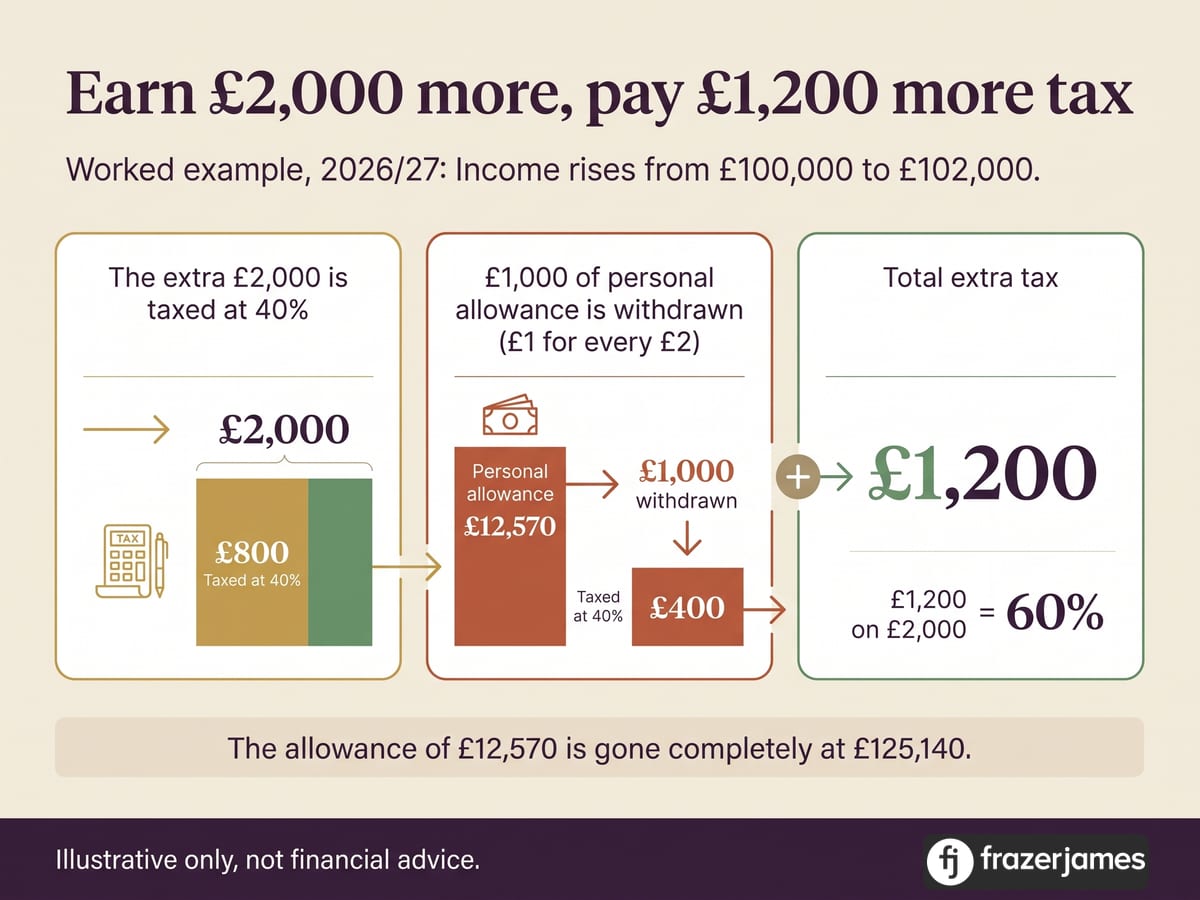
Here’s the mechanics in plain numbers. Suppose you earn £102,000. That £2,000 above the £100,000 threshold costs you £1,000 of personal allowance. That £1,000 of allowance, which was previously tax-free, now becomes taxable at 40%. So you pay 40% tax on the £2,000 of additional income, plus 40% tax on the £1,000 of lost allowance. That’s £1,200 of tax on £2,000 of income – an effective rate of 60%.
If you’re an employee, National Insurance contributions apply on top. Employee Class 1 NI at 2% on income above £50,270 pushes the effective rate to approximately 62% on that band of income. You are, in practical terms, keeping just 38p of every £1 earned between £100,000 and £125,140.
How does the personal allowance taper work above £100,000?
The taper works at a rate of £1 of personal allowance lost for every £2 of adjusted net income above £100,000. The full £12,570 personal allowance is eliminated once adjusted net income reaches £125,140 (£100,000 plus twice £12,570). Within this band, each extra pound is taxed at 40%. It also removes 50p of allowance, which is then taxed at 40% too. Together, that makes 60%. The taper applies to adjusted net income, not gross income, which is why the strategies below are so powerful.
Want the exact figure for your own income? Put your numbers into our Income Tax Relief Modeller below. It shows the tax you pay with and without a pension contribution, including the 60% band, in the order HMRC applies it. Illustrative only, not financial advice.
Income Tax and Pension Relief Modeller · 2026/27
How much tax relief will your pension contribution actually earn?
Most relief calculators assume every pound you earn is salary. This one takes each type of income separately, because savings and dividends are taxed on their own rates and in their own order.
Uses 2026/27 rates for England, Wales and Northern Ireland. Scottish income tax bands differ.
What the contribution earns you
Your tax, by type of income
–
Illustrative only, not financial advice. Uses 2026/27 rates and bands for England, Wales and Northern Ireland. Scottish income tax bands differ. Income is taxed in the statutory order: other income first, then savings, then dividends. Assumes the contribution is within your annual allowance and your relevant UK earnings. National Insurance savings under salary sacrifice are not included.
What is adjusted net income - and why it's the number that actually matters
Adjusted net income is the figure HMRC uses to determine whether you've crossed the £100,000 threshold. It is not the same as your gross salary or total income. HMRC's guidance on adjusted net income defines it as your total income minus certain deductions. The most common are personal pension contributions and Gift Aid donations.
This distinction is everything. A professional earning £115,000 in gross salary is firmly inside the trap. But if they make £15,000 of personal pension contributions, their adjusted net income falls to £100,000 and they retain their full personal allowance. The saving on that £15,000 contribution is not just 40% relief. It is relief at the 60% effective rate, which makes pension contributions very efficient in this band.
What is adjusted net income and how is it calculated?
Adjusted net income is your total taxable income for the year, less a few deductions. The main ones are gross personal pension contributions, grossed-up Gift Aid donations and certain trading losses. It does not include employer pension contributions, which is why employer contributions are a separate and particularly powerful tool for business owners. You can find the full definition and calculation method on GOV.UK's adjusted net income guidance page.
The hidden extras: childcare support and Child Benefit
The 60% effective rate is damaging enough on its own. For parents, crossing £100,000 can also cost the childcare support the government provides, on top of Child Benefit already lost further down the income scale.
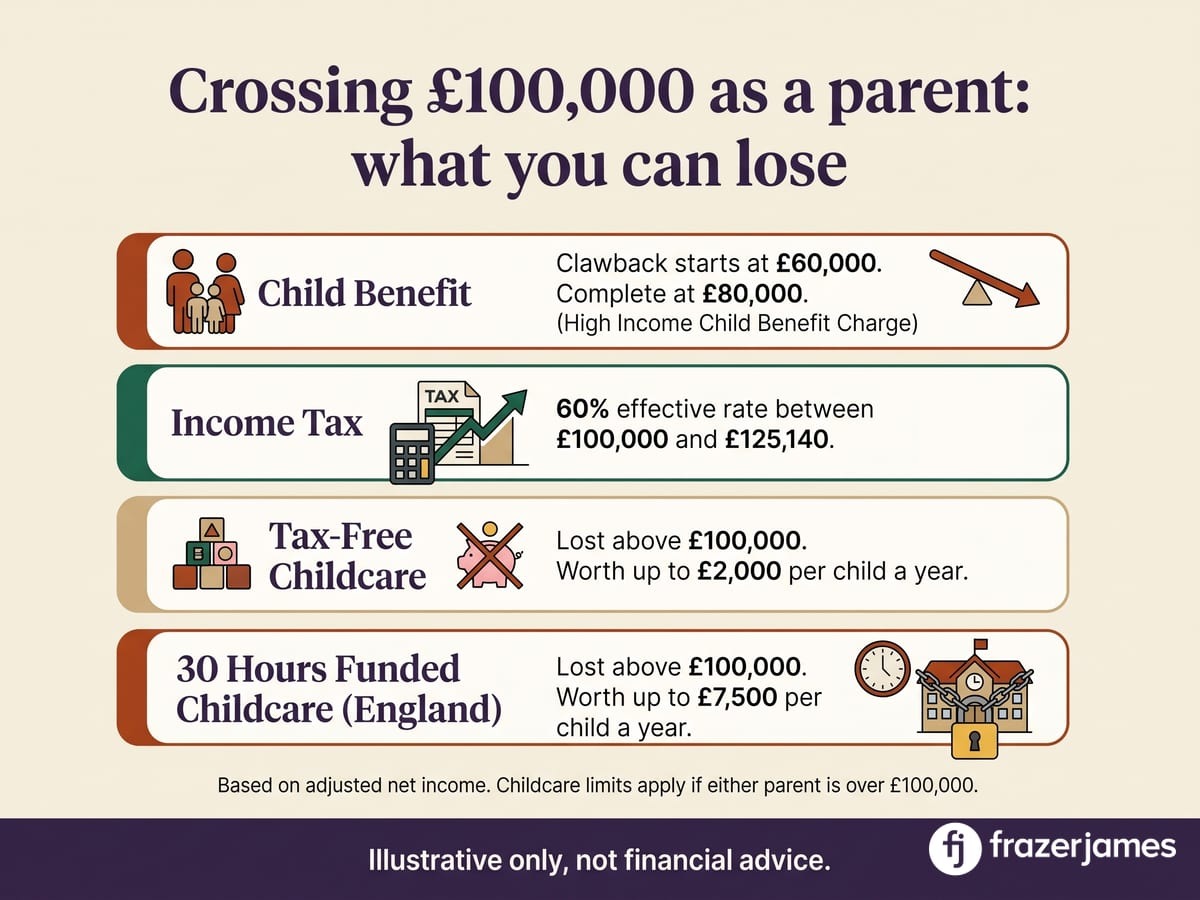
Tax-Free Childcare is available to working parents where neither parent has an adjusted net income above £100,000. The government tops up childcare accounts by 25%, worth up to £2,000 per child per year (or £4,000 for a disabled child). Cross the £100,000 threshold and you lose this entirely, for every child you have.
It does not stop there. In England, working parents can get 30 hours of funded childcare a week for 38 weeks of the year. It runs from the term after a child turns nine months until they start school. The government puts the saving at up to £7,500 a year per child. The same £100,000 rule applies. If either parent's adjusted net income is expected to be over £100,000, the family loses the funded hours too.
Child Benefit goes earlier. The High Income Child Benefit Charge starts when the higher earner's adjusted net income passes £60,000. It claws back 1% of the benefit for every £200 above that, so by £80,000 all of it is repaid through tax.
A parent earning £100,000 has usually lost the lot already. The same pension contributions that bring income below £100,000 can also bring it under £80,000 or £60,000, and win some or all of it back.
Take a parent of two young children earning £105,000. They pay £3,000 of tax on the £5,000 above the threshold, an effective 60%. They also lose up to £4,000 of Tax-Free Childcare top-ups. If both children are old enough for funded hours, that support, worth up to £7,500 a year each, goes as well. For parents in this position, the case for keeping adjusted net income below £100,000 is far stronger than the headline rate suggests.
Does the £100k tax trap affect Tax-Free Childcare and 30 hours free childcare?
Yes, directly. Tax-Free Childcare and the 30 hours of funded childcare in England both require that neither parent has an adjusted net income above £100,000. Eligibility is based on your expected income for the current tax year, and you reconfirm it every three months. So one year above the line can cost you both for that year. That makes £100,000 a hard cliff edge for parents, not just a taper. Bringing adjusted net income back below £100,000, for example through pension contributions, restores eligibility.
What inaction costs you: the five-year price of staying in the trap
Most people in the £100k trap know something feels wrong. They just haven't quantified it. Here's a simple illustration of what staying in the trap costs over five years.
Take a professional earning £115,000 per year who takes no action. Their adjusted net income is £115,000. They lose £7,500 of personal allowance (half of the £15,000 excess above £100,000). That lost allowance costs them £3,000 in extra income tax each year (£7,500 at 40%). Over five years, that's £15,000 in avoidable tax, before any lost childcare support.
Now consider the same professional making £15,000 of pension contributions annually. Their adjusted net income drops to £100,000. They retain their full personal allowance. The pension contribution attracts 60% effective relief - meaning a £15,000 contribution costs them only £6,000 net. Over five years, they've put £75,000 into their pension at a net cost of £30,000. That pot grows free of income tax and capital gains tax. The difference in outcomes is not marginal.
| £115,000 income, each year | Do nothing | £15,000 gross pension contribution |
|---|---|---|
| Adjusted net income | £115,000 | £100,000 |
| Personal allowance kept | £5,070 | £12,570 |
| Extra tax from the lost allowance | £3,000 | £0 |
| Five-year total | £15,000 of avoidable tax | £75,000 in your pension for a net £30,000 |
How to reduce your adjusted net income below £100,000
There are several legitimate routes to reducing adjusted net income. The most powerful, by some distance, is pension contributions.
Personal pension contributions
Every pound contributed to a personal pension reduces your adjusted net income by one pound. At the 60% effective rate, a £10,000 pension contribution saves £6,000 in tax - a 60% return before the investment has done anything. You can contribute up to 100% of your earnings or the annual allowance (currently £60,000 for most people), whichever is lower. Unused allowances from the previous three tax years can also be carried forward.
Gift Aid donations
Charitable donations made under Gift Aid are deducted from adjusted net income at the grossed-up value. A £800 cash donation becomes a £1,000 deduction against adjusted net income. The charity claims £200 from HMRC, and someone in the trap gets a further £400 back through their tax return. The charity receives £1,000 and the donor's net cost is £400. It is a useful extra tool, though rarely enough on its own to escape the trap.
Salary sacrifice
Employees can ask their employer to reduce their salary in exchange for higher employer pension contributions. Because employer contributions don't count as income at all, they reduce gross pay and therefore adjusted net income. This also saves employee National Insurance contributions, pushing the effective saving above 60% for those in the trap.
From April 2029, only the first £2,000 a year you sacrifice will stay free of National Insurance. The income tax saving does not change. Read what the salary sacrifice cap means for you.
Bonus deferral
If only a bonus takes your income over £100,000, you may be able to ask your employer to pay it in the next tax year. This requires employer agreement and careful timing, but it's a legitimate and often overlooked option.
It must be arranged before the bonus is contractually due. Once a bonus is legally owed to you, deferring it for tax purposes becomes significantly more complex and may not achieve the intended result. The arrangement must be genuine and documented. If your income only crosses £100,000 in years when a bonus is paid, this can be a highly effective strategy. Speak to a financial planner before approaching your employer, so the timing and structure are correct from the outset.
Business owner strategies: going beyond personal pension contributions
This is where the picture changes significantly. Employed individuals have limited levers: personal pension contributions, Gift Aid, and salary sacrifice if their employer agrees. Business owners have a wider set of options. An owner-director has three ways out that an employee does not.
For business owners managing their income, the key point is this. Adjusted net income depends on how you take money out of your company, not just on how much it earns.
| Lever | Employee | Owner-director |
|---|---|---|
| Personal pension contributions | Yes | Yes |
| Salary sacrifice | Only if the employer agrees | You decide |
| Employer pension contributions | Set by the employer | The company pays in directly |
| Salary and dividend mix | No | Yes |
| Leave profit in the company for a later year | No | Yes |
1. Salary and dividend structuring
As a director-shareholder, you control the mix of salary and dividends you take. Dividends are not subject to National Insurance and are taxed at 10.75%, 35.75% and 39.35% in 2026/27, after a £500 allowance. They still count towards adjusted net income, so a dividend can push you into the trap just as a salary can. More importantly, you can choose how much to extract in any given tax year. If salary plus dividends would push you over £100,000, you can leave surplus profit in the company. You then take it in a year when it is taxed less.
2. Employer pension contributions
This is usually the most powerful tool available to business owners. Your company can make employer pension contributions directly to your pension. These contributions are not income to you - they don't appear in your adjusted net income at all. They are normally an allowable company expense, reducing corporation tax, and they build your retirement pot without triggering the personal allowance taper. They do count towards your £60,000 annual allowance.
Take a business owner who would otherwise extract £120,000 in salary and dividends. They could take £100,000 instead and have the company pay £20,000 into their pension. The result: full personal allowance retained, corporation tax reduced, and pension funded at the company's expense.
3. Retained profits and timing
Business owners can also time the extraction of profits across tax years. In an unusually profitable year, you can leave the surplus in the company and draw it in a leaner year. That can keep you below £100,000 in both. This requires forward planning, but the tax savings are substantial.
These three sit alongside the wider planning in our guide to 10 tax-saving strategies for business owners and high earners.
If you're a business owner navigating these decisions, our structured financial planning service is designed to map out exactly this kind of multi-year income strategy.
When to speak to a financial planner about the £100k trap
Deadline: 5 April
The right time to act is before the tax year ends, ideally well before. Pension contributions must be made within the tax year to reduce that year's adjusted net income. If you're approaching 5 April and your income is above £100,000, the window is closing.
But the deeper answer is: speak to a financial planner as soon as your income is approaching £100,000, not after you've already crossed it. The strategies above - employer pension contributions, salary-dividend structuring, bonus deferral - all require planning time. They can't be retrofitted after the fact.
If your income is near or above £100,000 and you haven't reviewed your adjusted net income position, the cost of waiting is measurable. Book a consultation with our team to understand exactly where you stand and what options are available to you.
About The Author

About The Author

Related news












Get in touch
Schedule a free consultation with one of our financial advisers, or give us call.
0117 990 2602