 Client Login
  Retirement assessment
  Book a call
  0117 990 2602


Modified on: September 2026
SSAS vs SIPP: Which Pension Is Best for a Business Owner
You’ve spent years building a successful business. But your pension is sitting in a standard scheme with no connection to the assets and opportunities you understand best. That disconnect is more common than you’d think. For many company directors, it represents a significant missed opportunity.
If you’re a company director who feels your pension should work harder and smarter alongside your business, not separately from it, you’re not alone. Most guides on this topic define what a small self-administered scheme (SSAS) is and leave it at that. This one goes further.
Here’s what you’ll get from reading this. A clear explanation of what a SSAS actually is and who it suits. A structured framework for deciding between a SSAS and a SIPP. A plain-English walkthrough of the strategic uses, HMRC rules, and exit-planning implications that most articles never touch. If you’re a business owner looking for financial planning for business owners that genuinely connects your pension to your wider wealth strategy, this is the guide to start with.
What is a small self-administered scheme (SSAS)?
A small self-administered scheme (SSAS) is a type of occupational pension scheme. It is set up by a limited company or partnership, typically for its directors and senior employees. According to MoneyHelper, a SSAS usually allows up to 11 members to join. You need to be a company director to establish one.
Unlike a personal pension, a SSAS is trust-based. The members of the scheme are also its trustees. That means they collectively control how the pension fund is invested. That trustee structure is what gives a SSAS its distinctive flexibility – and its distinctive responsibilities.
Contributions into a SSAS attract the same tax relief as any registered pension scheme. The company can make employer contributions directly into the scheme. Those contributions are treated as a business expense, reducing corporation tax. Individual members can also contribute personally and receive income tax relief at their marginal rate.
Who can set up a SSAS pension?
A SSAS must be established by a sponsoring employer – typically a limited company or partnership. The members are usually company directors, though senior employees can also be included. Family members who are directors of the same business can join the same SSAS. This makes it a particularly useful structure for family-run businesses where multiple directors want to pool pension assets and make collective investment decisions.
Who can set up a SSAS – and who should consider one?
A SSAS is not the right pension structure for every business owner. It suits a specific profile: a company director with a profitable business, a meaningful pension pot already building, and a genuine interest in using that pension fund strategically rather than simply accumulating it passively.
The business owners who tend to benefit most from a SSAS are those who want to invest their pension in commercial property, including their own business premises. It also suits those who want the option to lend money back to their business from the pension fund. And it suits those thinking about business succession or exit who want their pension to form part of a broader wealth strategy.
A SSAS is less suited to sole traders, who cannot set one up. It is also less suited to employees without a directorship, or business owners who simply want a low-maintenance pension with no governance responsibilities. For those individuals, a self-invested personal pension (SIPP) is usually the more practical choice.
Take one couple — we’ll call them Barry and Fiona — business owners whose company had generated a significant cash surplus with no clear strategy for managing it. Their concern was inflation eroding the value of retained profits. They had no structure connecting their business wealth to their retirement planning. Working with Frazer James, they established a clear financial strategy. It used their pension structure as a central pillar, giving them a way to extract value from the business tax-efficiently while building long-term financial security beyond it.
How a SSAS works: trustees, pooled funds, and investment control
When a SSAS is established, the members become trustees of the scheme. This is a legal role with real responsibilities. Trustees must act in the best interests of all scheme members, comply with HMRC rules, and report to The Pensions Regulator. Many SSAS arrangements also appoint a professional pensioneer trustee to provide governance support and ensure compliance.
The pension fund itself is pooled. All members’ contributions sit within a single trust fund, and investment decisions are made collectively by the trustees. This pooling is one of the SSAS’s most powerful features. It means the combined fund can reach a size that opens up investment opportunities – particularly commercial property – that would be out of reach for individual members acting alone.
Investment flexibility within a SSAS is broad. Trustees can invest in commercial property, equities, bonds, cash, and certain alternative assets. Residential property is not permitted as a direct investment. The key point is that the trustees – the business owners themselves – make the investment decisions, rather than delegating them entirely to a fund manager.
The four strategic uses of a SSAS that most business owners never explore
Most articles on SSAS pensions list the benefits in abstract terms. Here are the four that actually change the financial picture for business owners, explained in practical terms.
1. Buying your own commercial property. A SSAS can purchase commercial property, including the premises your business operates from. The business then pays rent to the SSAS at a commercial rate. That rent goes into the pension fund tax-free, the business gets a tax-deductible expense, and the property grows within a tax-efficient wrapper. When the property is eventually sold, there is no capital gains tax within the pension fund. For some business owners who already pay rent to a third-party landlord, this can be a compelling structural advantage. It is not automatically the right home for your pension – the trade-offs are covered later in this guide.
2. Lending money back to the business. A SSAS can lend up to 50% of its net fund value back to the sponsoring employer. This is known as an employer loan-back. HMRC requires the loan to be secured against assets of at least equal value. It must be charged at a minimum interest rate (currently 1% above the average base rate) and repaid within five years. Used correctly, this gives a business owner access to capital at a competitive rate while the interest payments flow back into the pension fund. It is not a mechanism for extracting pension money early – it is a structured loan with strict conditions.
3. Tax-efficient contributions at scale. The pension annual allowance currently stands at £60,000 per year (or 100% of relevant UK earnings, whichever is lower). A SSAS allows the sponsoring company to make employer contributions on top of personal contributions. Unused allowance from the previous three tax years can be carried forward. For how the allowances, carry forward and tax relief fit together, see our guide to saving tax with pensions. For a profitable business with multiple director members, the combined contribution capacity across the scheme can be substantial.
4. Inheritance tax planning. Pension funds, including SSAS funds, currently sit outside of a member’s estate for inheritance tax purposes. This changes from 6 April 2027, when unused pension funds are brought into the estate. A SSAS can also pass to the next generation of family members who are directors of the same business. This makes it a useful vehicle for intergenerational wealth transfer within a family company structure.
One client came to Frazer James having managed his own pension with a focus on high-risk technology investments. He described the shift in perspective that professional advice brought. “Rather than focusing solely on investment performance, James asked my wife and me what we actually wanted our retirement to look like. He then showed us how our existing position compared with those goals and laid out a clear, structured plan for getting there while reducing risk.” That shift from product-focus to strategy-focus is exactly what a SSAS decision requires.
SSAS vs SIPP: which pension structure is right for a business owner?
This is the question most guides avoid answering directly. Here is a structured comparison.
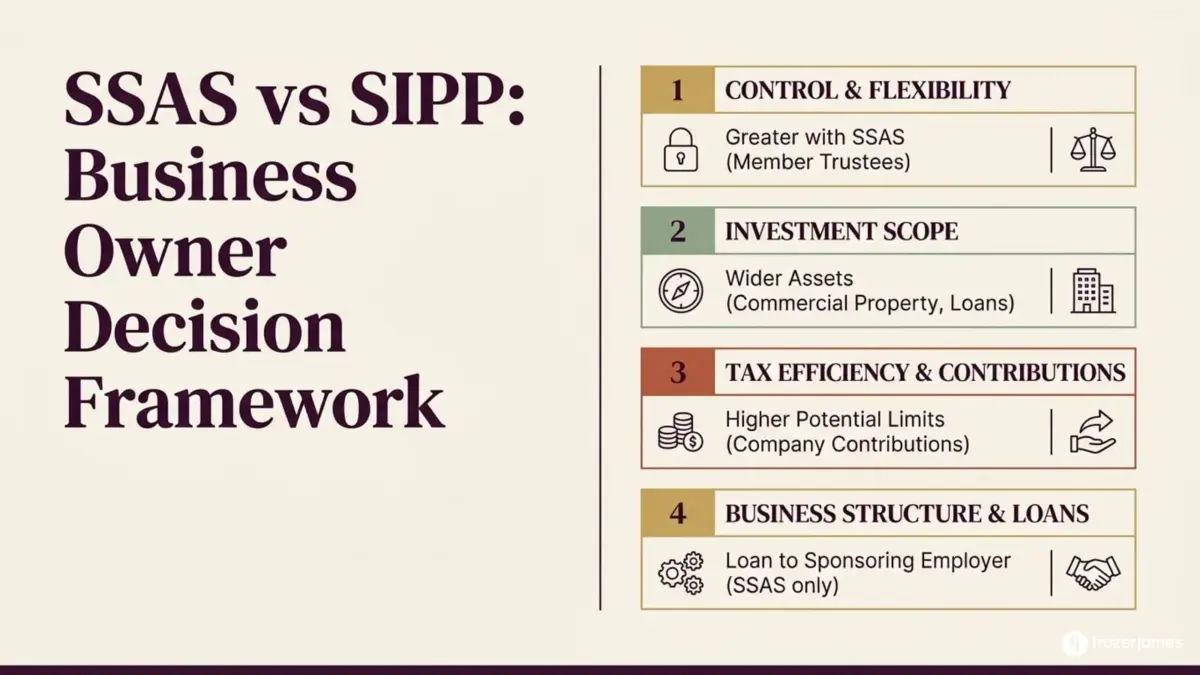
A SIPP (self-invested personal pension) is a personal pension held in the individual’s name. It offers broad investment flexibility, including commercial property in most cases. But it is not connected to a business structure. There is no employer loan-back facility. There is no pooling of funds with other members. And the individual, not a group of trustees, makes all investment decisions.
A SSAS is an occupational pension scheme tied to a sponsoring employer. It requires at least one company director to establish it. It involves collective trustee governance. And it unlocks the employer loan-back and pooled commercial property purchase features that a SIPP cannot replicate.
The practical decision framework looks like this:
If you are a sole trader or self-employed without a limited company, a SSAS is not available to you. A SIPP is the appropriate vehicle.
If you are a company director but want a simple, low-governance pension with broad investment choice, a SIPP is likely the better fit.
If you are a company director with a profitable business, a growing pension fund, and a specific interest in commercial property or business lending, a SSAS warrants serious consideration.
If you have multiple directors in a family business and want to pool pension assets for larger investments, a SSAS is usually the more capable structure – provided you accept the governance and compliance duties that come with it.
One important nuance: a SSAS and a SIPP are not mutually exclusive. Some business owners hold both. They use a SSAS for business-connected strategic investments and a SIPP for more conventional investment management. The right answer depends on your specific circumstances. This is why specialist pensions advice from a Chartered Financial Planner matters here.
What is the difference between a SSAS and a SIPP?
The core difference is structural. A SIPP is a personal pension held by an individual. A SSAS is an occupational pension scheme established by a company, with members who are also trustees. A SSAS can lend money back to the sponsoring employer (up to 50% of the fund value) – a SIPP cannot. A SSAS pools contributions from multiple members into a single fund; a SIPP is individual. Both offer broad investment flexibility including commercial property. But the governance, control, and business-integration features of a SSAS go significantly further.
The drawbacks of property in a SSAS – and why many advisers prefer managed funds
The property and loan-back features are what draw most business owners to a SSAS. They are also where the risks concentrate. Before going further, it is worth being honest about the trade-offs.
Concentration. If your pension owns your business premises, your retirement and your livelihood depend on the same asset. A downturn that hurts the business can hurt your pension at the same time. Diversification exists to prevent exactly this.
Illiquidity. Property cannot be sold quickly or in part. That matters when you need to draw retirement income, pay death benefits or rebalance. A fund that is mostly one building has very little room to move.
Cost. Buying property through a pension involves legal fees, surveys, valuations and ongoing management. Regular professional valuations are needed, and the administration never stops.
Compliance. HMRC’s rules on connected-party transactions, rent levels and borrowing are strict. Getting them wrong can trigger significant tax charges. A SSAS also makes every member a trustee, with real legal duties.
Changing course is hard. If your strategy changes – or the business is sold – unwinding a property holding takes time and cost that a portfolio of funds does not.
This is why, like most advisers, we tend to favour a diversified portfolio of managed funds as the default for pension money. Property ownership through a SSAS can be attractive for some business owners in specific circumstances. It is not automatically better – and for many people it is not better at all. That is the honest conversation we would have with you before any decision.
HMRC rules, registration, and the ongoing compliance obligations you need to know
A SSAS must be registered with HMRC as a registered pension scheme. Registration is what gives the scheme its tax-advantaged status. Contributions receive tax relief, the fund grows free of income tax and capital gains tax, and employer contributions are deductible against corporation tax. You can find the relevant HMRC guidance in the Pensions Tax Manual.
The trustee obligations are real and ongoing. Trustees must keep accurate records, file annual returns with HMRC, and ensure all investments comply with pension legislation. Prohibited investments – including residential property, tangible moveable property, and loans to members – can trigger significant tax charges. The employer loan-back facility, while powerful, must meet strict HMRC conditions on security, interest rate, and repayment term. Otherwise it will be treated as an unauthorised payment.
Most SSAS arrangements work with a professional pensioneer trustee or SSAS administrator to manage compliance. This adds an ongoing cost but significantly reduces the risk of inadvertent rule breaches. For business owners who are already managing a company, the governance burden of a SSAS should not be underestimated. It is one of the key reasons why a SSAS is not automatically the right choice over a SIPP.
How do I set up a SSAS pension in the UK?
Setting up a SSAS involves establishing a trust deed and rules. Trustees must be appointed – typically the scheme members. The scheme must then be registered with HMRC. In most cases, a professional pensioneer trustee or SSAS administrator is appointed to handle ongoing compliance. The process requires input from a regulated financial adviser and usually a solicitor to draft the trust documentation. It is not a quick or simple process. This is another reason why it suits business owners with a clear strategic purpose for the structure, rather than those simply looking for more investment choice.
What happens to your SSAS when you sell or exit your business?
This is the question almost no SSAS guide addresses. It is one of the most important for the business owners we work with at Frazer James.
When a business is sold, the SSAS does not automatically wind up. The pension fund belongs to the trustees, not the company, so it is not part of the business sale. However, the connection between the SSAS and the sponsoring employer matters in several ways. If the SSAS holds commercial property that the business occupies, the sale of the business may require a renegotiation of the lease. A decision will also be needed about whether the new owner continues to rent from the SSAS. If there is an outstanding employer loan-back, the acquiring company inherits the obligation to repay it.
For business owners planning an exit, the SSAS can actually become a strategic asset in the sale process. Separating the commercial property from the business sale – retaining it within the SSAS while selling the trading company – can simplify the transaction. It also preserves a valuable income-generating asset within the pension fund. This kind of pre-sale structuring is exactly where specialist advice makes a material difference.
Consider one couple who worked with Frazer James to plan an early retirement. Their case shows how pension strategy and business exit planning need to work together. Their goal was to leave work sooner than they had thought possible. The key was building a clear financial plan. It connected their business assets, their pension, and their retirement income needs into a single coherent picture. They achieved early retirement and began living their dream of sailing around the Mediterranean. Not because they had the most complex pension structure, but because they had a plan that made the most of what they had.
If you are approaching a business sale and want to understand how your pension fits into the picture, our retirement planning service is designed exactly for this stage.
Is a SSAS right for you? How to decide with the help of a financial adviser
A SSAS is a genuinely powerful pension structure for the right business owner. But “powerful” and “right for you” are not the same thing. The decision depends on your company structure, the size of your pension fund, and your investment objectives. Your appetite for trustee governance matters too, as does how your pension fits into your broader exit and retirement strategy.
The business owners who get the most from a SSAS are those who approach it as a strategic tool, not a product. They have a clear reason for wanting the employer loan-back facility or the commercial property purchase capability. They understand the trustee responsibilities they are taking on. And they have professional advice that connects the SSAS to their wider financial plan.
At Frazer James, we work with business owners at every stage – from those building wealth during the growth phase to those preparing for exit. Our Chartered and Certified Financial Planners take the time to understand your specific situation before recommending any pension structure. As one client put it: “They are professional, proactive, and always looking for ways to add value through intelligent tax planning and smart investing.”
If you are a company director wondering whether a SSAS could work harder for your retirement, the best starting point is a conversation. Book a free consultation with Frazer James and we will help you understand whether a SSAS, a SIPP, or a combination of both is the right structure for where you are now and where you want to be.
Frequently Asked Questions
This section answers common questions on SSAS membership, tax advantages, buying commercial property and lending to your own business.
How many members can a SSAS have?
A SSAS typically allows up to 11 members, though some sources cite 12 depending on the scheme rules. All members are usually directors or senior employees of the sponsoring employer. Each member also acts as a trustee of the scheme. This member-trustee structure is what distinguishes a SSAS from other occupational pension arrangements. It gives the members direct control over investment decisions.
What are the tax advantages of a SSAS?
A SSAS offers several significant tax advantages. Employer contributions are deductible against corporation tax. Personal contributions attract income tax relief at the member’s marginal rate. The fund grows free of income tax and capital gains tax, meaning property gains and investment returns accumulate without an annual tax drag. On death, the SSAS fund currently sits outside the member’s estate for inheritance tax purposes. This changes from 6 April 2027, when unused pension funds are brought into the estate, and professional advice should be sought on the current position.
Can a SSAS buy commercial property?
Yes. A SSAS can purchase commercial property, including the premises occupied by the sponsoring employer. The business pays rent to the SSAS at a commercial rate, which flows into the pension fund tax-free. Any capital growth on the property is free of capital gains tax within the fund. For business owners who currently pay rent to a third-party landlord, this redirects that rental expenditure into their own pension fund. It also concentrates pension and livelihood in one asset, so the risks described earlier in this guide apply. Many owners are better served by a diversified managed portfolio.
Can a SSAS lend money back to the business?
Yes, subject to strict HMRC conditions. A SSAS can lend up to 50% of its net fund value to the sponsoring employer. The loan must be secured against assets of at least equal value. It must be charged at a minimum interest rate of 1% above the average base rate and structured for repayment within five years. If these conditions are not met, HMRC will treat the loan as an unauthorised payment, which triggers a significant tax charge. Professional advice is essential before using this facility.
About The Author

About The Author

Related news






Get in touch
Schedule a free consultation with one of our financial advisers, or give us call.
0117 990 2602