 Client Login
  Retirement assessment
  Book a call
  0117 990 2602


Modified on: October 2026
Salary Sacrifice Changes 2029: What the £2,000 Cap Means for You

Do you sacrifice part of your salary or bonus into your pension? Then a rule change in April 2029, which limits how much you can sacrifice free of National Insurance, may cost you money.
This guide is for two groups. The first is directors and professionals on £100,000 to £200,000 who use salary sacrifice to keep their tax bill down. The second is business owners who want to know whether their company’s pension payments are affected.
We work through what changes, what it costs at real salaries, what stays the same, and what to check before April 2029.
At a glance
- From 6 April 2029, only the first £2,000 a year you put into your pension through salary sacrifice will be free of National Insurance.
- Above £2,000, both you and your employer pay National Insurance on it, just as you would on normal pay.
- Income tax relief does not change. Salary sacrifice still works the same, and is an effective way to avoid the £100,000 tax trap.
- Pension payments your company makes directly, and not in exchange for salary or a bonus, are free of National Insurance.
- Some of the details have not been published yet. The government says more guidance will follow before April 2029.
Budget update
Last updated 13 October 2026, before the Budget on 28 October. We will update this page after the Budget, and again when the detailed rules are published.
First, what is salary sacrifice?
Salary sacrifice is an agreement with your employer. You accept a lower salary or give up some or all of your bonus. In return, your employer pays the same amount into your pension.
Because your pay is lower, you pay less income tax. You also pay less National Insurance. That is the tax on earnings that helps pay for the State Pension and other benefits.
Your employer pays less National Insurance too, at 15% of what you give up. Some employers make an extra contribution to your pension, effectively passing on the National Insurance saving.
Today, all of the money you sacrifice is free of employee and employer National Insurance, however much it is. That is the part that changes.
What changes on 6 April 2029
The change is now law. It is set out in the National Insurance Contributions (Employer Pensions Contributions) Act 2026.
From 6 April 2029, the first £2,000 you sacrifice into your pension in each tax year stays free of employee and employer National Insurance. A tax year runs from 6 April to the following 5 April.
Anything above £2,000 is treated like normal pay for National Insurance. You pay your share on it, and so does your employer. This covers both salary and bonuses that you give up for your pension.
The government estimates that 7.7 million employees use salary sacrifice for their pension. About 3.3 million give up more than £2,000 a year. It puts the average extra cost at £84 a year for each employee. For higher earners who sacrifice large amounts, the cost is much bigger, as the examples below show.
What we do not know yet. The government says the detail of how the £2,000 limit works will be set out in separate rules later, after talking to employers. For example, it has not said whether the £2,000 applies to each job or to each person. We will update this page when those rules are published.
What it costs: £150,000 salary, £50,000 sacrificed
Take a director or senior professional earning £150,000. They sacrifice £50,000 a year into their pension, so their salary falls to £100,000. Here is how the numbers look today and from April 2029.
| No sacrifice | Sacrifice £50,000, today | Sacrifice £50,000, from April 2029 | |
|---|---|---|---|
| Salary paid | £150,000 | £100,000 | £100,000 |
| Paid into your pension | £0 | £50,000 | £50,000 |
| Income tax | £53,703 | £27,432 | £27,432 |
| Your National Insurance | £5,011 | £4,011 | £4,971 |
| Your employer’s National Insurance saving | None | £7,500 | £300 |
| Take-home pay | £91,286 | £68,557 | £67,597 |
Three things stand out.
- Your income tax saving does not change. It is £26,271 a year, before and after April 2029.
- Your own National Insurance goes up by £960 a year. Today you save £1,000. From April 2029 you save £40.
- Your employer’s saving falls by £7,200 a year. If your employer adds its saving to your pension today, that £7,200 a year will stop going in.
If your employer adds its saving to your pension
The table above shows only a small change in take-home pay. For many people, the bigger change is in their pension.
Many employers pay their National Insurance saving into your pension as a top-up. In our example, that top-up is £7,500 a year today. From April 2029, it falls to £300, because only the first £2,000 you sacrifice is still free of National Insurance.
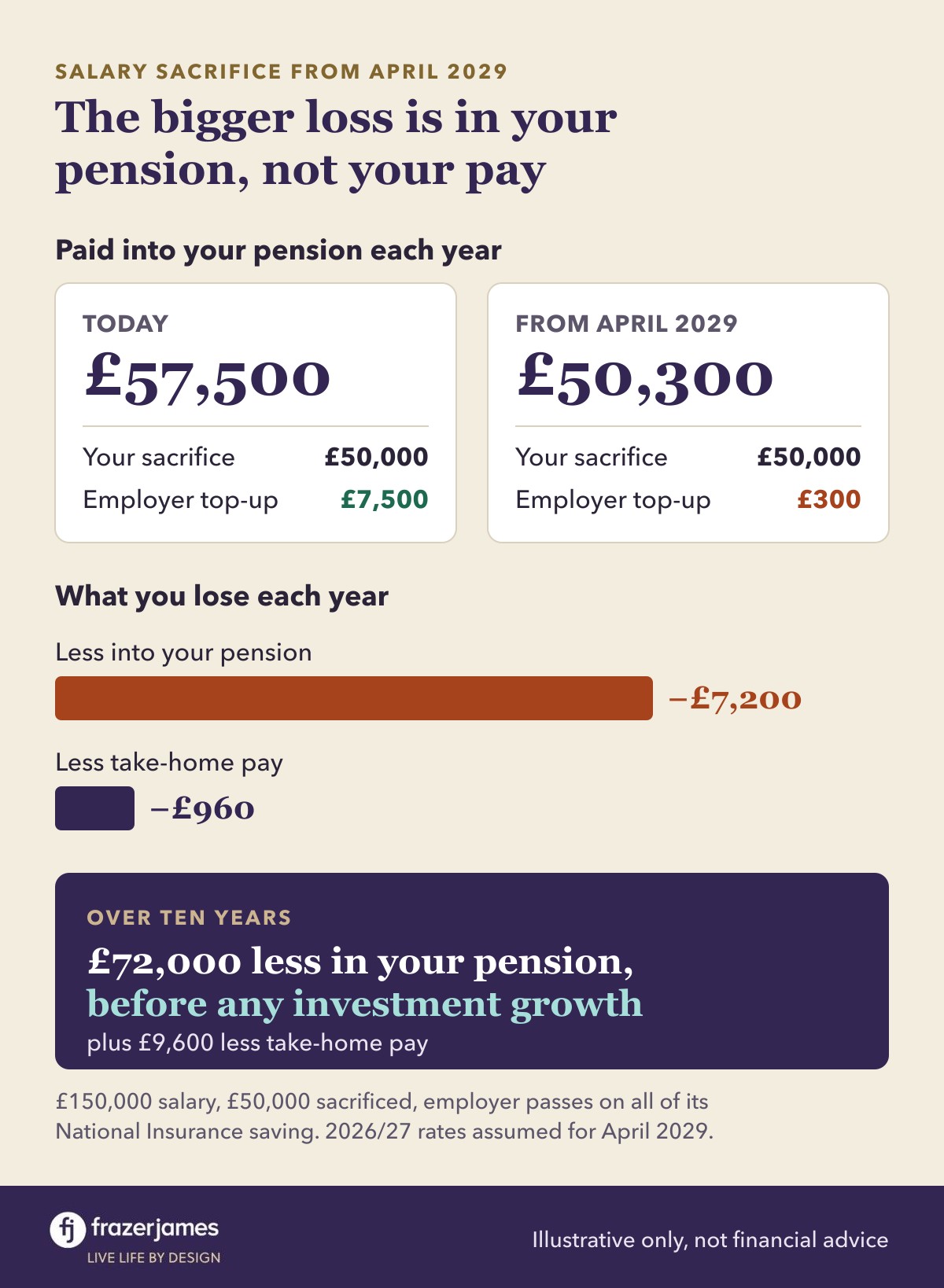
| £150,000 salary, £50,000 sacrificed | Today | From April 2029 | Change |
|---|---|---|---|
| You sacrifice | £50,000 | £50,000 | No change |
| Employer adds its National Insurance saving | £7,500 | £300 | −£7,200 |
| Paid into your pension | £57,500 | £50,300 | −£7,200 |
| Your take-home pay | £68,557 | £67,597 | −£960 |
| Pension and take-home pay together | £126,057 | £117,897 | −£8,160 |
So the change costs £8,160 a year in total. Only £960 of that comes out of your take-home pay. The other £7,200 is money that would have gone into your pension. Over ten years to retirement, it adds up to £81,600, before any investment growth.
If your employer keeps its saving today, you lose only the £960 a year. Your payslip or HR team can tell you which applies to you.
Salary and Bonus Sacrifice Calculator 2026/27
How much tax do you save from salary sacrifice?
Give up some salary, or a bonus, and your employer pays it into your pension instead. You skip income tax and National Insurance on it, and your employer skips its National Insurance too. This compares your pay and pension with and without the sacrifice.
Based on tax rates and allowances in England, 2026/27
What the numbers say
Enter your salary and the amount to sacrifice to see the comparison.
,
,
Your pay with and without sacrifice
| Per year | Without sacrifice | With sacrifice | Difference |
|---|---|---|---|
| Gross salary | , | , | , |
| Amount sacrificed | , | , | , |
| Taxable pay | , | , | , |
| Income tax | , | , | , |
| Employee National Insurance | , | , | , |
| Total income tax and NI | , | , | , |
| Take-home pay | , | , | , |
| Sacrifice paid into your pension | , | , | , |
| Additional pension contribution from your employer sharing their NI saving | , | , | , |
| Total pension contribution going in | , | , | , |
| Take-home pay plus pension | , | , | , |
,
,
,
Illustrative only, not financial advice. This calculator is based on tax rates and allowances in England for 2026/27. Personal allowance £12,570, tapered above £100,000. Basic rate 20% to £50,270, higher rate 40% to £125,140, then 45%. Employee National Insurance 8% between £12,570 and £50,270 and 2% above, employer National Insurance 15% above £5,000. Scottish income tax bands differ. National Insurance is worked out on an annual basis, which is exact for directors and a close approximation for most employees. Student loan repayments, the High Income Child Benefit Charge and pension contributions made outside salary sacrifice are left out. Salary after sacrifice must not fall below the National Minimum Wage. Sacrificed amounts count as employer contributions towards the £60,000 annual allowance, and towards adjusted income for the tapered allowance. A lower salary can affect mortgage applications, statutory pay and life cover based on salary. The results depend entirely on what you enter and your circumstances may differ. Talk your figures through with us, the first conversation is free.
You can run your own numbers with our salary sacrifice calculator. It works for salary or a bonus, and it lets you choose how much of your employer’s saving goes into your pension.
The £100,000 tax trap: why salary sacrifice still gets you out
Once your income goes over £100,000, you start to lose your tax-free personal allowance. You lose £1 of it for every £2 you earn above £100,000. By £125,140, it has gone.
That means each pound you earn between £100,000 and £125,140 is taxed at an effective rate of 60%. We explain this in full in our guide to the £100k tax trap.
Salary sacrifice brings your income for this test back down. In our example, it cuts the tax bill by £26,271 a year. The new rule does not touch that saving. It only adds £960 a year of National Insurance for you.
So for most people in this position, salary sacrifice will still be well worth it after April 2029. It just becomes a little less generous. Our income tax relief modeller shows how a pension payment changes your own tax bill.
Own your company? Your pension payments are probably not caught
Many business owners pay themselves a small salary and some dividends. Their company then pays directly into their pension. This is an employer pension contribution, not salary sacrifice.
The government has been clear on this point. In its words: “All employer pension contributions will continue to be free of NICs.” NICs means National Insurance contributions.
Say your company pays £60,000 a year into your pension. Today there is no National Insurance on it. From April 2029, there is still none. The new limit does not apply.
Your company can usually also take the payment off its profits before corporation tax. On £60,000, that saves £15,000 at the 25% main rate, or £11,400 at the 19% small profits rate. HMRC allows this when the payment is made wholly and exclusively for the business, which for a working director it usually is.
The point to watch. The limit applies when a pension payment is made in exchange for giving up salary or a bonus. If your pay is set up, or changed, so that a contribution replaces pay you would otherwise receive, it could count as salary sacrifice. Then the National Insurance exemption may be limited. Speak to your accountant before you change your salary or pension contributions.
Our guide to company pension contributions covers how directors use them in more detail. The salary vs dividend calculator shows the best mix of pay for your profits.
Bonus sacrifice: three tax years left at today’s rules
Senior employees often sacrifice their bonus rather than their salary. The new limit covers bonuses too. If you are a few years from retiring, timing matters.
Take an employee aged 56 who plans to retire in 2030. Their salary is £180,000. Each year they sacrifice a £60,000 bonus into their pension.
| Bonus paid in tax year | Income tax saved | Your National Insurance saved | Employer’s National Insurance saved |
|---|---|---|---|
| 2026/27, 2027/28 or 2028/29 | £27,000 | £1,200 | £9,000 |
| 2029/30 onwards | £27,000 | £40 | £300 |
The income tax saving stays at £27,000, because the whole bonus would be taxed at 45%. But from 2029/30, £9,860 a year of combined employee and employer National Insurance savings disappears, if the employer passes its saving on.
For this person, the three tax years before April 2029 are worth planning around. The rules for bonuses close to the start date have not been published yet. Check the timing with your employer before you rely on it.
One more check at this level of income. You can usually pay up to £60,000 a year into pensions with tax relief. This is called the annual allowance. It can shrink when your income is over £200,000 and your income plus pension payments is over £260,000. In our example, the second figure is £240,000, so the full £60,000 is available. If you are close to the limit, our tapered annual allowance calculator will show where you stand.
What to do before April 2029
There is no need to rush. The rule does not start until 6 April 2029, and some of the detail is still to come. But a few checks now will help you plan.
- Check what you sacrifice now. Your payslip or your HR team can tell you how much goes into your pension each year through salary sacrifice.
- Find out whether your employer adds its saving. If it does, ask how it plans to respond to the change. Some employers may reduce or stop it.
- Keep the bigger picture in mind. If salary sacrifice keeps your income under £100,000, the income tax saving is usually far larger than the new National Insurance cost.
- Use your allowances. You may be able to use unused annual allowance from the last three tax years. This is called carry forward. Check it before making a large payment.
- Wait for the detail before changing anything. Watch the Budget on 28 October 2026 and the guidance due before April 2029.
- Business owners: check how your contributions are set up. Make sure company pension payments are not tied to giving up salary or a bonus.
Who this is not for
If you pay basic rate tax and sacrifice less than £2,000 a year, nothing changes for you.
This guide is also not for anyone looking for a scheme to get around the new rule. We will not suggest one. The best results come from a plan that looks at your salary, pension, tax and goals together.
Talk to a certified financial planner
Earn over £100,000, or own a company?
We can look at how the change affects you. We will show you the numbers for your own pay and pension, before and after April 2029. Read how we help successful professionals and business owners. The first conversation is free, with no pressure to proceed.
Important information
The examples in this guide are illustrative only and are not personal advice. They use 2026/27 income tax and National Insurance rates for England, Wales and Northern Ireland. Scotland has different income tax bands. For April 2029 onwards, we have assumed today’s National Insurance rates and thresholds, because future rates are not yet known.
Tax rules can change, and how they apply depends on your circumstances. The value of a pension can go down as well as up. You cannot usually take money from a pension until age 55, rising to 57 from 6 April 2028.
We checked the rules in this guide against GOV.UK on 5 October 2026. We will update it after the Budget on 28 October 2026, and again when the detailed rules are published.
About The Author

About The Author

Related news











Get in touch
Schedule a free consultation with one of our financial advisers, or give us call.
0117 990 2602