 Client Login
  Retirement assessment
  Book a call
  0117 990 2602


Modified on: September 2026
What Happens to Your Pension When You Die?

Why This Matters More Than Most People Realise
Your pension is likely one of your largest assets. Yet most people spend more time choosing a holiday than deciding who inherits it. At Frazer James, we work with clients across Bristol and beyond who are surprised to discover how much control they actually have over what happens to their pension after death. This guide explains the process clearly, so you can act with confidence.
The April 2027 Change: Pensions and Inheritance Tax
From April 2027, unused pension funds will be brought into the estate for inheritance tax purposes. This is a significant change that will affect many people with substantial pension wealth. We have written a detailed guide covering what this means and how to plan ahead: pension inheritance tax changes 2027.
The current inheritance tax nil-rate band is £325,000, with a residence nil-rate band of £175,000 where applicable. Pensions currently sit outside this calculation entirely, but that will change.
If you have significant pension savings, reviewing your estate plan before April 2027 is now a priority, not an option.
The 2027 Change in Pounds: A Worked Example
Numbers make this real. Take a £500,000 pension left to an adult child who pays higher-rate tax, where death occurs after age 75.
|
|
Death before April 2027 |
Death after April 2027 |
|---|---|---|
|
Pension value |
£500,000 |
£500,000 |
|
Inheritance tax at 40% |
£0 — pensions sit outside the estate |
£200,000 |
|
Income tax when your family draws it (40%) |
£200,000 |
£120,000 |
|
Your family receives |
£300,000 |
£180,000 |
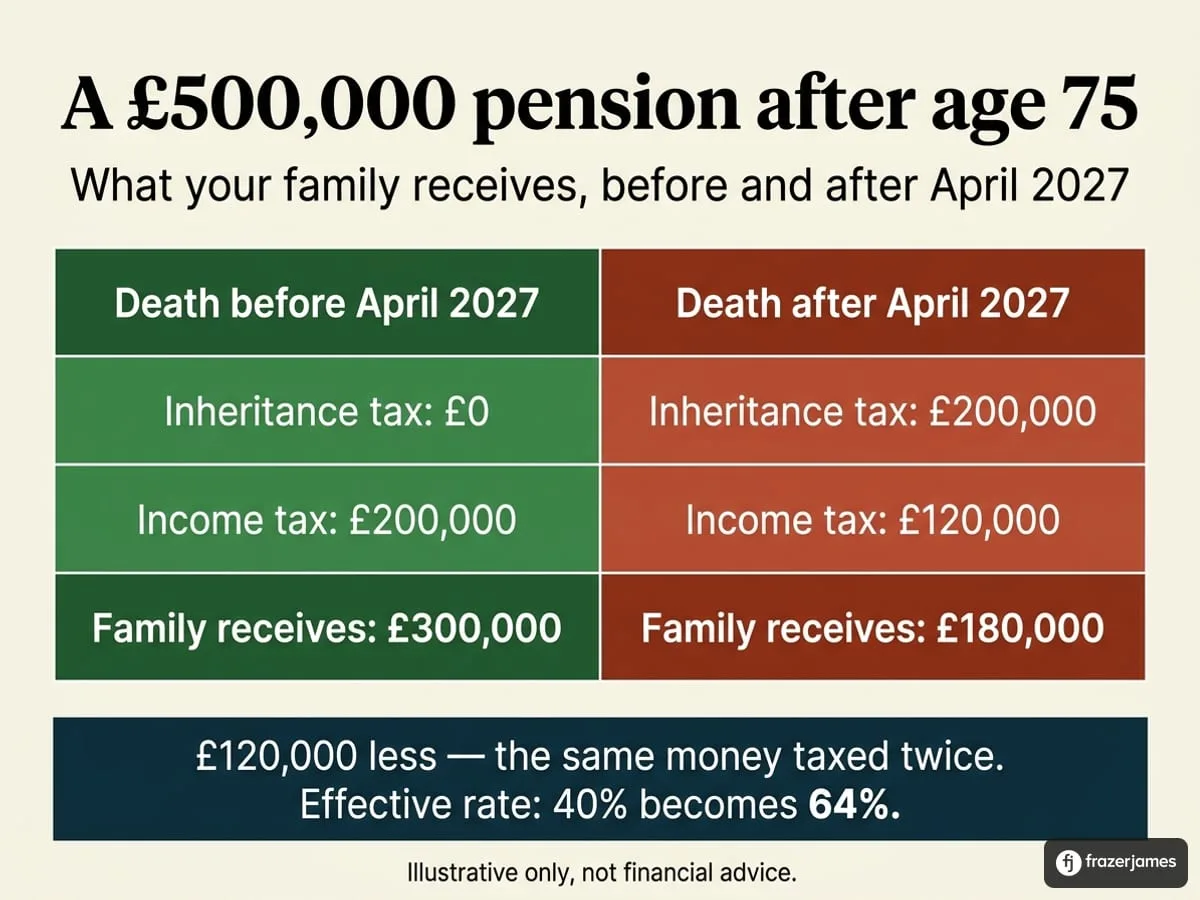
Same pension, same family: £120,000 less. The effective tax rate rises from 40% to 64%, because the same money is taxed twice — once through inheritance tax, then again as income when it is withdrawn.
Illustrative example only: it assumes death after age 75, the full pension falling within the taxable estate with the nil-rate bands used elsewhere, and a beneficiary who pays income tax at 40%. Your circumstances will differ — this is not financial advice.
What Actually Happens Step by Step
When you die, your pension does not automatically pass to your estate in the way a bank account or property does. Here is what typically happens:
-
Your pension provider is notified. A family member, executor or solicitor contacts the provider and registers the death.
-
The provider reviews your nomination form. This is the expression-of-wish form you completed when you joined the scheme or set up your pension.
-
The trustees or provider exercise discretion. For most personal pensions and SIPPs, the provider considers your nomination but is not legally bound by it. This keeps the pension outside your estate for inheritance tax purposes (until April 2027, when the rules change).
-
Beneficiaries are contacted and offered options. They can usually take a lump sum or move the funds into a beneficiary drawdown arrangement.
-
Tax treatment is determined. This depends primarily on whether you died before or after age 75.
The whole process can take several weeks to several months, depending on the complexity of your arrangements and how up-to-date your paperwork is.
Nomination Forms: Why They Matter and Why Yours Is Probably Out of Date
Your nomination form, sometimes called an expression of wish, is the single most important document governing who receives your pension. Most people fill one in when they first set up their pension and never look at it again.
Life changes. Your nomination form often does not.
Consider how many of the following may have happened since you last updated yours:
-
You married or remarried
-
You divorced or separated
-
Children grew up and became financially independent
-
Grandchildren were born
-
A named beneficiary died
-
Your financial circumstances changed significantly
-
You moved pension providers and forgot to complete a new form
If your form names an ex-spouse, a deceased parent, or simply says “my estate,” the outcome may be very different from what you intended. Providers will use their discretion, but they can only work with the information they have.
Your 5-Minute Nomination Form Checklist
Set aside five minutes now and work through the following:
-
Locate your current nomination form. Contact your pension provider if you cannot find a copy. Ask them to confirm who is currently named.
-
Check that the names are still correct. Are all named beneficiaries still alive? Are they still the people you would choose today?
-
Check that the percentages add up to 100%. If you have named multiple beneficiaries, confirm the split still reflects your wishes.
-
Consider whether your family structure has changed. Marriage, divorce, new children or grandchildren may all warrant an update.
-
Check every pension separately. If you have more than one pension, each provider holds its own form. Updating one does not update the others.
Updating a nomination form is usually straightforward. Most providers allow you to do it online or by post. It takes minutes and can make an enormous difference to your family.
The Age-75 Rule: A Clear Comparison
The tax treatment of your pension on death depends heavily on whether you die before or after age 75. This is one of the most important distinctions in pension planning, and it is widely misunderstood.
Note that age 75 is also linked to the crystallisation test for pension funds. For a full explanation of how crystallised and uncrystallised pensions interact with this, see our guide to understanding crystallised pensions.
|
Scenario |
Tax treatment for beneficiaries |
Key point |
|---|---|---|
|
You die before age 75 |
Beneficiaries usually receive the pension income-tax-free, whether taken as a lump sum or drawdown |
No income tax on withdrawals, subject to the Lump Sum and Death Benefit Allowance |
|
You die at or after age 75 |
Beneficiaries pay income tax at their own marginal rate on any withdrawals |
A higher-rate taxpaying beneficiary could lose 40% or more to income tax |
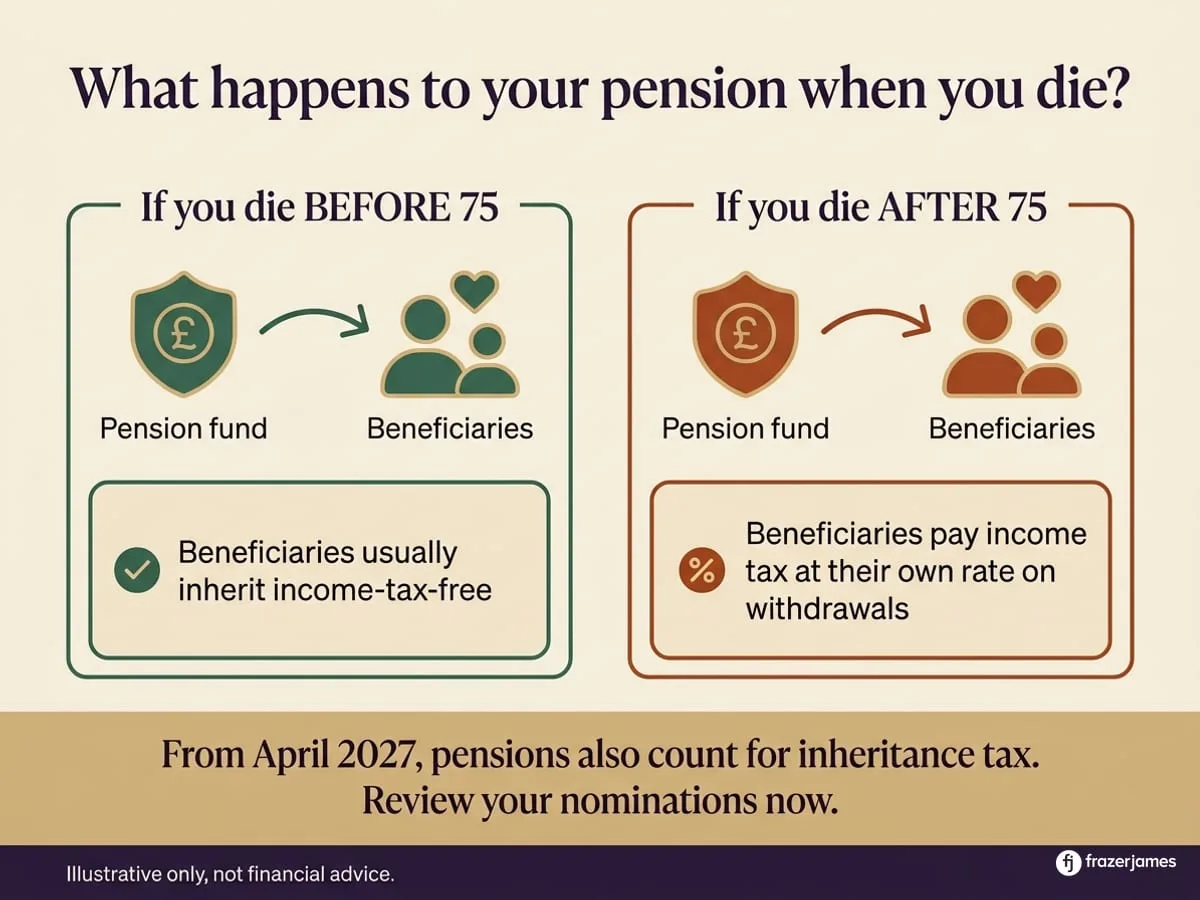
The Lump Sum and Death Benefit Allowance (LSDBA) is currently £1,073,100. Where a pre-75 death benefit exceeds this, the excess is taxed at the beneficiary’s marginal rate. The Lifetime Allowance was abolished in April 2024, but this separate allowance remains relevant for death benefits.
The age-75 rule is not something you can easily plan around, but understanding it helps your beneficiaries make better decisions about how and when they draw from an inherited pension.
What Options Do Beneficiaries Have?
When someone inherits a pension, they typically face a choice. Getting this decision wrong can be costly.
Option 1: Take a Lump Sum
The beneficiary receives the full pension fund as a single cash payment. This is simple and immediate. However, if the pension owner died after age 75, the entire lump sum is taxed as income in the year it is received. A large lump sum could push a beneficiary into the higher or additional rate tax band, even if they are normally a basic rate taxpayer.
Illustrative example only: Imagine a beneficiary who earns £30,000 a year receives a £200,000 lump sum from an inherited pension (post-75 death). That £200,000 is added to their income for the year, taking their total to £230,000. A significant portion would be taxed at 40% or even 45%. Spreading withdrawals over several years would have been far more tax-efficient.
Option 2: Beneficiary Drawdown
The inherited pension remains invested, and the beneficiary draws from it at a pace that suits them. This allows them to manage their tax position year by year, taking only what they need and leaving the rest to grow. For post-75 deaths, this is often the more tax-efficient route.
Beneficiary drawdown also allows the funds to remain outside the beneficiary’s own estate in some circumstances, though the rules here are complex and professional advice is essential.
Not all providers offer beneficiary drawdown. If your current pension provider does not, your beneficiaries may need to transfer to one that does. This is worth checking now, not after you have died.
Three Ways to Reduce the Tax on Your Pension
The April 2027 change turns lifetime pension planning into estate planning. Three strategies are worth discussing with a planner. Each has trade-offs, and the right combination depends on your circumstances.
1. Use Your Tax-Free Cash During Your Lifetime
As the worked example shows, a pension left behind after age 75 can be taxed twice: inheritance tax first, then income tax when your family draws it. Tax-free cash (usually 25% of your pension, capped at £268,275) escapes income tax entirely, but only if you take it. Withdrawing it during your lifetime and spending or gifting it means that money is never exposed to the double charge. Gifts made more than seven years before death fall outside your estate altogether.
2. Draw Taxable Income and Gift It
Beyond tax-free cash, drawing pension income at your marginal rate and gifting it can still beat leaving the fund untouched, because the money is taxed once rather than twice. Regular gifts made out of surplus income can be immediately exempt from inheritance tax under the normal expenditure out of income rules, one of the most underused exemptions in the system.
3. Do Not Hold Everything in Your Pension
Before this change was announced, the standard logic was to spend other assets first and preserve the pension, because it sat outside your estate. That logic has weakened. Spreading new savings across ISAs (£20,000 allowance per year) and other wrappers gives your estate options: ISAs do form part of your estate for inheritance tax, but your beneficiaries pay no income tax on what they inherit, which avoids the double charge that catches pensions after 75.
What You Should Do Now
If you are between 50 and 65 with meaningful pension wealth, here is a practical action list:
-
Review every nomination form you hold. Contact each provider and confirm who is named. Update where necessary.
-
Check whether your provider offers beneficiary drawdown. If not, consider whether a transfer to a more flexible provider makes sense.
-
Revisit your estate plan before April 2027. The incoming inheritance tax changes mean your pension now needs to be part of a broader estate planning conversation.
-
Consider the age-75 implications. If you are approaching 75, discuss with an adviser how your pension is structured and what options your beneficiaries will have.
-
Talk to your intended beneficiaries. They do not need to know every detail, but knowing a pension exists and who to contact makes an enormous practical difference.
For a broader view of how your pension fits into your retirement income strategy, our retirement planning guide covers the key decisions in one place.
Speak to a Certified Financial Planner
Pension death benefits sit at the intersection of tax planning, estate planning and family circumstances. Getting the details right matters. At Frazer James, we are certified financial planners based in Bristol, and we help clients across the UK think through exactly these questions.
If you would like to talk through your situation, we offer a free, no-obligation initial conversation. Book a consultation here, and we will be in touch to arrange a time that suits you.
About The Author

About The Author

FAQs
Does my pension automatically go to my spouse when I die?

What happens to my pension if I die without completing a nomination form?
Can I leave my pension to anyone I choose, or only to family members?
Will the April 2027 inheritance tax change affect pensions already in drawdown?
Related news








Get in touch
Schedule a free consultation with one of our financial advisers, or give us call.
0117 990 2602