 Client Login
  Retirement assessment
  Book a call
  0117 990 2602


Modified on: September 2026
You’ve Sold Your Business. Now What?

The Chapter Nobody Writes
Most exit planning content stops at completion. The deal is done, the funds have landed, and the advisers move on. But for many former business owners, the real work starts the morning after.
This article is for you if you have just sold, or are about to sell, a business for £1 million or more. We are Frazer James, certified financial planners based in Bristol. We work with business owners at every stage of the exit process, and we have seen what happens when the post-sale period is handled well and when it is not.
Consider this the missing final chapter of the exit story.
If you are still in the planning stage, our business exit financial planning checklist is a good place to start. And if you are still working out whether the sale price is enough, read our guide on how much you need to sell your business for.
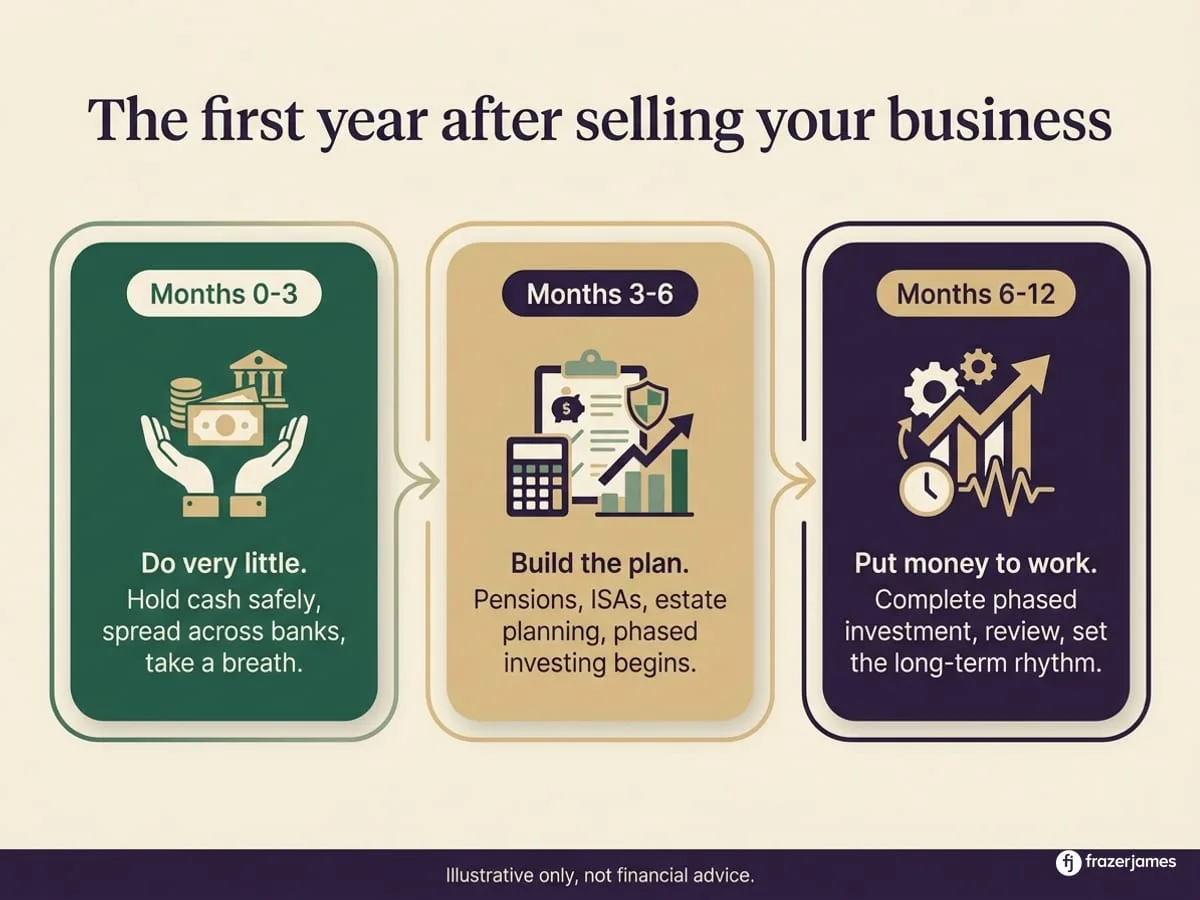
The First 90 Days: Deliberately Do Less
This is the most counterintuitive advice we give, and it is the most important.
When a large sum of money arrives in your account, the instinct is to act. To invest it, to restructure it, to put it to work. That instinct is understandable. It is also usually wrong.
The first 90 days after a sale are not the time for major financial decisions. They are the time to stabilise, to breathe, and to think clearly about what you actually want your life to look like.
Here is what we recommend instead.
Hold Cash Safely Above FSCS Limits
The Financial Services Compensation Scheme protects up to £85,000 per person per authorised institution. With £1 million or more sitting in cash, you need a deliberate strategy to keep it safe.
Practical options include:
-
NS&I accounts: National Savings and Investments is backed by HM Treasury. There is no upper limit on protection for most NS&I products. This makes it a natural home for a significant portion of your cash in the short term.
-
Spreading across banks: Use multiple authorised institutions to keep each balance within the £85,000 FSCS limit. Be aware that some banks share a banking licence, so check before spreading.
-
Short-dated gilts: UK government bonds maturing in the near term can offer a secure, liquid home for cash with a known return. They are not a long-term investment strategy, but they are a sensible holding pen.
The goal here is not to maximise returns. The goal is to keep your money safe while you make considered decisions.
Why Rushing to Invest Is the Classic Error
We see this pattern regularly. A business owner receives a large sum, feels uncomfortable holding cash, and quickly invests the full amount. Sometimes it works out. Often it does not.
There are two specific risks worth understanding.
Sequence Risk
If you invest a large lump sum at a market peak and values fall shortly afterwards, the psychological damage can be severe. You may sell at the wrong moment, locking in losses. Even if you hold on, the experience can undermine your confidence in the plan.
This is not a reason to avoid investing. It is a reason to invest thoughtfully and in stages.
Decision Fatigue
Selling a business is exhausting. The legal process, the due diligence, the negotiations, the emotional weight of letting go. By the time completion arrives, most owners are running on empty.
Making complex, irreversible financial decisions in that state is a risk in itself. Your judgement is not at its sharpest. Your priorities may shift once you have had time to rest.
The Case for Phased Investment
Rather than investing everything at once, a phased approach spreads your entry point over time. This is sometimes called pound-cost averaging or drip-feeding into markets.
It will not always produce the best mathematical outcome. But it reduces the risk of a catastrophic start, and it gives you time to refine your thinking as you go. For most people in this situation, that trade-off is worth making.
A reasonable approach might be to invest in tranches over six to twelve months, with each tranche informed by a clearer picture of your goals, your tax position, and your income needs.
Rebuilding Your Tax Wrappers From Scratch
One of the most valuable things you can do in the first year is to build a tax-efficient structure around your wealth. For many former business owners, this is genuinely starting from scratch. The business was the wealth. Now you need to build the wrappers around the proceeds.
Here is the order we typically recommend, and why.
1. Pensions: Use Carry Forward First
The pension annual allowance for 2026/27 is £60,000. But if you have been a member of a registered pension scheme for the past three tax years and have not used your full allowance, you can carry forward unused allowance from those years.
In practice, this means you could potentially contribute significantly more than £60,000 in a single tax year. The exact amount depends on your unused allowances in the three preceding years and your pensionable earnings.
Pension contributions attract income tax relief. If you have taken a salary from the business or have other earned income in the year of sale, this can be a powerful way to reduce your tax bill while building a protected pot.
A few important points for 2026/27:
-
The annual allowance is £60,000 (or 100% of your UK earnings, whichever is lower).
-
The Money Purchase Annual Allowance (MPAA) is £10,000. This applies if you have already flexibly accessed a defined contribution pension. If the MPAA applies to you, carry forward is not available for money purchase contributions.
-
The Lifetime Allowance was abolished in April 2024. There is no longer a cap on the total value of your pension pot, though the Lump Sum Allowance of £268,275 caps the amount of tax-free cash you can take.
-
Tax-free cash remains 25% of the fund, up to the £268,275 Lump Sum Allowance.
-
The minimum pension access age is currently 55 and will rise to 57 in April 2028.
Pensions are currently outside your estate for inheritance tax purposes. However, from April 2027, unspent pension funds will be brought within the scope of IHT. We cover exactly how this works, and who is affected, in our guide to the 2027 pension inheritance tax changes. This changes the planning calculus significantly, and we cover it below.
2. ISAs: Both Spouses, Every Year
The ISA allowance for 2026/27 is £20,000 per person. If you are married or in a civil partnership, that is £40,000 between you each tax year, sheltered from income tax and capital gains tax permanently.
This sounds modest against a seven-figure sum. But over time, consistent ISA funding builds a meaningful tax-free pot. Start immediately and do not miss a year.
Consider using a Stocks and Shares ISA rather than a Cash ISA if your investment horizon is long enough. The tax shelter is most valuable when the underlying assets are growing.
3. General Investment Account: The Rest
Once pensions and ISAs are funded, the remainder of your investable assets could sit in a General Investment Account (GIA). This is not tax-sheltered, but it is not without planning opportunities.
Key figures for 2026/27:
-
CGT annual exemption: £3,000 per person.
-
Dividend allowance: £500 per person.
These allowances are modest, but they can be used deliberately. Bed-and-ISA strategies (selling assets in the GIA and repurchasing inside an ISA) can gradually move gains into a sheltered environment. Spousal transfers can make use of both exemptions.
Asset location matters too. Income-generating assets are often better held inside a pension or ISA. Growth assets held in a GIA can be managed to crystallise gains within the annual exemption each year.
4. Offshore Bonds: For Larger Sums
For proceeds beyond what pensions, ISAs and a GIA can tax-efficiently absorb, an offshore investment bond is worth considering.
-
Gross roll-up: investments grow largely free of ongoing UK tax inside the bond, with tax deferred until money is drawn out.
-
5% tax-deferred withdrawals: you can draw up to 5% of your original investment each year, for up to 20 years, with no immediate tax charge.
-
Timing control: gains are taxed as income only when realised, which can be planned for a year in which you pay a lower rate, such as the early years of retirement.
-
Assignment: bond segments can be assigned to a spouse or adult children, potentially moving the tax point to someone with a lower rate.
Offshore bonds are more complex than the other wrappers, and charges vary considerably between providers. They tend to earn their place for larger portfolios once the simpler allowances are used. This is an area where advice is essential.
The Order Matters
Pension first, ISA second, then a GIA, with offshore bonds considered for larger sums beyond these. This order reflects the tax efficiency of each wrapper and the relative illiquidity of pensions. You want your most tax-efficient wrapper to hold as much as possible, while keeping enough accessible for income and spending needs.
The Identity Shift: What Former Owners Actually Struggle With
We want to be honest about something that financial planning guides rarely address.
Selling a business is not just a financial event. For most owners, the business has been the structure of their days, the source of their identity, and the measure of their progress for years or decades. When it goes, something goes with it.
We have sat with clients who expected to feel liberated and instead felt lost. That is not a failure. It is a very human response to a profound change.
Here are the three things former owners most commonly struggle with.
Structure
Running a business gives you a reason to get up. There are problems to solve, people to lead, and decisions to make. Without it, the days can feel shapeless. Many former owners underestimate how much they relied on the business for rhythm and routine.
Building a new structure takes time and intention. It might come from a portfolio of non-executive roles, a new venture, charitable work, or simply a deliberate daily routine. There is no single answer, but the need is real.
Purpose
Related to structure, but distinct. Many business owners built something they believed in. The sale can feel like the end of that story, even when it is financially successful. Finding a new sense of purpose is not automatic.
We encourage clients to think about this before the sale completes, not after. What do you want the next chapter to look like? What would make you proud to look back on in ten years?
Spending Permission
This one surprises people. After years of reinvesting in the business, of watching cash flow carefully, of deferring personal spending for the sake of growth, many former owners find it genuinely difficult to spend money on themselves.
The wealth is there. The permission feels absent.
Part of our role as financial planners is to show clients, with evidence, what they can afford to spend. A well-constructed cashflow model can demonstrate that spending £10,000 on a holiday, or £50,000 on a renovation, will not derail their financial security. Sometimes people need to see the numbers before they can give themselves permission to enjoy what they have built.
The IHT Consequence You Cannot Ignore
This is urgent, and we want to be direct about it.
While you owned your business, the shares were likely sheltered from inheritance tax under Business Relief. Qualifying trading company shares attracted 100% relief, meaning they could pass outside your estate entirely.
From April 2026, Business Relief is capped at £2.5 million at 100% relief. Above that threshold, relief reduces to 50%. This is a significant change for larger estates, but even below the cap, the key point remains: once you sell, the relief disappears.
The sale proceeds are cash. Cash is fully exposed to IHT at 40% above the available nil-rate bands.
For 2026/27, the nil-rate band is £325,000, and the residence nil-rate band is £175,000, giving a combined threshold of £500,000 per person (subject to conditions). For a married couple, this can be up to £1 million. But on a £3 million or £5 million estate, the exposure above those thresholds is substantial.
Pensions have historically been outside the estate. From April 2027, unspent pension funds will be brought within the scope of IHT. This makes early planning even more important.
IHT planning after a business sale is not something to defer. The options available to you, including trusts, gifting strategies, and life assurance written in trust, take time to implement, and some require a seven-year survival period to be fully effective.
We have written in detail about this in our guide to inheritance tax planning for business owners in the UK. We strongly recommend reading it alongside this article.
Your First-Year Timeline
Here is a practical framework for the twelve months after completion. Treat it as a guide, not a rigid prescription. Every situation is different.
|
Period |
Priority Actions |
What to Avoid |
|---|---|---|
|
Months 0 to 3 |
|
|
|
Months 3 to 6 |
|
|
|
Months 6 to 12 |
|
|
A Note on BADR and Your Tax Position
Business Asset Disposal Relief (BADR) applies a reduced CGT rate to qualifying business disposals. From April 2026, the rate is 18%, with a lifetime limit of £1 million of qualifying gains.
For illustrative purposes only: if you sell a qualifying business and realise a £1 million gain, BADR reduces the CGT rate to 18% on that gain, rather than the standard 24% rate. On £1 million of gains, that difference is £60,000. It is worth confirming your eligibility carefully with your accountant before and after the sale.
BADR is claimed on your self-assessment return. Make sure your accountant is aware of the sale and the timeline.
Working With a Financial Planner After the Sale
We are not the right fit for everyone, and we will always say so honestly. But if you have just sold a business for £1 million or more, the complexity of your situation almost certainly warrants specialist advice.
The decisions you make in the first twelve months will shape your financial life for decades. Getting them right matters. Getting them wrong is expensive and sometimes irreversible.
At Frazer James, we work in depth with a small number of clients. We are certified financial planners based in Bristol, advising clients across the UK. Our work combines technical financial planning with the kind of honest, human conversation that this transition genuinely requires.
If you would like to talk through your situation, we would be glad to hear from you. There is no obligation and no sales pressure. Book a free consultation here.
About The Author

About The Author

Related news









Get in touch
Schedule a free consultation with one of our financial advisers, or give us call.
0117 990 2602