 Client Login
  Retirement assessment
  Book a call
  0117 990 2602


Modified on: October 2026
Pension Tax-Free Lump Sum: Should You Take It Before the October 2026 Budget?
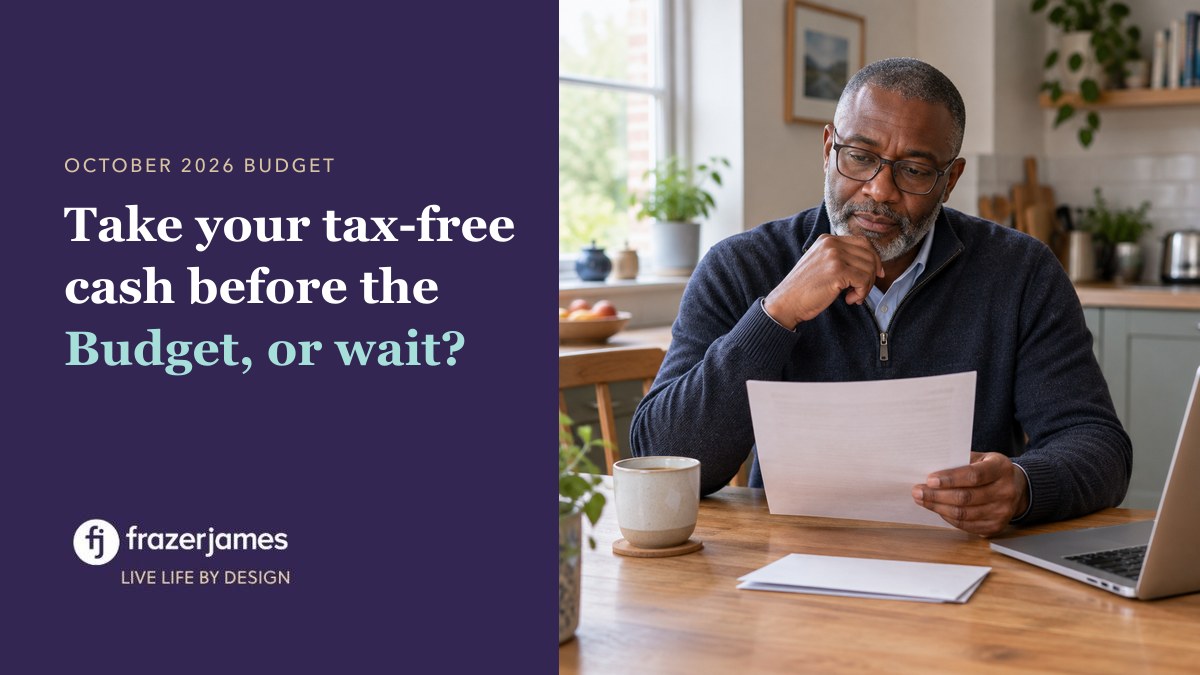
Every autumn, the same story goes round: the Chancellor is about to cut tax-free cash, so take yours now while you can. It came up before the Budget in October 2024. It came up again in November 2025. Both times, tax-free cash was (largely) left alone.
That does not mean the risk is zero. A £100,000 cap is being talked about again ahead of the Budget on Wednesday, 28 October 2026. The question is whether that risk is large enough to justify acting now, before you know the full picture.
This article puts a number on both sides. You will see what taking your tax-free cash early could mean in practice, and what a cut to the tax-free allowance may cost you. You will also see why the answer changes once your pension value exceeds £1,073,100. We cover the recycling rules that catch out owner-directors, the inheritance tax change in April 2027, and how tax-free cash can be given away tax-efficiently. If you want to run your own numbers, there is a calculator below.
This page is written for people in their fifties and sixties with larger pensions, and for owner-directors whose company pays into their pension. If your pensions are smaller, the free Pension Wise service from MoneyHelper is a good place to start. It gives free, impartial guidance to anyone aged 50 or over with a pension that builds up a pot of money.
At a glance
- Once tax-free cash is paid out, it cannot be put back. So a rushed decision cannot be undone.
- For a £900,000 pension, waiting usually comes out ahead.
- Once your pensions pass £1,073,100, your tax-free cash stops growing. Then there is a strong case for taking it before the Budget.
- From April 2027, unused pensions count for inheritance tax. That removes one of the main reasons to leave the cash where it is.
- Taking tax-free cash in regular stages and giving it away can take it out of your estate straight away.
Budget update
Last updated 2 October 2026, before the Budget. We will update this page and the calculator on 29 October with what the Budget changed and what it did not.
This is not a prediction of what the Budget will say. It is a way to make a calm decision with your own figures. If you would like to talk it through before 28 October, the Frazer James pension team can help.
What is tax-free cash?
Tax-free cash is the part of your pension you can take without paying income tax on it. You may also see it called a tax-free lump sum. Most people can take up to 25% of their pension savings tax-free. The total you can take tax-free across all your pensions is capped at £268,275. This cap is called the Lump Sum Allowance.
You can usually take it from age 55. The money can be taken all at once or in stages. Once it is paid, it is yours to use however you like.
Aged 55 or 56 on 6 April 2028? Read thisTap to open
The minimum age for taking money from a pension rises from 55 to 57 on 6 April 2028. This affects a small group of people, but for them it matters a lot.
If you are 55 or 56 on that date and have not taken any pension money yet, you will usually have to wait until 57. That could mean a gap of up to two years when you cannot touch your pension at all.
The exception is a scheme that gives you a protected pension age, which keeps your minimum age at 55. Some older schemes do this. Your pension provider can tell you whether yours does.
If this applies to you and you will need the money in that gap, it is a real reason to plan now. If you are under 55 today, the decision is not urgent for you yet.
The remaining 75% of your pension is not tax-free. When you draw it as income, it is taxed like a salary. You can draw it down bit by bit (called drawdown), or buy an annuity that pays a guaranteed income for life. The amount of tax you pay will depend on how much income you receive in that tax year.
How much tax-free cash can I take from my pension?
You can take up to 25% of each pension you hold, as long as the total across all pensions does not exceed £268,275. So if you have £500,000 in one pension and £200,000 in another, your maximum tax-free cash is £175,000. That is 25% of £700,000. If your total pensions are worth more than £1,073,100, the 25% calculation still applies, but the cash amount is capped at £268,275 regardless. The government’s guidance on tax-free pension cash explains that people with lifetime allowance protection from before 2024 may be able to take more.
Can I take 25% tax-free from each pension I have?
Yes, the 25% applies to each pension individually. But the total across all pensions cannot exceed the Lump Sum Allowance of £268,275. If you have already taken tax-free cash from one pension, that amount counts against your overall allowance when you access another. Your pension provider should tell you how much of your allowance remains.
The one thing you cannot undo
In September 2025, HM Revenue and Customs and the Financial Conduct Authority confirmed something important. Once tax-free cash has been paid to you, it cannot be reversed. Even if you pay the money back. Even if a cooling-off period applies to the product you used.
This matters because some people take their tax-free cash in a panic, then regret it when the Budget comes and goes without any change. The money is gone from the pension. It now sits in a bank account, where the interest it earns may be taxed.
The Financial Conduct Authority published figures in September 2026 showing that £22.1 billion was taken as tax-free cash in 2025/26. That is up 21% on the £18.3 billion taken the year before. Some of that was normal retirement planning. Some of it was people acting on Budget rumours. Because the decision cannot be undone, it is worth slowing down.
Work out your own numbers
Enter your pensions and your tax rates below. The calculator compares taking the cash now with waiting, and works out what a cut to £100,000 would cost you. Then it shows how likely a cut would need to be before going early pays off. The results are examples only, not a forecast or advice.
Tax-Free Cash Calculator 2026/27
Take your tax-free cash now, or wait?
Put in your pensions. See what taking your tax-free cash early would cost you, what a cut to the limit would cost you, and how the two compare.
Based on tax rates and allowances in England, 2026/27
What the numbers say
Enter the value of your main pension to see your tax-free cash and what each choice could cost.
| If nothing changes | Take it now | Wait |
|---|---|---|
| Value after one year | , | , |
,
,
Illustrative only, not financial advice. Based on tax rates and allowances in England for 2026/27. Tax-free cash is usually 25% of your pensions, up to a total of £268,275 for most people. The calculator assumes cash left in a savings account is taxed as savings interest, after a personal savings allowance of £1,000 for basic rate, £500 for higher rate and nothing for additional rate taxpayers, with no other savings using that allowance. Pension growth beyond your tax-free cash is taxed at the rate you choose when it is drawn. It does not model inheritance tax, investing the cash, or any protection you may hold. Nothing about the limit has been announced, and any change could come with protection for savings already built up. Talk your figures through with us, the first conversation is free.
If you want to understand the logic behind the calculator, the next section shows how it works for two example pensions.
Two pensions, side by side
Both savers below are 58 years old. Both pay 40% income tax now and plan to stop working in about a year. Saver 1 expects to pay 20% tax in retirement. Saver 2 has a bigger pension, so expects to pay 40%. These are illustrative figures, not a forecast or a guarantee.
| Saver 1 (£900,000 pension) | Saver 2 (£1.25 million pension) | |
|---|---|---|
| Tax-free cash available today | £225,000 | £268,275 (the limit) |
| Cost of taking it a year early | £5,650 | £1,410 |
| Cost if the limit were cut to £100,000, with no protection | £27,250 | £67,310 |
| Taking it early pays off if a cut is more likely than | About 1 in 5 (20%) | About 1 in 48 (2%) |
Where does the cost of going early come from? If you take the cash now, it sits in a savings account and the interest is taxed. If you wait, the money stays in your pension and grows without tax. A quarter of that growth also adds to your tax-free cash, up to the £268,275 limit. The cost is the difference after one year.
Show the workingsTap to open
We assume cash earns 4% a year before tax, and pensions grow 5% a year after charges. Both savers pay 40% tax on interest, after the first £500, which is tax-free.
Saver 1, take it now: £225,000 earns £9,000 of interest. Tax on £8,500 is £3,400. After one year, the cash is worth £230,600.
Saver 1, wait: the £900,000 pension grows to £945,000. A quarter of that, £236,250, can be taken tax-free. Waiting is £5,650 better.
Saver 2, take it now: £268,275 earns £10,731 of interest. Tax is £4,092. After one year, the cash is worth £274,914.
Saver 2, wait: the tax-free cash is stuck at £268,275. The £13,414 of growth on that slice is taxed at 40% when drawn, leaving £8,048. That totals £276,323, so waiting is only £1,410 better.
The cost of a cut: suppose the limit fell to £100,000. Saver 1 would lose £136,250 of tax-free cash and pay 20% on it, which is £27,250. Saver 2 would lose £168,275 and pay 40% on it, which is £67,310.
The odds: divide the cost of going early by the cost of a cut. For Saver 1, £5,650 divided by £27,250 is about 1 in 5. For Saver 2, £1,410 divided by £67,310 is about 1 in 48.
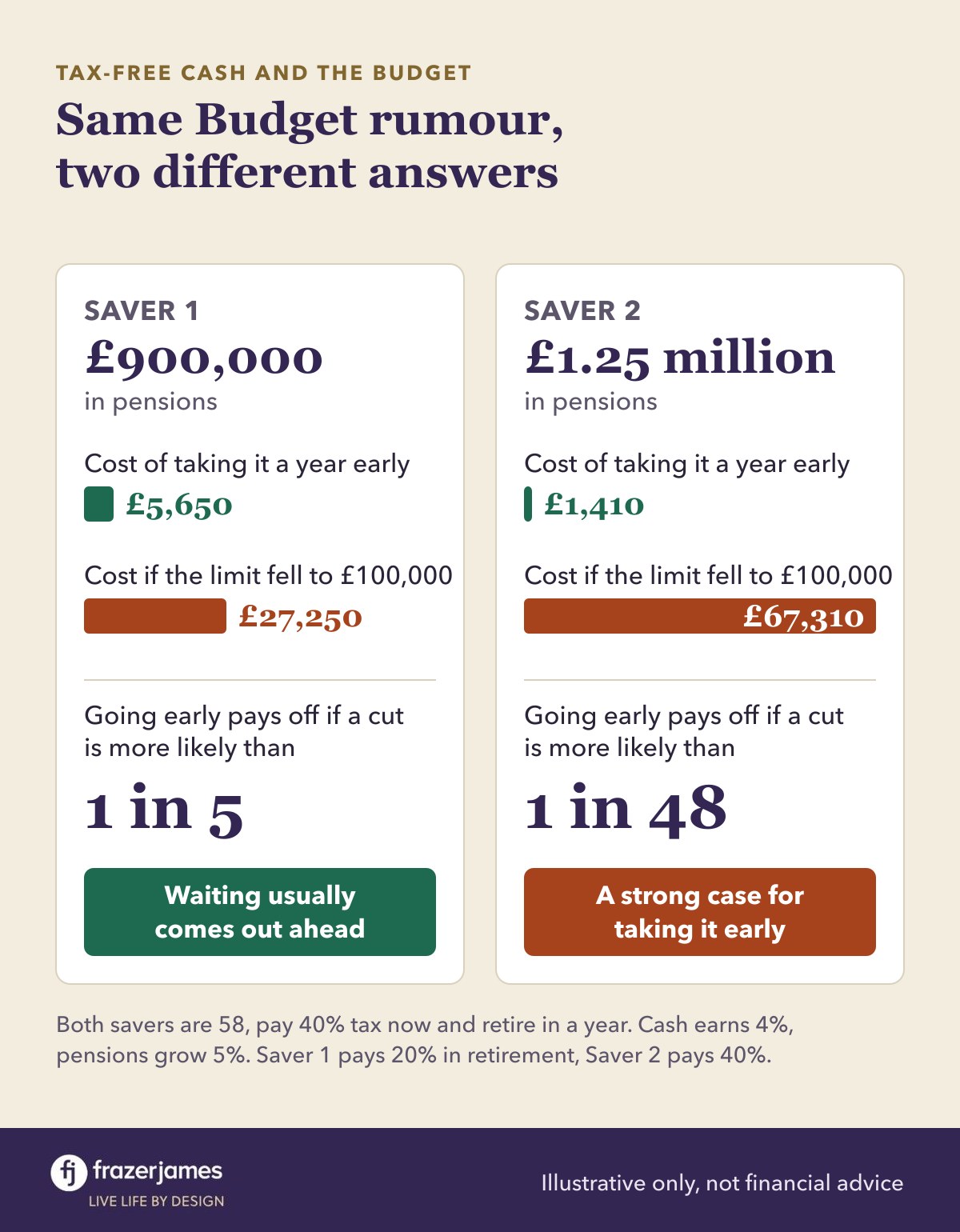
For Saver 1, the numbers point to waiting. Going early costs £5,650. A cut would cost £27,250. So taking early only makes sense if you think the chance of an unprotected cut is higher than about one in five. That is a judgement call, but a much more grounded one than acting on headlines alone.
For Saver 2, going early costs just £1,410. But a cut would cost £67,310. Taking early pays off if a cut is more likely than about one in 48. That is a low bar, a chance of about 2%. So for Saver 2, there is a strong case for taking the cash before the Budget. The inheritance tax change in April 2027, covered below, makes that case stronger still.
What if Saver 1 invested the cash instead of saving it? The gap narrows to about £1,300 in year one, before tax on dividends and gains. That still does not make taking it early the obvious choice.
Why a bigger pension changes the answer
The Lump Sum Allowance of £268,275 is exactly 25% of £1,073,100. Once your total pensions exceed £1,073,100, your tax-free cash does not grow any further. Every pound above that threshold will eventually be taxed when you draw it as income.
This changes the maths in two ways. First, the cost of taking the cash early is lower for someone with a larger pension, because growth above the limit will be taxed anyway. Second, the amount at risk from a cut is higher, because they have more tax-free cash to lose.
For Saver 2, both of those things are true at once. That is why the same rumour means different things for different people. For a £900,000 pension, waiting usually comes out ahead. For a pension over about £1.07 million, the case for going early is strong.
You can explore how drawdown works alongside your tax-free cash using our pension drawdown calculator.
Talk to a certified financial planner
Pensions worth more than £1 million?
We can look at your numbers before 28 October. That includes the limit, inheritance tax from April 2027, and whether giving money away makes sense for you. The first conversation is free, with no pressure to proceed.
Would there be protection?
When the government cut the lifetime allowance in the past, it offered protection for savings already built up. The lifetime allowance was cut in 2012, 2014 and 2016. Each time, people could apply to protect the savings they had already built up. When the lifetime allowance was scrapped entirely in 2024, existing rights to higher tax-free cash were kept.
An unprotected cut to the Lump Sum Allowance would break that pattern. It could happen. It has not happened so far. Nobody knows whether protection would be offered this time. But history points towards some protection being offered.
This is why the “take it now” argument is weaker for smaller pensions than it sounds. If protection is offered, the people who rushed will have given up pension growth for nothing. For larger pensions, the inheritance tax change below matters more than the Budget itself.
Inheritance tax: why April 2027 strengthens the case
Until now, one of the best reasons not to take your tax-free cash was simple. Money left inside a pension usually sat outside your estate, so it could pass to your family free of inheritance tax. Money taken out of the pension did not have that shelter.
That changes on 6 April 2027. From then, most unused pension money will count as part of your estate for inheritance tax. You can read a full breakdown of the 2027 pension inheritance tax changes on our site.
Now put that together with the limit. Once your pensions pass £1,073,100, leaving the cash in does not grow your tax-free cash. And from April 2027, leaving it in will not keep it out of inheritance tax either. Both of the main reasons to wait are going.
So if your pensions are worth more than £1,073,100, there is a much stronger case for taking the full £268,275. The case is strongest if you plan to give money to your family. Taking the cash does not, on its own, remove it from your estate. Giving it away does.
Most gifts to people fall outside your estate once you have lived for seven more years. These are called potentially exempt transfers. But there is a faster route for regular gifts, set out below.
Taking tax-free cash to give away
A useful strategy is to take your tax-free cash in regular stages and give it away as you go. Regular gifts like this can qualify for an exemption called “normal expenditure out of income”. Gifts that qualify leave your estate straight away. There is no seven-year wait.
The exemption normally applies to income, not savings. But regular tax-free cash payments from a pension can count as income for this purpose, as M&G’s technical guidance explains. To qualify, the gifts must meet three tests:
- They are part of a regular pattern. For example, the same amount to your children each year.
- They come from income. Regular tax-free cash payments can count. A one-off lump sum usually does not.
- They leave you enough to live on. Your usual standard of living must not be affected.
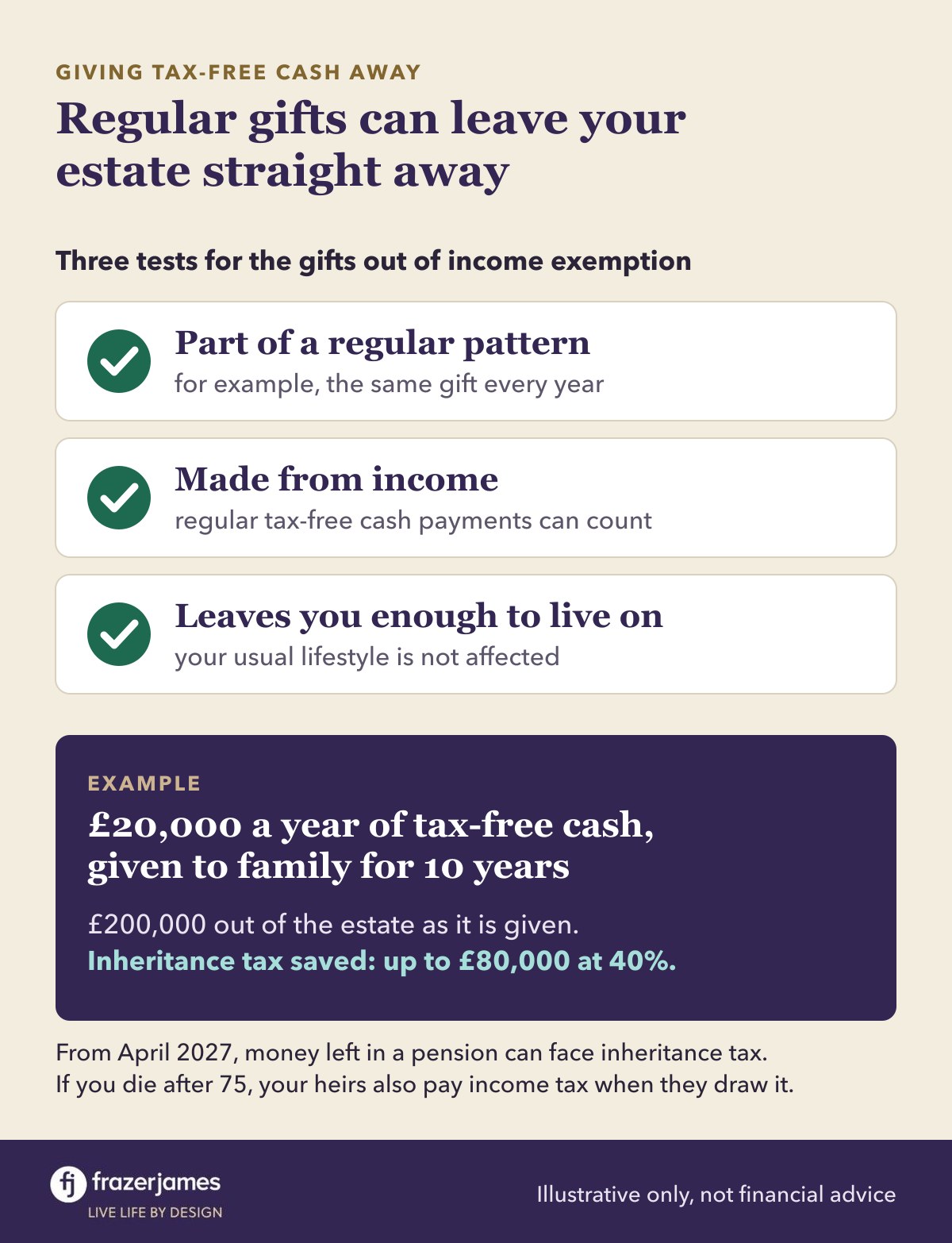
Here is an example. You take £20,000 of tax-free cash each year and give it to your children. Over ten years, that is £200,000 out of your estate as it is given. At the 40% inheritance tax rate, that could save your family up to £80,000.
This is particularly useful if you have an inheritance tax bill and already plan to give money away. It is even more useful after age 75. From April 2027, if you die after 75, your family could pay inheritance tax on your pension. They would then also pay income tax on what they draw from it. Giving the cash away during your lifetime can save both taxes.
A single large gift of tax-free cash does not usually count as regular. It would normally be a potentially exempt transfer, with the seven-year wait. Keep a simple record of each gift and your income, because your executors will need it to claim the exemption.
If your company pays into your pension
Owner-directors need to be aware of the pension recycling rules. These are HM Revenue and Customs rules for when tax-free cash is used, directly or indirectly, to pay extra into a pension. The rules exist to stop people taking tax-free cash and then putting it straight back into a pension to get tax relief again.
The recycling rules only apply when all four of these are true at the same time:
- More than £7,500 of tax-free cash is taken in a 12-month period.
- Because of that, much more is paid into a pension than would be usual.
- The extra payments add up to more than 30% of the tax-free cash taken.
- The arrangement was planned in advance.
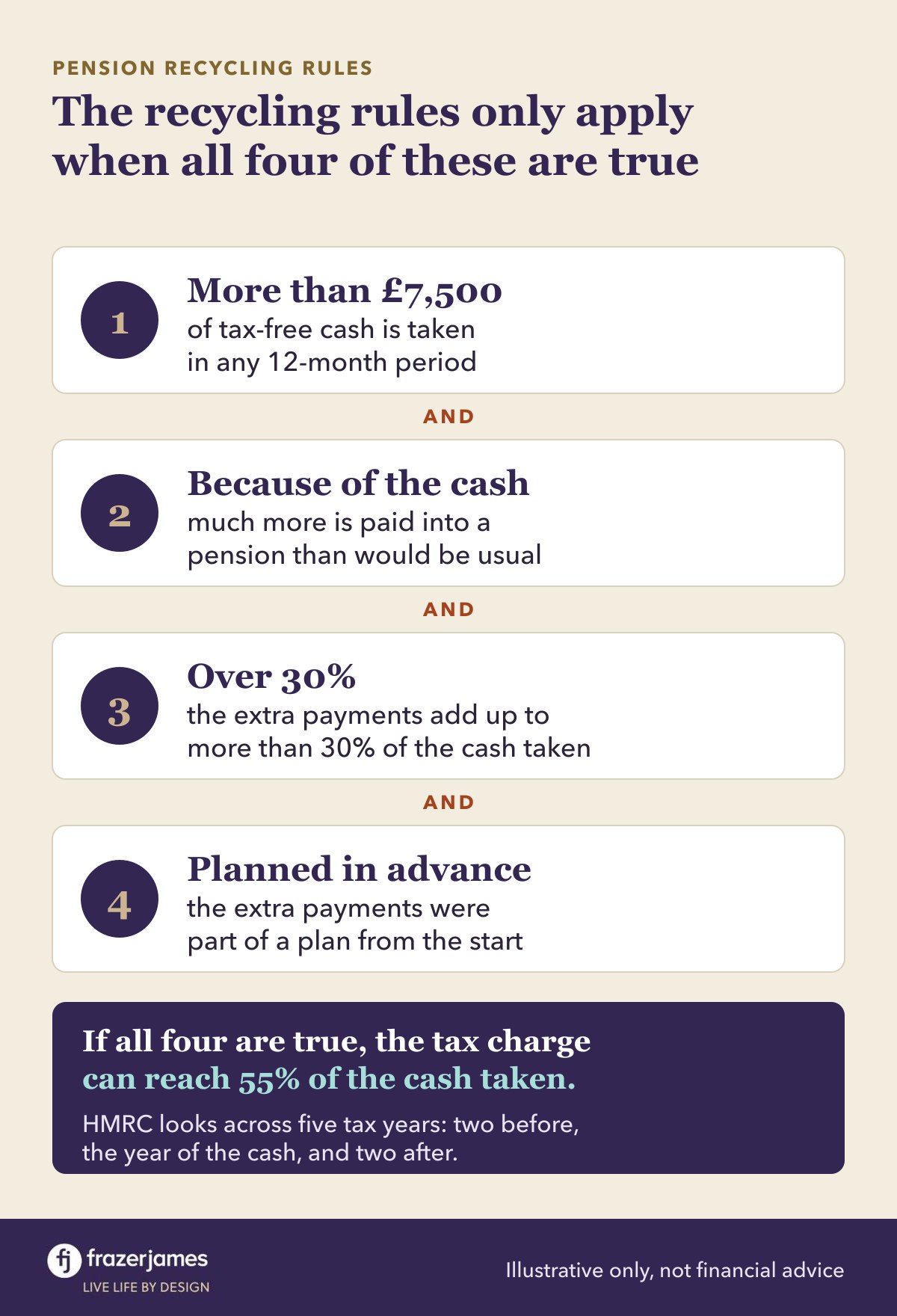
HM Revenue and Customs looks across five tax years: two before the year you take the cash, the year itself, and two after. Here is an example. Your company normally pays £30,000 a year into your pension. You take £225,000 of tax-free cash. Then your company pays £60,000 a year for three years.
That is £90,000 of extra payments. The threshold is 30% of £225,000, which is £67,500. You are over the line. The charge can reach 55% of the tax-free cash taken, which in this example would be £123,750.
Genuine business reasons for increasing payments are treated differently. And taking only tax-free cash does not reduce how much you or your company can pay in each year. That yearly limit is called the annual allowance. It only drops to £10,000 if you start taking taxable income from your pension. This is known as triggering the money purchase annual allowance. You can read more about how company pension contributions fit with your personal tax position on our site.
When taking it early can make sense
Taking your tax-free cash before the Budget can be the right call. The case is stronger when:
- Your pensions are over about £1.07 million. As Saver 2 shows, going early costs far less once you reach the limit.
- You plan to give money to your family. With pensions counting for inheritance tax from April 2027, giving the cash away can take it out of your estate.
- You already need the money. Paying off a mortgage that charges more than your pension is likely to earn is a real reason.
- You would take it within months anyway. The shorter the wait, the less going early costs.
- You are 55 or 56 and would otherwise be locked out. If the 2028 age rise would stop you taking any money until 57, and you need access, that matters.
- Your company payments will stay the same or stop. That keeps the recycling rules out of the picture.
The case is weakest when the only reason is the rumour. That is especially true if the pension is well under £1 million and the money would sit in a savings account.
None of these are automatic reasons to act. They are reasons to run the numbers with someone who can see your whole picture.
Five things to do before 28 October
You do not need to make a final decision before the Budget. But five things are worth doing now.
- Add up your pensions. Ask each provider for its current value and how much of your Lump Sum Allowance you have used. Include old workplace pensions.
- Check for older protection. If you applied for lifetime allowance protection before 2024, you may be able to take more than £268,275.
- Run your own numbers. Use the calculator above with the tax rate you pay now and the rate you expect in retirement.
- Check your company payments. If you are a director, list what was paid into your pension in the last two years and what is planned for the next two. That is the window the recycling rules look at.
- Do not leave it to the last week. Pension companies take time to pay out. A rushed choice in late October is the one most likely to be regretted.
Our guide to crystallised pensions explains what happens to your pension once you start drawing from it.
Talk to a certified financial planner
Have a decision to make before the Budget?
Talk it through with us before the day, not after it. We work through these choices with people who are within three years of retiring. The first conversation is free, with no pressure to proceed.
The figures in this article are examples only. They are not a forecast or personal advice. They use tax rates and allowances for England in 2026/27. Tax rules can change, and their effect depends on your own circumstances. The value of pensions and investments can fall as well as rise.
About The Author

About The Author

Related news








Get in touch
Schedule a free consultation with one of our financial advisers, or give us call.
0117 990 2602