 Client Login
  Retirement assessment
  Book a call
  0117 990 2602


Modified on: September 2026
Inheritance Tax Planning for Business Owners in the UK

Most people who need inheritance tax planning don’t think they do. By the time they realise, the most powerful options are already off the table. If you’ve spent years building a business, accumulating property, growing a pension and investing wisely, you’ve almost certainly crossed the threshold where HMRC will take a significant interest in your estate. The question isn’t whether inheritance tax applies to you. It’s how much of your wealth you’re prepared to hand over unnecessarily.
You’ve worked hard to build wealth, and you want to pass it on rather than hand 40% to HMRC. This guide shows you how IHT works and which planning tools are most effective for people in your position. It also covers the three mistakes that leave even financially savvy people worse off than they need to be.
Specifically, you’ll learn three things. How the current thresholds interact with business assets and retained profits. Why the proposed 2027 pension inheritance rule changes are the most consequential shift in UK estate planning in a generation. And how a coordinated long-term strategy protects far more than any single exemption could. If you’re a business owner or successful professional looking for long-term financial planning that includes your IHT position, this is where to start.
Why inheritance tax catches more people than you’d expect – and why now matters more than ever
The standard Inheritance Tax rate is 40%, charged on everything above the nil-rate band. According to HMRC, IHT receipts reached record levels in recent years. Frozen thresholds and rising asset values are driving this. The nil-rate band has been fixed at £325,000 since 2009. Property prices, business valuations and investment portfolios have not stood still in the same period.
For business owners specifically, the problem is compounded. Retained profits sitting inside a company, shares in a trading business, and the proceeds of a business sale all interact with IHT in ways that most people haven’t mapped out. A business worth £2 million today might attract full Business Property Relief and sit outside your estate entirely. Sell that business, bank the proceeds, and those same assets become fully exposed to 40% IHT overnight. That’s not a hypothetical. It’s a scenario we see regularly at Frazer James.
The urgency is real. The government’s proposed changes to pension inheritance rules are due to take effect in April 2027. They will bring unspent pension funds into the scope of IHT for the first time. For professionals who have deliberately left pension funds untouched as a tax-efficient inheritance vehicle, this changes the calculation entirely. The window to restructure is open now. It won’t stay open indefinitely.
When should I start inheritance tax planning?
Inheritance tax also rarely exists in isolation: our guide to reducing your overall tax bill shows how income tax, capital gains and estate planning interact. The honest answer is: earlier than you think, and almost certainly earlier than you have. The most effective IHT planning tools require time to work. This is particularly true of lifetime gifts under the seven-year rule and Business Property Relief. A gift made today only becomes fully exempt from IHT after seven years. Business Property Relief requires assets to have been held for at least two years. Trusts need to be established and funded well in advance of any anticipated estate event. Starting at 70 is better than not starting at all, but starting at 55 gives you options that simply aren’t available later.
How inheritance tax actually works in the UK: thresholds, rates, and what counts as your estate
Your estate for IHT purposes includes everything you own at death. This covers property, savings, investments, business interests, life insurance not written in trust, and personal possessions. The Nil-Rate Band (NRB) is £325,000 per person. Married couples and civil partners can combine allowances, giving a potential £650,000 before IHT applies. Everything above that is taxed at 40%.
There is an additional allowance called the Residence Nil-Rate Band (RNRB), worth up to £175,000 per person. It applies when a main residence is passed to direct descendants. Combined with the NRB, a married couple can potentially pass up to £1 million to children or grandchildren free of IHT. However, the RNRB tapers away for estates worth more than £2 million, reducing by £1 for every £2 above that threshold. For many business owners and senior professionals, this taper means the RNRB is partially or entirely unavailable.
What counts as your estate is broader than most people assume. Assets held in your sole name, jointly owned property (your share), business interests where relief doesn’t apply, and gifts made within seven years of death can all be included. MoneyHelper’s IHT guide provides a useful overview of what’s included. The complexity for business owners, however, goes well beyond the standard checklist.
What is the inheritance tax threshold in the UK in 2026?
The standard nil-rate band remains £325,000 in 2026, unchanged since 2009. The residence nil-rate band adds up to £175,000 where a main home passes to direct descendants. This gives a combined potential threshold of £500,000 per individual, or £1 million for a married couple. These thresholds are frozen until at least 2030 under current government plans. That means more estates will be pulled into scope each year as asset values rise. For business owners with significant company assets, retained profits or property portfolios, the effective threshold is often much lower once reliefs are properly assessed.
The seven-year rule, annual exemptions, and gifting: what you can do right now
Lifetime gifts are one of the most accessible IHT planning tools, and one of the most underused. Any gift you make to an individual is a Potentially Exempt Transfer (PET). If you survive seven years from the date of the gift, it falls outside your estate entirely. If you die within seven years, the gift is brought back into your estate. Taper relief does reduce the IHT charge on gifts made between three and seven years before death.
The annual exemption allows you to give away £3,000 per tax year completely free of IHT. You can carry forward one unused year, giving £6,000 in the first year if you haven’t used the previous year’s allowance. You can also make small gifts of up to £250 per person to any number of individuals. Gifts from surplus income are immediately exempt with no seven-year clock, provided you can demonstrate the gift comes from regular income rather than capital. For high earners with income exceeding their lifestyle costs, this last exemption is particularly powerful and consistently overlooked.
One business-owner couple we worked with had accumulated significant surplus cash in their business with no clear strategy for managing it. Inflation was eroding its value, and they had no plan for how it would interact with their estate. By mapping out a structured gifting programme alongside a broader financial strategy, we helped them begin moving assets out of their estate in a tax-efficient way. The key was treating gifting not as a one-off decision but as part of an ongoing plan.
How much can I gift tax-free each year in the UK?
The annual exemption is £3,000 per tax year. You can carry forward one year’s unused allowance, giving a maximum of £6,000 in a single year. Additional exemptions include £250 per person to any number of recipients. Wedding gifts are also exempt: up to £5,000 to a child, £2,500 to a grandchild and £1,000 to anyone else. Gifts from surplus income are immediately exempt if they meet HMRC’s conditions. Potentially Exempt Transfers above these amounts are not immediately taxable. They must survive the seven-year period to fall fully outside your estate.
Trusts and inheritance tax: when they help, when they don’t, and what to watch out for
Trusts are a legitimate and well-established part of estate planning, but they are not a universal solution. The right trust structure depends on your assets, your family situation, your age and your objectives. Used well, trusts can remove assets from your estate and protect them for future generations. They also give you a degree of control over how and when beneficiaries receive them. Used poorly, they create complexity, cost and potential tax charges that outweigh the benefits.
A discretionary trust allows trustees to decide how income and capital are distributed among a class of beneficiaries. Assets placed into a discretionary trust are a chargeable lifetime transfer. This means IHT may apply at the time of transfer if the value exceeds the nil-rate band. There are also ten-year anniversary charges and exit charges to consider. These are manageable with proper planning, but they require ongoing attention.
A Family Investment Company (FIC) is an increasingly popular alternative to a traditional trust. It suits business owners and high-net-worth families particularly well. An FIC is a private limited company through which family wealth is held and managed. It can offer income tax efficiency, control over distributions and a mechanism for passing wealth to the next generation at a lower IHT cost over time. Whether a family investment company or trust is right for your estate depends on your specific circumstances, the nature of your assets and your long-term objectives. It’s not a decision to make without specialist advice.
Are trusts a good way to avoid inheritance tax?
Trusts can be an effective part of an IHT strategy, but “avoid” is the wrong framing. Trusts don’t eliminate IHT. They restructure when and how it applies, and in some cases remove assets from your estate entirely over time. The effectiveness of a trust depends on the type of trust, the assets placed into it, the timing of the transfer and how it’s managed. For business owners with significant assets, a trust or FIC can be a powerful tool within a broader coordinated strategy. For most people, trusts work best alongside gifting, Business Property Relief and pension planning — not as a standalone solution.
Business Property Relief: the most powerful IHT tool most business owners aren’t using properly
Business Property Relief (BPR) is, for many business owners, the single most valuable IHT relief available. Under BPR, qualifying business assets can attract 100% relief from IHT. This means they pass to beneficiaries entirely free of tax.
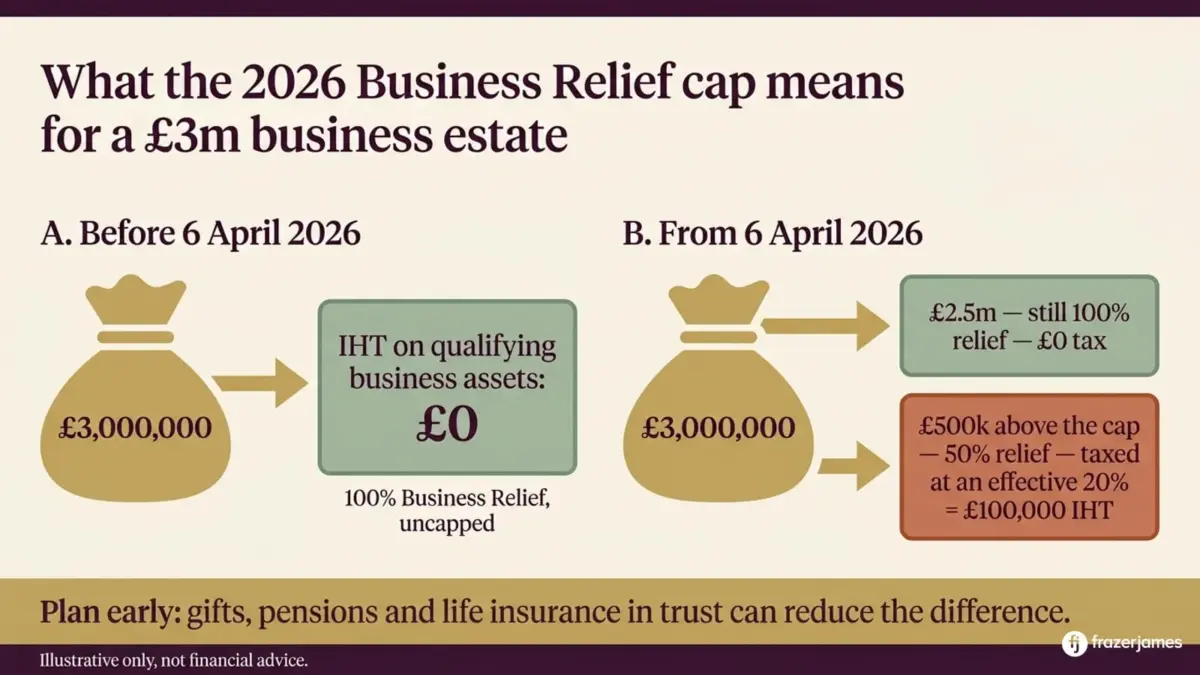
From 6 April 2026 the relief is capped. The first £2.5 million of combined business and agricultural property still receives 100% relief. Above that, relief drops to 50% — an effective IHT rate of 20% rather than the full 40%. The cap works as a lifetime allowance and refreshes every seven years for lifetime gifts. BDO’s guide to Business Relief explains the mechanics well.
Qualifying assets include shares in an unquoted trading company, interests in a business partnership and certain assets used in a business. The relief requires the asset to have been owned for at least two years.
The critical word is “qualifying”. BPR does not apply to investment businesses, property rental companies, or businesses that hold excessive cash or investment assets relative to their trading activity. HMRC applies a “wholly or mainly” test. If a business is wholly or mainly trading, it qualifies. If it has drifted into investment activity — through accumulated cash, property holdings or other non-trading assets — relief may be restricted or denied entirely.
This is where retained profits create a specific and underappreciated risk. A profitable trading business that has accumulated significant cash reserves may find that HMRC challenges the extent of BPR available. The argument is that the cash represents an investment asset rather than a trading one. The business may still qualify for partial relief. But the proportion of the estate exposed to 40% IHT could be substantially higher than the owner assumed. For financial planning for business owners, mapping this exposure is one of the first things we do.
One client, who came to us having managed his own pension funds with a focus on high-risk technology investments, described a similar moment of clarity when we reframed the conversation. He had been fixated on reaching a particular pension number without knowing whether that number was enough or what it would mean for his estate. The same pattern applies to business owners and BPR. They assume the relief applies in full, without ever having had someone map out exactly where the boundaries are. As one client put it after working with us: “We now have a clear plan covering pensions, investments, and tax considerations. The peace of mind that comes from knowing everything is professionally managed is genuinely invaluable.”
What is Business Property Relief and who qualifies?
Business Property Relief is an HMRC relief that reduces or eliminates IHT on qualifying business assets. 100% relief applies to shares in unquoted trading companies, sole trader businesses and partnership interests. 50% relief applies to certain assets used in a business but owned personally, such as land or machinery. To qualify, the asset must have been owned for at least two years. The business must also be a trading business rather than an investment business. Since 6 April 2026, the first £2.5 million of combined business and agricultural property receives 100% relief, with 50% relief above that — an effective rate of 20%. HMRC’s guidance on Business Property Relief sets out the qualifying conditions in detail. The practical application — particularly around retained cash and mixed-use businesses — requires professional assessment.
Pensions and inheritance tax: why the 2027 rule changes could reshape your estate plan
Until recently, unspent pension funds sat outside your estate for IHT purposes entirely. This made pensions one of the most powerful and underused IHT planning tools available. By drawing on other assets first and leaving pension funds to grow untouched, you could pass significant wealth to the next generation free of IHT. Many professionals and business owners have structured their retirement income strategy around exactly this principle.
The government’s proposed changes are due to take effect in April 2027. They will bring most unspent pension funds into the scope of IHT for the first time. Under the current proposals, pension funds will be included in the value of your estate. They will be subject to the standard 40% IHT charge above the nil-rate band. For anyone who has deliberately left pension funds untouched as an inheritance vehicle, this is a fundamental change to the planning landscape.
The implications are significant. If your estate currently sits below the IHT threshold partly because your pension is excluded, it may cross the threshold after 2027. If you’ve been drawing on ISAs and investments while leaving your pension intact, the sequencing of withdrawals may need to change. And if your pension is large relative to your other assets, the tax charge on death could be substantial. Our pensions advice and IHT strategy work addresses exactly this interaction. The right answer depends on your specific pension size, other assets, age and family circumstances.
One client — we’ll call her Lorna — came to us ahead of her retirement, unhappy with her previous IFA. She described the impact of reviewing her pension strategy with fresh eyes: “Their assessment, recommendations and advice has given me peace of mind about my financial future and the changes we’ve made to my pension pot investments have given excellent results.” The 2027 changes make that kind of fresh-eyes review more urgent than ever.
Does a pension count towards inheritance tax?
Currently, most defined contribution pension funds sit outside your estate for IHT purposes. They are not subject to the 40% charge on death. This is one of the reasons pensions have been used as an effective IHT planning tool. However, the government has proposed changes that would bring unspent pension funds into the scope of IHT from April 2027. If these changes proceed as planned, the pension exemption that many estate plans rely on will no longer apply. The sequencing of how you draw on different assets in retirement will need to be reconsidered. Taking professional advice before 2027 is strongly recommended for anyone with a significant pension fund.
How to build a coordinated IHT strategy – not just a list of exemptions
The most common mistake in IHT planning is treating each tool in isolation. Gifting is considered separately from trusts. Business Property Relief is assumed to apply without being tested. Pensions are left untouched without considering the 2027 changes. Wills are written once and never reviewed. The result is a collection of individual decisions that don’t add up to a coherent strategy — and gaps that HMRC will find.
A coordinated IHT strategy starts with a complete picture of your estate. This means every asset, every liability, every existing relief and every potential exposure. For business owners, this means mapping the interaction between company assets, retained profits, personal investments, property and pension funds. It means stress-testing the BPR position against HMRC’s qualifying criteria. It also means modelling the impact of a business sale on your IHT exposure. The moment you sell, the BPR disappears and the proceeds become fully exposed.
One couple we advised — call them Neil and Ruth — are a good example of what a joined-up approach looks like in practice. They worked with us to explore early retirement. They came to us with a clear aspiration — to retire early and sail the Mediterranean — but no clear picture of whether their assets could support it or how their estate would be structured. By mapping their full financial position, including pension funds, investments and the timing of any business interests, we built a plan that gave them the confidence to leave work behind sooner than they thought possible. The IHT strategy was part of that plan, not a separate exercise bolted on afterwards.
Wills are the foundation of any estate plan, but they are not the plan itself. A will determines who receives your assets. It doesn’t determine how much IHT is paid before they receive them. Keeping your will updated is essential — particularly after a business sale, a change in family circumstances or a significant shift in asset values. Probate, the legal process of administering an estate, is also affected by how assets are structured. Assets held in trust or jointly owned may pass outside the probate process entirely, which can be both faster and more private.
At Frazer James, we work with clients to build IHT strategies that evolve alongside their lives. One client described the approach well: “The team recently updated my annual plan to account for a new property and provided a growth analysis that gave me total confidence in my long-term position. They are professional, proactive, and always looking for ways to add value through intelligent tax planning and smart investing.”
How can I reduce inheritance tax in the UK?
The most effective ways to reduce IHT in the UK are:
- Annual gifting exemptions and Potentially Exempt Transfers under the seven-year rule
- Business Property Relief on qualifying business assets
- Structuring pension withdrawals around the proposed 2027 rule changes
- Trusts or a Family Investment Company to remove assets from your estate over time
- Life insurance written in trust, so the payout falls outside your estate
- A will that is up to date and reflects your current asset position
No single tool is sufficient on its own. The most effective IHT planning combines several of these approaches within a coordinated long-term strategy.
When to get professional inheritance tax advice (and what good advice actually looks like)
The right time to get professional IHT advice is before you need it urgently. For business owners, that means before a sale, not after. For professionals approaching retirement, it means before you start drawing down assets in a sequence that may not be tax-efficient. For anyone whose estate has grown significantly in recent years, it means now. Frozen thresholds mean more estates are in scope than ever before.
Good IHT advice is not a one-page summary of exemptions you could find on HMRC’s website. It’s a detailed analysis of your specific estate and a clear explanation of where your exposure lies. It also provides a set of recommendations that fit your life — your family, your risk tolerance, your income needs and your long-term objectives. It should be delivered by a Chartered Financial Planner with experience in estate planning, not a generalist who treats IHT as an afterthought.
One client moved his retirement portfolio to Frazer James after 45 years in the corporate world. He described what good advice actually feels like: “I have the sense that we are more like part of their wider team than just a client. Frazer James is bucking the trend providing a personal and personalised service. They have reset the bar for financial service.” That’s the standard we hold ourselves to at frazerjames.co.uk — not a checklist of exemptions, but a genuine understanding of your position and a plan that reflects it.
If you’re a business owner with retained profits, a pending sale or significant company assets, the IHT implications of your current structure deserve specific attention. The same applies if you’re a professional with a large pension fund, a property portfolio or a complex mix of assets. The earlier you map your position, the more options you have. If you’re ready to understand exactly where you stand, book a consultation with our team and we’ll start with a clear picture of your estate and what it means for the people you want to leave it to.
Frequently Asked Questions
This section covers the seven-year rule, trusts, Business Property Relief and how pensions are treated for inheritance tax.
How does the seven-year rule work for inheritance tax?
The seven-year rule applies to Potentially Exempt Transfers — gifts made to individuals during your lifetime. If you survive for seven years after making the gift, it falls completely outside your estate and no IHT is due on it. If you die within seven years, the gift is added back to your estate for IHT purposes. However, taper relief reduces the effective IHT rate on gifts made between three and seven years before death. The charge reduces from 40% on a sliding scale, reaching 8% for gifts made between six and seven years before death. The seven-year clock starts from the date of the gift, which is why starting early matters so much.
How can I reduce inheritance tax in the UK?
Reducing IHT requires a combination of tools used in a coordinated way. The most impactful options for business owners and professionals include:
- Business Property Relief on qualifying trading business assets
- Structured lifetime gifts using annual exemptions and the seven-year rule
- A pension strategy reviewed in light of the proposed 2027 rule changes
- Trusts or a Family Investment Company to move assets out of your estate over time
- Life insurance written in trust
- A will kept up to date with your current asset position
The key is treating these as an integrated strategy rather than isolated decisions, reviewed regularly as your circumstances change.
Are trusts a good way to avoid inheritance tax?
Trusts are a legitimate and effective part of an IHT strategy. They work best as one element within a broader plan rather than a standalone solution. Placing assets into a discretionary trust removes them from your estate over time. However, the transfer itself may be a chargeable lifetime transfer if it exceeds the nil-rate band, and ongoing charges apply at ten-year anniversaries and on exit. The right trust structure depends on your assets, family circumstances and objectives. For business owners and high-net-worth families, a Family Investment Company can offer similar benefits with different tax and control characteristics. Professional advice is essential before establishing any trust structure.
What is Business Property Relief and who qualifies?
Business Property Relief provides 100% IHT relief on qualifying business assets. This includes shares in unquoted trading companies, sole trader businesses and partnership interests. 50% relief applies to certain personally owned assets used in a qualifying business, such as land or machinery. It also applies to combined business and agricultural property above the £2.5 million lifetime cap introduced in April 2026. To qualify, the asset must have been held for at least two years and the business must be a trading business rather than an investment business. Businesses with significant retained cash, property holdings or other investment assets may find their BPR entitlement restricted. The relief disappears entirely on a business sale, making pre-sale IHT planning particularly important for business owners approaching an exit.
Does a pension count towards inheritance tax?
Under current rules, most defined contribution pension funds sit outside your estate for IHT purposes. They are not subject to the 40% charge on death. This has made pensions a valuable IHT planning tool for many professionals and business owners. However, the government has proposed changes effective from April 2027 that would bring unspent pension funds into the scope of IHT. If these changes proceed, the pension exemption that many estate plans rely on will no longer apply. The sequencing of retirement withdrawals will need to be reconsidered. Anyone with a significant pension fund should review their estate plan before 2027 to understand the potential impact and explore their options.
About The Author

About The Author

Related news











Get in touch
Schedule a free consultation with one of our financial advisers, or give us call.
0117 990 2602