 Client Login
  Retirement assessment
  Book a call
  0117 990 2602


Modified on: September 2026
Financial Planning for Business Owners: Why Your Business Isn’t a Financial Plan

Most business owners are building significant wealth – they just can’t access any of it. The business is growing, the revenue is real, and on paper everything looks impressive. But ask yourself honestly: if the business stopped tomorrow, what would you actually have?
If you’ve spent years reinvesting everything back into your business, you may quietly wonder whether you’re on track for the life you want. You’re not alone. This is one of the most common patterns we see at Frazer James. Successful, profitable business owners often conflate the value of their business with their personal financial security. They haven’t yet built the two separately.
This guide will show you exactly how to separate your personal wealth from your business. It covers the tax-efficient strategies available to you right now. It also shows what a financial plan built around your stage of business looks like in practice. Specifically, you’ll learn why treating your business as a pension is dangerous. You’ll see how to extract money from your business in the most tax-efficient way. And you’ll understand what protection and exit planning you need to turn your hard work into lasting personal wealth.
Why running a successful business doesn’t mean you have a financial plan
There’s a version of financial success that looks convincing from the outside. Turnover is up. The team is growing. You’re reinvesting profits and the business is worth more than it was three years ago. But none of that is a financial plan – it’s a business plan.
A financial plan answers a different set of questions. What income do you need to live the life you want? When do you want to stop working, and what does that actually cost? What happens to your family if you can’t work? These questions don’t get answered by growing the business. They require deliberate, separate planning.
The distinction matters because business value is illiquid, uncertain, and entirely dependent on a successful exit. Until you sell, your wealth exists only on paper. We’ve worked with business owners who had built companies worth several million pounds. They were drawing a modest salary, had minimal pension savings, and had no protection in place. The business was thriving. Their personal finances were fragile.
One client, the managing director of a commercial cleaning business, described the shift that came from working with us: “Since working together, I feel more organised, more secure and more positive about the future. Your advice has been exceptionally valuable financially, professionally and personally.” That shift – from business-focused to genuinely financially organised – is what long-term financial planning tailored to your goals actually delivers.
The danger of treating your business as your pension
Should I use my business as my pension?
This is one of the most common questions we hear. The honest answer is: not as your only strategy. The logic is understandable. You’re putting everything into the business, the business is growing in value, and one day you’ll sell it and live off the proceeds. It feels like a plan. It isn’t.
The problem is concentration risk. Your income, your wealth, and your retirement are all tied to a single asset. That asset could be affected by a market change, a key client leaving, a health crisis, or a buyer who doesn’t materialise at the price you expected. The MoneyHelper guidance on self-employed pensions makes this point clearly. Relying solely on a business sale to fund retirement leaves you exposed in ways that a diversified pension strategy does not.
To make this concrete: imagine you’ve built a business you expect to sell for £2 million. Based on that figure, you’ve done no meaningful pension saving and hold little in personal investments. The sale completes — but at £800,000, not £2 million. A key contract ended six months before completion and the buyer repriced accordingly. After tax and professional fees, you’re left with around £650,000. Invested to generate a sustainable income, that might produce £26,000 a year. If the sale falls through entirely, you have nothing liquid to fall back on at all. That gap — between the retirement you planned and the one you can actually fund — is the real cost of treating your business as your pension.
We worked with a client who had been managing his own pension funds with a focus on high-risk technology investments. He was broadly successful, but increasingly stressed about tax implications and the volatility of his portfolio. When he came to us, he was fixated on reaching a particular pension number. He didn’t really know whether that number was enough, or what it would mean for his retirement. As he later described it: “James changed the conversation entirely. Rather than focusing solely on investment performance, James asked my wife and me what we actually wanted our retirement to look like.” That reframe — from a number to a life — is where real financial planning begins.
The practical risk of the business-as-pension approach is also timing. Business sales take longer than expected, fall through, or complete at lower valuations than anticipated. If your entire retirement depends on a single transaction, you have no margin for any of those outcomes.
Financial planning by business stage: what to focus on and when
Financial planning for business owners isn’t one-size-fits-all. What matters at year two of building a business is very different from what matters at year fifteen. Getting the sequencing right is as important as the strategies themselves.
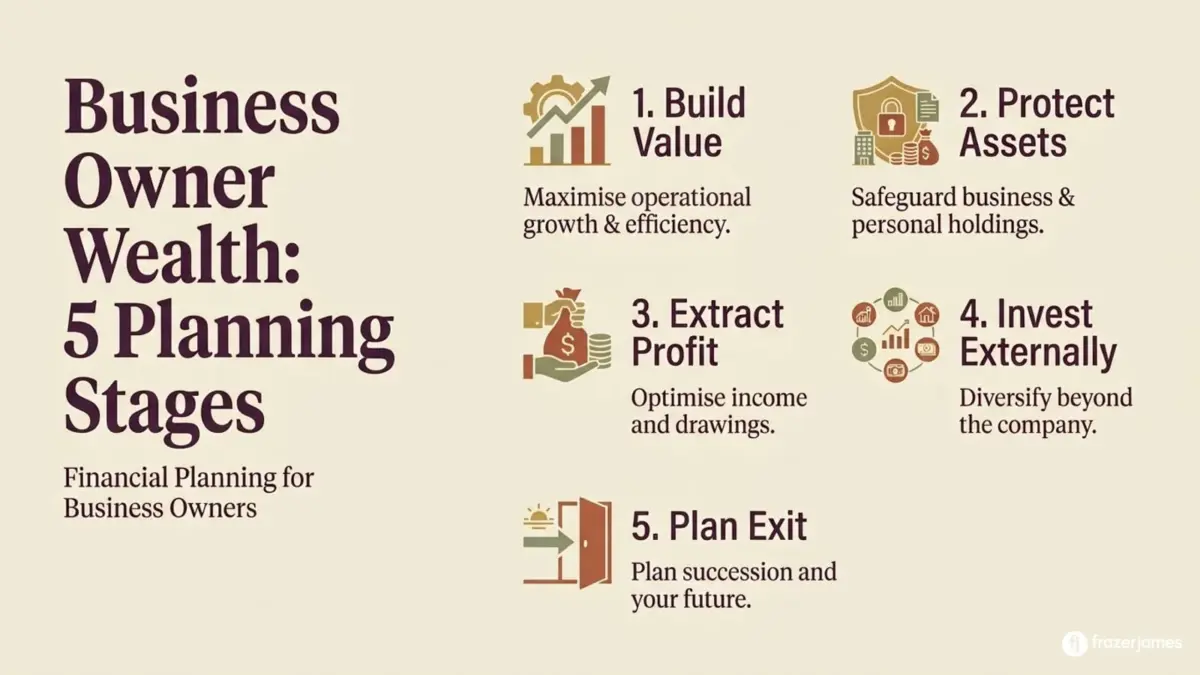
Early stage: The priority is protection and foundations. Life cover, income protection, and a basic pension contribution structure should be in place before you consider sophisticated investment strategies. Cash flow management is critical. Personal and business finances need to be clearly separated from day one, both legally and psychologically.
Scaling: As the business generates surplus cash, the question becomes how to deploy it efficiently. This is where salary versus dividend optimisation, employer pension contributions, and ISA allowances become genuinely valuable. The goal is to build personal wealth in parallel with business growth, not instead of it.
Pre-exit: This is where the planning becomes most complex and most consequential. Business Asset Disposal Relief, inheritance tax structures such as family investment companies and trusts, investment of sale proceeds and retirement income planning all need structuring well before any transaction. Leaving this until the sale is agreed is too late.
One couple we have advised since the early days of their business are a good example of getting this right. They worked with us from the start, receiving professional financial advice that helped them make smart decisions at each stage. The result: they built long-term wealth and financial security for their family while successfully growing their business – not after it, but alongside it.
How to extract money from your business tax-efficiently
How can a business owner reduce their tax bill legally?
This is where the practical planning gets specific. There are several legitimate, HMRC-approved strategies that business owners can use to extract value from their business while minimising the tax they pay. Used together, they can make a significant difference to how much of your business income you actually keep.
Salary versus dividends: Most owner-directors take a combination of a low salary and dividends from company profits. The salary is typically set at the National Insurance threshold. Dividends are taxed at lower rates than salary — 10.75% for basic rate taxpayers, 35.75% for higher rate — and don’t attract National Insurance contributions. The optimal split depends on your personal tax position and the company’s profit level, and it changes as tax thresholds shift.
Employer pension contributions: One of the most tax-efficient strategies available to business owners is making pension contributions directly from the company. These are treated as a business expense, reducing corporation tax. They don’t count as personal income, so they avoid income tax and National Insurance entirely. The HMRC guidance on pension schemes for employers sets out the rules. The key point is that employer contributions can be significantly larger than personal contributions in many cases, making this a powerful wealth-building tool.
Business Asset Disposal Relief (BADR): When you sell a qualifying business, BADR reduces the Capital Gains Tax rate you pay on the disposal. The rate that applies depends on when you sell. Disposals made between 6 April 2025 and 5 April 2026 are taxed at 14%, while disposals from 6 April 2026 onwards are taxed at 18%. Both rates remain meaningfully lower than the standard CGT rates that would otherwise apply. Tax rates and rules can change, so it’s worth reviewing your position well in advance of any planned sale. The official BADR guidance from HMRC outlines the qualifying conditions in detail, including the shareholding and trading status requirements your business needs to meet.
One client described the impact of this kind of proactive approach: “The team recently updated my annual plan to account for a new property and provided a growth analysis that gave me total confidence in my long-term position. They are professional, proactive, and always looking for ways to add value through intelligent tax planning and smart investing.”
If you want to explore what these strategies could mean for your specific situation, our financial planning for business owners at every stage service is designed exactly for this.
Building personal wealth alongside your business: pensions, investments, and ISAs
The goal of separating personal wealth from business value isn’t just about risk management. It’s about building a financial position that gives you genuine options – the ability to retire when you choose, not when the business forces you to.
Pensions remain the most tax-efficient vehicle for most business owners. Employer contributions from the company attract corporation tax relief. The funds grow free of income tax and capital gains tax within the pension wrapper. For higher-rate taxpayers, the effective cost of contributing £10,000 to a pension can be as low as £5,500 after tax relief. That’s a return no investment can reliably match before you’ve even invested the money. Our guide to saving tax with pensions covers the allowances, reliefs and contribution routes in detail.
ISAs provide a complementary layer. The annual allowance of £20,000 per person (£40,000 for a couple) builds a pot of genuinely tax-free savings that can be accessed at any time without triggering a tax event. Unlike pensions, ISAs have no minimum access age. This makes them particularly useful for business owners who want the option of early retirement.
Beyond pensions and ISAs, evidence-based investment management for business owners can help deploy surplus business profits into a diversified portfolio. This is aligned with your time horizon and risk tolerance. The key is that these investments sit outside the business – they’re yours, regardless of what happens to the company.
One client couple are a powerful illustration of what this kind of parallel wealth-building makes possible. They worked with Frazer James to understand their options and build a clear plan. The result: they achieved early retirement and began living their dream of sailing around the Mediterranean. This wasn’t because the business sold for a windfall. It was because they had built sufficient personal wealth alongside it to make that choice on their own terms.
Protecting what you’ve built: the financial risks most business owners overlook
What financial protection does a business owner need?
Business owners are typically well-insured for their business risks – public liability, professional indemnity, property. But personal financial protection is frequently neglected, and the consequences of getting this wrong are severe.
The three areas that matter most are life cover, income protection, and key person insurance. Life cover ensures that if you die, your family isn’t left with a business they can’t run and debts they can’t service. Income protection replaces a proportion of your income if you’re unable to work due to illness or injury. This is critical for business owners who don’t have an employer sick pay scheme to fall back on. Key person insurance protects the business itself against the financial impact of losing a critical individual, whether that’s you or a key employee.
Risk management in this context isn’t just about insurance. It’s about ensuring that your personal financial plan doesn’t collapse if the business hits a difficult period. That means having personal savings and investments that are genuinely separate from the business. It also means not drawing down on them to fund business cash flow.
One couple’s situation illustrates this well. Their business success had left them with a significant surplus of cash but no clear strategy for managing it, with real concerns about inflation and risk. Frazer James acted as their personal financial director, providing a strategy for achieving financial security and stability beyond their business. The business was doing well – but their personal financial position needed its own structure.
Planning your exit: how to turn a business sale into lasting personal wealth
How do I plan financially for selling my business?
Exit planning is where everything comes together. It’s also where the most value can be created or destroyed depending on how well-prepared you are. The business owners who get the best outcomes from a sale are almost always the ones who started planning three to five years before the transaction.
The financial planning work before a sale covers three areas. First, qualifying for Business Asset Disposal Relief and structuring the deal well – we cover this in depth in our guide to reducing capital gains tax on a business sale. Second, extracting value before the sale through pensions and dividends rather than taking everything at completion. Third, planning what happens to the proceeds: how they are invested, what income they generate and how they are structured for tax. For the step-by-step version, see our financial checklist for preparing to sell.
The emotional dimension of exit planning is also real. Many business owners have spent decades building something that defines them professionally and personally. The transition from business owner to retiree requires as much psychological preparation as financial preparation. Clients who have a clear picture of what they’re retiring to — not just what they’re retiring from — make better financial decisions throughout the process.
One client worked with Frazer James to map out a clear path to financial independence and build confidence in his retirement strategy. Expert advice gave him and his wife the clarity and structure to make informed decisions through changing times. They stepped into retirement on their own terms. That outcome – retiring on your own terms – is what good exit planning actually delivers.
For a deeper look at planning your retirement as a business owner, including the specific considerations around pension consolidation and income planning post-sale, our retirement planning service covers this in detail.
When does it make sense to work with a financial adviser as a business owner?
When should a business owner hire a financial adviser?
The honest answer is: earlier than most business owners do. The most common pattern we see is business owners who come to us in their late forties or early fifties. They’ve spent the previous decade reinvesting everything into the business and doing very little personal financial planning. There’s nothing wrong with that – it’s a rational response to the demands of building a business. But it does mean there’s less time to build personal wealth and more complexity to unravel.
The right time to engage a Chartered Financial Planner is when the business starts generating consistent surplus. That’s when you have more coming in than you need to reinvest, and you’re not sure what to do with it. That’s the moment when decisions about salary, dividends, pensions, and investments start to compound significantly over time.
It also makes sense to engage a financial adviser before any major business event. This includes a significant growth phase, a potential acquisition, or the early stages of thinking about exit. These are moments when the financial decisions are large and the consequences of getting them wrong are lasting.
One client, a government director, described the value of working with us this way: “I feel reassured and better able to make decisions about our finances. Frazer James was responsive and active, but also worked around our timetable. A really positive experience.” That combination of proactive advice and genuine responsiveness is what we aim to deliver for every client.
The FCA’s guidance on financial advice is also worth reading if you’re considering whether regulated advice is right for your situation. It sets out clearly what regulated advisers are required to do and how to find one.
If you’re ready to build a financial plan that works for you personally, not just for the business, book a free consultation with a Chartered Financial Planner at Frazer James. We’ll start by understanding where you are, where you want to get to, and what needs to happen in between.
Frequently Asked Questions
This section covers what financial planning for business owners involves, how it differs from planning for the business itself, and how to plan for retirement or a future sale.
What is financial planning for business owners?
Financial planning for business owners is the process of building a personal financial strategy that runs alongside — and independently of — the business. It covers how you extract income from the business tax-efficiently. It covers how you build personal wealth through pensions, ISAs, and investments. It covers how you protect yourself and your family against financial risk. And it covers how you plan for the eventual transition out of the business. The key distinction from business planning is that it focuses on your personal financial security, not the performance of the company.
What is the difference between business financial planning and personal financial planning?
Business financial planning focuses on the financial health and growth of the company. This includes cash flow, investment in the business, tax efficiency at the corporate level, and business continuity. Personal financial planning focuses on you as an individual: your income, your retirement, your protection, and your personal wealth. For business owners, the two are closely connected. Decisions made at the business level directly affect personal finances. But they need to be managed as separate disciplines. Conflating the two is one of the most common and costly mistakes business owners make.
How should a business owner plan for retirement?
Retirement planning for business owners should start well before you intend to stop working, ideally at least ten years out. The core elements are: building a pension pot through employer contributions from the business, accumulating personal savings and investments outside the business, understanding what your business is worth and what a realistic sale might generate, and planning how you’ll generate income once you stop working. Relying solely on a business sale to fund retirement is high-risk. A diversified approach that combines pension savings, personal investments, and business exit proceeds gives you far more resilience and flexibility.
How do I plan financially for selling my business?
Planning for a business sale should begin three to five years before you intend to sell. The key steps are: ensuring your business structure qualifies for Business Asset Disposal Relief to reduce Capital Gains Tax on the proceeds, reviewing how much value you can extract from the business before the sale through pension contributions and dividends, and planning how the sale proceeds will be invested and structured to generate sustainable income. You should also consider what happens if the sale is delayed or falls through. Having personal wealth built outside the business means you’re not entirely dependent on the transaction completing on your preferred timeline.
About The Author

About The Author

Related news










Get in touch
Schedule a free consultation with one of our financial advisers, or give us call.
0117 990 2602