 Client Login
  Retirement assessment
  Book a call
  0117 990 2602


Modified on: September 2026
Family Investment Company or Trust? What Business Owners Need to Know Before Deciding

Family Investment Company vs Trust: Which Protects More Wealth Over Time?
You’ve spent years building a successful business, and now you’re sitting on significant wealth – but the question of how to pass it on to your family without handing a large chunk to HMRC is keeping you up at night. You’re not alone. This is one of the most common conversations we have with business owners planning their next chapter.
Most guides on this topic give you a legal definition of each structure and leave you to figure out the rest. That’s not good enough when you’re making a decision that could affect your family’s wealth for decades. This article gives you something different: a practical, numbers-grounded comparison of a Family Investment Company (FIC) and a discretionary trust, covering how each structure handles Inheritance Tax, Capital Gains Tax, and Income Tax over a 10 to 20 year horizon.
By the end, you’ll understand three specific things: how the tax treatment of each structure plays out in real terms over time, what control you retain as the founder under each arrangement, and how to use a simple decision framework to identify which structure fits your family’s goals. If you’re ready to explore your options with a Chartered Financial Planner, you can book a free consultation here.
Why business owners face a different wealth transfer decision than most families
Most articles about FICs and trusts are written for a generic “high-net-worth individual.” But business owners face a specific set of circumstances that change the calculation entirely. You’ve likely accumulated wealth inside a trading company, you understand corporate structures intuitively, and you may be approaching a sale or exit that will crystallise a significant lump sum.
That exit changes everything. Business Property Relief (BPR) can shelter trading company shares from Inheritance Tax while you own them. The moment you sell and receive cash or listed shares, that protection disappears. You now have a liquid estate that is fully exposed to IHT at 40% above the nil-rate band. The question shifts from “how do I protect my business?” to “how do I protect the proceeds?”
Take Barry and Sarah, a couple we worked with whose business success left them with a significant cash surplus but no clear strategy for managing it. They came to us concerned about inflation eroding their wealth and unsure how much risk to take. Acting as their personal financial director, we helped them build a structure that addressed both the investment and the intergenerational planning dimensions together. The choice between a FIC and a trust was central to that conversation.
This is the lens through which the rest of this article is written: not a generic comparison, but a decision guide for someone who already thinks in terms of company structures and needs to protect wealth that is either inside a business or has recently come out of one.
What is a Family Investment Company – and how does it actually work?
A Family Investment Company is a private limited company set up specifically to hold and grow family wealth. It is incorporated under the Companies Act 2006 and operates like any other limited company, with directors, shareholders, and annual filing obligations at Companies House.
The power of a FIC lies in its share structure. The founding generation typically holds a class of shares that carries voting rights and control, while children or grandchildren hold a separate class that carries economic rights – entitlement to dividends and capital growth – without the ability to override the founders’ decisions. This separation of control from beneficial ownership is what makes a FIC so attractive to business owners who want to transfer wealth without losing the ability to direct how it is invested.
Assets are transferred into the FIC, which then invests them. Investment returns are subject to Corporation Tax (currently 25% for profits above £250,000, or 19% for smaller companies), which is lower than the higher or additional rate of Income Tax that would apply if the same returns were received personally. Dividends paid to family members who are basic-rate taxpayers can be extracted at a lower effective rate, creating a further efficiency.
Directorship sits with the founders. They decide when dividends are paid, how the portfolio is invested, and whether capital is distributed. For a business owner who has spent decades in control of a company, this structure feels natural – because it essentially is one.
What is a trust – and when does it still make sense?
What is the difference between a Family Investment Company and a trust?
A trust is a legal arrangement in which a settlor transfers assets to trustees, who hold them for the benefit of named or described beneficiaries. Legal ownership sits with the trustees; beneficial ownership sits with the beneficiaries. The trust deed sets out the rules – how income is distributed, when capital can be accessed, and who qualifies as a beneficiary.
A discretionary trust gives trustees the widest possible powers. They can decide which beneficiaries receive income or capital, in what amounts, and when. This flexibility is genuinely valuable in certain family situations: where beneficiaries are young, where family dynamics are complex, or where you want to include future generations not yet born. A trust can run for up to 125 years under current UK law, meaning it can benefit grandchildren and great-grandchildren who don’t yet exist.
The regulatory landscape for trusts shifted significantly after 2006. Before that, trusts were a more tax-efficient vehicle. The Finance Act 2006 introduced the “relevant property” regime for most discretionary trusts, which means assets in trust are subject to a periodic charge of up to 6% every ten years and an exit charge when assets leave the trust. These charges apply regardless of whether the trust has made any gains. That change fundamentally altered the cost-benefit calculation for many families and is one reason FICs have grown in popularity since.
Trusts still make sense in specific circumstances: where asset protection from creditors or divorcing spouses is the primary concern, where beneficiaries need to be protected from themselves, or where the settlor wants to benefit people not yet born. They are also simpler to establish than a FIC and carry lower ongoing administrative costs in many cases.
Family Investment Company vs trust: how the tax treatment compares
Is a Family Investment Company better than a trust for inheritance tax planning?
This is the question most people are really asking. The honest answer is: it depends on the timeline and the assets involved. But the numbers tell a clearer story than most guides admit.
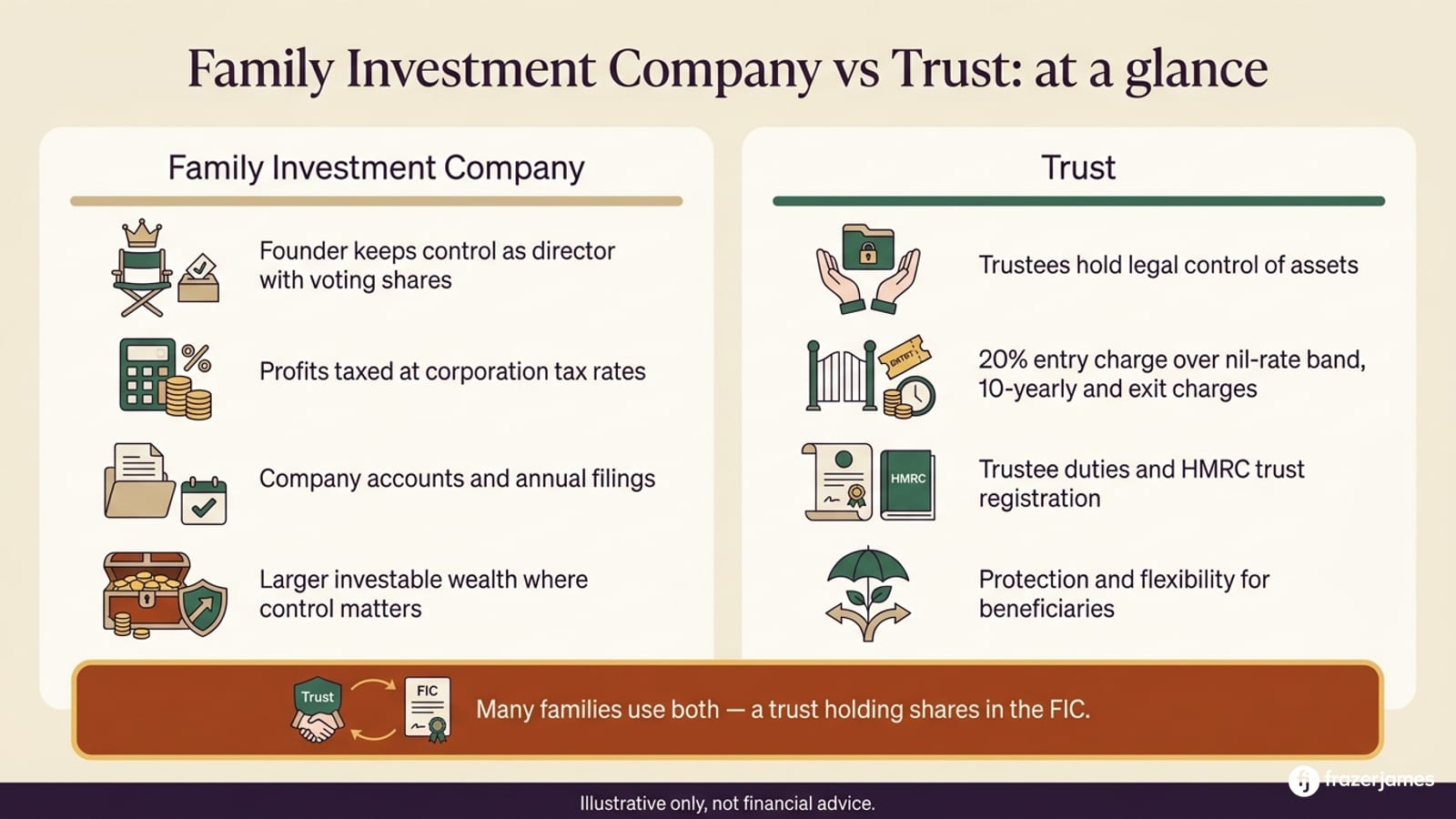
Consider an illustrative scenario. A business owner, aged 58, transfers £1 million into either a FIC or a discretionary trust after selling their company. They want to pass as much as possible to their two adult children over the next 15 years. Assume a net investment return of 5% per year in both cases.
Inheritance Tax: A gift into a discretionary trust above the nil-rate band (currently £325,000) triggers an immediate IHT charge of 20% on the excess – so a £1 million transfer would incur a £135,000 entry charge on the £675,000 above the threshold. A FIC does not trigger an immediate IHT charge on formation, because you are exchanging cash for shares of equivalent value. The IHT saving on entry alone is £135,000. The shares in the FIC will still form part of the founder’s estate unless gifted, but they can be gifted gradually using the annual exemption (£3,000 per year) or as potentially exempt transfers (PETs) that fall outside the estate after seven years.
The ten-year periodic charge: A discretionary trust holding £1 million growing at 5% per year would be worth approximately £1.63 million after ten years. The periodic charge at year ten would be up to 6% of the value above the nil-rate band – roughly £78,000 on the excess of £1.3 million. A FIC has no equivalent periodic charge. Over a 20-year horizon with two ten-year charges, the trust could pay £150,000 or more in periodic charges alone, before any exit charges on distributions.
Income Tax: Investment income inside a discretionary trust is taxed at 45% (the trust rate for income other than dividends) or 39.35% for dividends. Inside a FIC, investment income is subject to Corporation Tax at 25% (or 19% for smaller profits). On £50,000 of annual investment income, the trust pays up to £22,500 in tax; the FIC pays £12,500. Over 15 years, that difference compounds significantly.
Capital Gains Tax: Trusts pay CGT at 24% on gains (as of the 2024 Autumn Budget changes). A FIC pays Corporation Tax on gains, which includes indexation allowance for assets held since before 2018 and is taxed at the Corporation Tax rate rather than CGT rates. For a portfolio generating significant capital growth, the FIC’s Corporation Tax treatment is generally more favourable than the trust’s CGT position.
Across all three taxes over a 15-year horizon, the FIC typically retains more wealth inside the structure. The trust’s entry charge, periodic charges, and higher income tax rate create a cumulative drag that the FIC avoids. These are illustrative figures based on current rates – individual circumstances vary, and you should always take personalised advice before acting.
Control, flexibility, and the founder’s dilemma: which structure lets you stay in the driving seat?
Who controls a Family Investment Company?
In a FIC, control is structural and explicit. The founder holds voting shares and sits as a director. They can invest, reinvest, pay dividends, or retain profits entirely at their discretion. Children hold economic shares but have no power to override the directors. This is control that a business owner will recognise immediately – it mirrors the relationship between a majority shareholder and minority shareholders in any trading company.

In a discretionary trust, control sits with the trustees. If the settlor is also a trustee (which is common), they retain significant influence. But the trust deed constrains what trustees can do, and HMRC scrutinises arrangements where the settlor retains too much control – if the settlor is deemed to have retained a “benefit” from the trust, the assets may still be treated as part of their estate for IHT purposes. This is the “gift with reservation of benefit” trap, and it catches more people than you might expect.
A FIC also offers more flexibility to adapt over time. Share classes can be restructured, new shares can be issued, and the investment mandate can change without the formality required to vary a trust deed. For a business owner who is used to making decisions quickly and adapting to changing circumstances, this operational agility matters.
One area where trusts retain an advantage is asset protection. Assets held in a properly structured trust are legally owned by the trustees, not the beneficiaries. This means they are generally protected from a beneficiary’s creditors or in the event of divorce. A FIC’s shares, once transferred to children, are owned by those children and are therefore exposed to the same risks as any other personal asset they hold.
The real administrative cost of each structure (and why it matters more than most guides admit)
What are the disadvantages of a Family Investment Company?
Running a FIC is not passive. As a private limited company, it must file annual accounts at Companies House, submit a Corporation Tax return to HMRC, and maintain statutory registers. Directors have legal duties under the Companies Act. If the FIC holds investments managed by a third party, those investment management costs sit on top of the compliance costs. For a well-run FIC, annual running costs – accountancy, legal, investment management – can easily reach several thousand pounds per year.
A discretionary trust also carries ongoing costs: trustee meetings, trust tax returns, and the professional fees associated with administering distributions. But for a simple trust holding a single investment portfolio, the annual compliance burden is often lower than for a FIC, particularly in the early years.
The setup costs also differ. A FIC requires incorporation, a bespoke articles of association drafted by a solicitor, and potentially a stamp duty land tax charge if property is transferred in. A trust can be established with a relatively simple trust deed, though professional drafting is still essential. Neither structure should be set up without specialist legal and financial advice – the consequences of getting the structure wrong are significant and difficult to unwind.
Our experience at frazerjames.co.uk is that clients often underestimate the ongoing commitment of running a FIC. It is not a “set and forget” structure. It requires active governance, annual filings, and regular review to ensure it continues to serve its original purpose as tax rules and family circumstances change.
Can you use a Family Investment Company and a trust together?
Can you use a Family Investment Company and a trust together?
Yes – and for some families, this is the most effective approach. A FIC and a trust are not mutually exclusive. They can be layered to capture the advantages of both structures while mitigating the weaknesses of each.
One common arrangement is for a discretionary trust to hold shares in the FIC. The trust becomes a shareholder, giving it access to the FIC’s tax-efficient investment returns, while the trust wrapper provides the asset protection and flexibility to benefit future generations not yet born. The FIC’s directors retain control of the investment decisions; the trust’s trustees control how the economic benefit flows to beneficiaries.
This combined approach is more complex to administer and requires careful drafting to avoid unintended tax consequences. But for a business owner with a large estate, multiple generations to consider, and specific asset protection concerns, it can be the most powerful solution available. Our long-term financial planning work with clients often involves coordinating these structures alongside pension planning and ISA allowances to build a genuinely joined-up picture.
Tony Borthwick, one of our clients, came to us having managed his own pension funds with a focus on high-risk technology investments. He was increasingly concerned about tax implications and the stress of managing volatile assets. What changed for him was not just the investment strategy – it was having a clear, structured plan that covered pensions, investments, and tax considerations together. That kind of joined-up thinking is exactly what a combined FIC and trust strategy requires.
Which structure is right for your family? A practical decision framework
There is no universal answer. But there are clear signals that point toward one structure over the other.
A FIC is likely the better starting point if: you are a business owner who understands and is comfortable with corporate governance; you want to retain active control over investment decisions; your primary concern is IHT efficiency over a 10 to 20 year horizon; and your intended beneficiaries are adults who do not need protection from themselves or their creditors.
A discretionary trust is likely the better fit if: your primary concern is protecting assets from a beneficiary’s creditors or in the event of divorce; you want to benefit future generations not yet born; your estate is below the threshold where the FIC’s administrative costs are justified; or you want a simpler structure with lower ongoing governance requirements.
For many business owners approaching or following a sale, the FIC wins on the numbers over a long horizon. The absence of an entry IHT charge, the lower income tax rate on investment returns, and the absence of periodic charges all compound in the FIC’s favour over time. But the right answer depends on your specific family circumstances, the nature of the assets involved, and your appetite for ongoing administration.
Nick and Rachel, clients who came to us wanting to explore early retirement, are a good example of how these decisions sit within a broader plan. They didn’t just need a tax structure – they needed to understand whether their overall financial position could support the life they wanted. Once that clarity was in place, the structural decisions followed naturally. That is the right order: life goals first, structures second.
If you are a business owner weighing these options, the most important step is to get advice that looks at your whole picture – not just the legal mechanics of each structure. Our wealth management team works with business owners at exactly this stage, helping them move from complexity to clarity. To start that conversation, book a free consultation with a Chartered Financial Planner.

Frequently Asked Questions
This section addresses how Family Investment Companies are taxed, whether they still work after recent HMRC scrutiny, typical set-up costs, and the main drawbacks to weigh up.
What taxes does a Family Investment Company pay?
A FIC pays Corporation Tax on its profits, including investment income and capital gains. The main rate is currently 25% for profits above £250,000, with a small profits rate of 19% for profits up to £50,000 and marginal relief between those thresholds. When the FIC pays dividends to shareholders, those dividends are taxed in the hands of the recipient at their personal dividend tax rate. This layered tax treatment is generally more efficient than the trust tax rates of 45% on income and 39.35% on dividends, particularly where shareholders include basic-rate taxpayers.
Are Family Investment Companies still effective after recent HMRC scrutiny?
Yes, FICs remain a legitimate and effective planning tool. HMRC launched a review of FICs in 2019 and concluded it in 2021 without introducing any specific anti-avoidance legislation targeting them. The HMRC Company Taxation Manual confirms that FICs are taxed as ordinary companies. That said, HMRC does scrutinise arrangements where the structure appears to have been set up primarily to avoid tax with no genuine commercial purpose, so professional advice and proper governance are essential. A well-structured FIC with genuine family investment objectives remains a robust planning vehicle as of 2026.
How much does it cost to set up a Family Investment Company?
Setup costs vary depending on the complexity of the share structure and the assets being transferred in. Legal fees for drafting bespoke articles of association and shareholder agreements typically run from £2,000 to £5,000 or more for a specialist solicitor. If property is being transferred into the FIC, Stamp Duty Land Tax may apply. Ongoing annual costs – accountancy, Corporation Tax returns, Companies House filings, and investment management – typically add several thousand pounds per year. These costs need to be weighed against the tax savings the structure generates, which is why a FIC is generally only cost-effective for estates of significant size.
What are the disadvantages of a Family Investment Company?
The main disadvantages are administrative complexity and ongoing cost. A FIC requires annual accounts, Corporation Tax returns, Companies House filings, and active director governance. Unlike a trust, the FIC’s shares are owned by family members and are therefore exposed to creditor claims and divorce proceedings. There is also no equivalent of the trust’s ability to benefit future generations not yet born – a FIC’s shareholders must be identifiable legal persons. Finally, if the FIC is wound up, any accumulated gains inside the company will be subject to Corporation Tax at that point, which requires careful planning around exit strategy.
About The Author

Related news













Get in touch
Schedule a free consultation with one of our financial advisers, or give us call.
0117 990 2602