 Client Login
  Retirement assessment
  Book a call
  0117 990 2602


Modified on: August 2026
How much do you need to sell your business to retire on £100,000 a year?
Quick Answer: To retire on £100,000 a year after selling your business, you typically need a net retirement pot of around £2.5 million. This is based on the common 25× rule: £100,000 of annual spending multiplied by 25.
That figure is your net target, not necessarily the sale price you need. Other income, such as the State Pension, pensions, rental income or existing investments, can reduce the amount you need from the business sale. Large one-off costs, such as clearing a mortgage, helping children, buying a second home or funding care, can increase it.
You also need to allow for tax. If you sell your business, Capital Gains Tax and Business Asset Disposal Relief can materially affect how much of the sale proceeds you actually keep. So, to end up with £2.5 million after tax, the gross sale price may need to be higher.

If you’re like most business owners, you probably have a number in your head. A sale price that feels like it would mean you’d made it, could stop working, and never have to worry about money again. Mark was no different.
Mark had spent twenty-two years building his business.
He had taken the risk, remortgaged his house, missed school plays, and turned a 2-person operation into an 18-person company.
Now at age sixty-one, Mark was tired in a way he had never felt before. For the first time in years, he was seriously thinking about life after work.
He had always carried a £5 million exit number in his head. He wasn’t sure where it came from, but it felt big enough to mean he had made it. Big enough to stop. Big enough to never worry about money again.
The problem was that £5 million felt a long way from any offer he was likely to receive. So he kept pushing the exit plan further into the future.
Mark had never properly worked out what his life actually cost, or how much capital it would take to fund it. Not because he was careless. He had simply been too busy building the business. For twenty-two years, every spare hour and every spare pound had gone back into the company.
That is common. Business owners often give their company far more financial attention than they give their own future.
When Mark finally worked out his number, he was surprised. It wasn’t the arbitrary £5 million target he had been carrying around for years. It was much lower.
This article walks through how to find the number you would feel comfortable exiting with, and why the smartest exits are never built on the sale price alone.

How much is enough? It depends on what you spend
How much you need to sell your business depends almost entirely on one thing: How much you plan to spend each year in retirement. Everything else follows from that decision.
Sale price is vanity, lifestyle cost is reality
It is natural to start with what your business might be worth. You have spent years building it. You have taken the risk, carried the pressure, and made the decisions. Of course, the sale price matters.
But the sale price does not determine whether you can stop working.
How much life will cost in retirement, and whether the sale value is enough to cover that determines whether you can stop working.
Before you settle on a number, ask yourself one question:
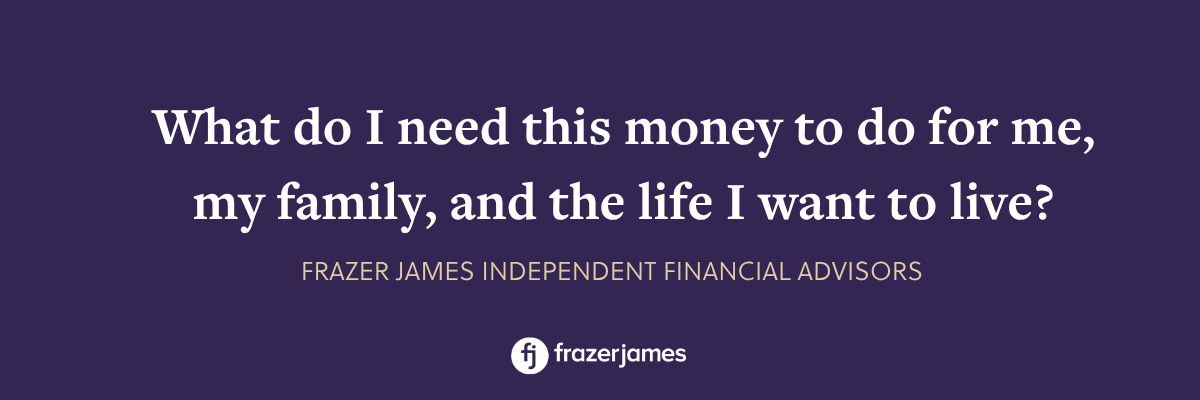
That means getting specific. Not the lifestyle you think you should want. Not the number that sounds impressive. The real life you want to fund: the house, the holidays, the cars, the help you want to give the children, the support you may need later in life, and enough slack that you are not watching prices in the supermarket.
Until you know what that life costs, the sale price is just a guess.
Is there a “right” retirement income for business owners?
Not really. “Enough” looks different depending on your values, your priorities, and the life you actually want. For some business owners, £60,000 a year is genuinely plenty. For others, it’s £150,000. There’s no right answer here, only your answer, and it’s one of the most important things to settle before you sell.
A few things to consider as you work out your number:
- Ongoing lifestyle costs — the everyday spending that needs to be sustainable for decades, not just comfortable in year one.
- Family support — help with deposits, school fees, or simply being able to say yes without checking the bank balance first.
- Care and health costs later in life — often the single biggest unknown in any retirement plan.
- Inflation — the quiet enemy that erodes a fixed number over a 25 or 30-year retirement if it isn’t built in from the start.
- Legacy — what, if anything, you want to leave behind, and to whom.
Why £100,000 a year is a common target for business owners
£100,000 a year is a useful, round figure, and for plenty of owners we work with, it’s about right: comfortable, without being extravagant. But you can’t work out how much to sell for until you’ve worked out how much you actually spend. Skip that step, and everything that follows is guesswork dressed up as a plan.
For the rest of this article, £100,000 a year is the figure we’re building the maths around, because it’s the number Mark landed on after doing the work properly. Your mileage will vary, but the principles will remain the same.

How much do you need to sell your business for?
When you know how much you need to spend each year, the maths becomes surprisingly simple. As a rough yardstick, multiply your annual spending by 25 to get the “ideal” pot needed to sustain that income for the rest of your life.
Why 25 times your annual spending is a useful starting point
Multiplying by 25 is the flip side of withdrawing around 4% of your money each year, sometimes called the 4% rule. Historically, a sensibly invested portfolio has been able to sustain roughly that level of withdrawal across a long retirement, with withdrawals rising with inflation each year, without running dry. It’s a rule of thumb rather than a guarantee, the right figure will depend on your investment approach and how long the money needs to last.
This is not a one-time exercise. It will need reviewing as markets move and inflation changes, which is exactly the kind of thing a financial adviser can help you with. For £100,000 a year, the starting sum is straightforward: £100,000 × 25 = £2.5 million.
What your 25× number doesn’t include
The 25 times figure covers your ongoing lifestyle. But it doesn’t consider two crucial factors:
- Add the big one-offs. Don’t forget the major lump-sum expenses that come later. Clearing the mortgage, a holiday home, a chunk towards each child’s first deposit, and a new car every few years. List them honestly and add them in.
- Subtract your other income. This is where the number usually shrinks in your favour. You won’t be living on the business proceeds alone. The full new State Pension is now £12,547.60 a year, and most owners have personal or workplace pensions, ISAs, or rental income alongside. Every pound of reliable income from elsewhere is a pound your sale proceeds don’t have to produce. (Source: GOV.UK, Benefit and pension rates 2026 to 2027)
Example: How pensions and one-off costs change your number
When Mark came to us for a full review of his finances, one thing became clear very quickly: he did not need to sell his business for £5 million to achieve financial independence.
Once we worked through his retirement income, State Pension, one-off costs, and the capital needed to fund his lifestyle, his real target was much lower.
He needed around £2.37 million after tax, not £5 million.
Here’s how that number was calculated:
| Step | Figure |
| Target annual income | £100,000 |
| Less full State Pension (£12,547.60) | − £12,547.60 |
| His investments need to produce income | £87,452.40 |
| Net pot needed at 25 times | ≈ £2.19 million |
| Plus one-off costs (clearing the mortgage, a deposit for his daughter) | + £180,000 |
| Mark’s net target | ≈ £2.37 million |
Illustrative only, based on figures and circumstances specific to this example.
Why you should never bet everything on the sale price
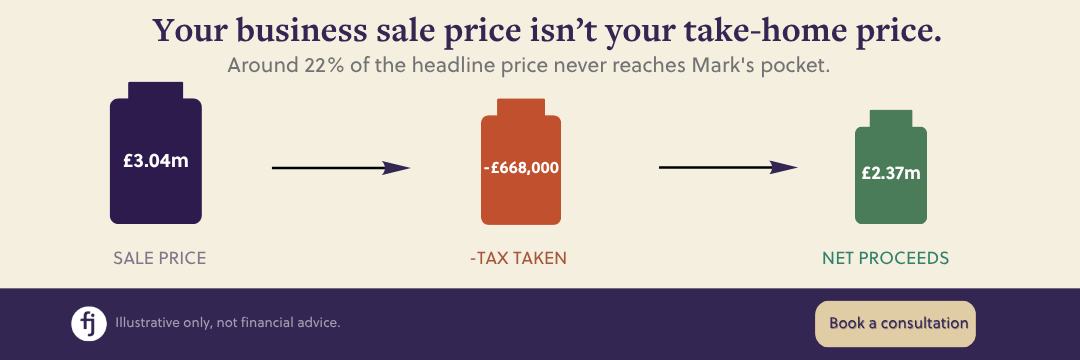
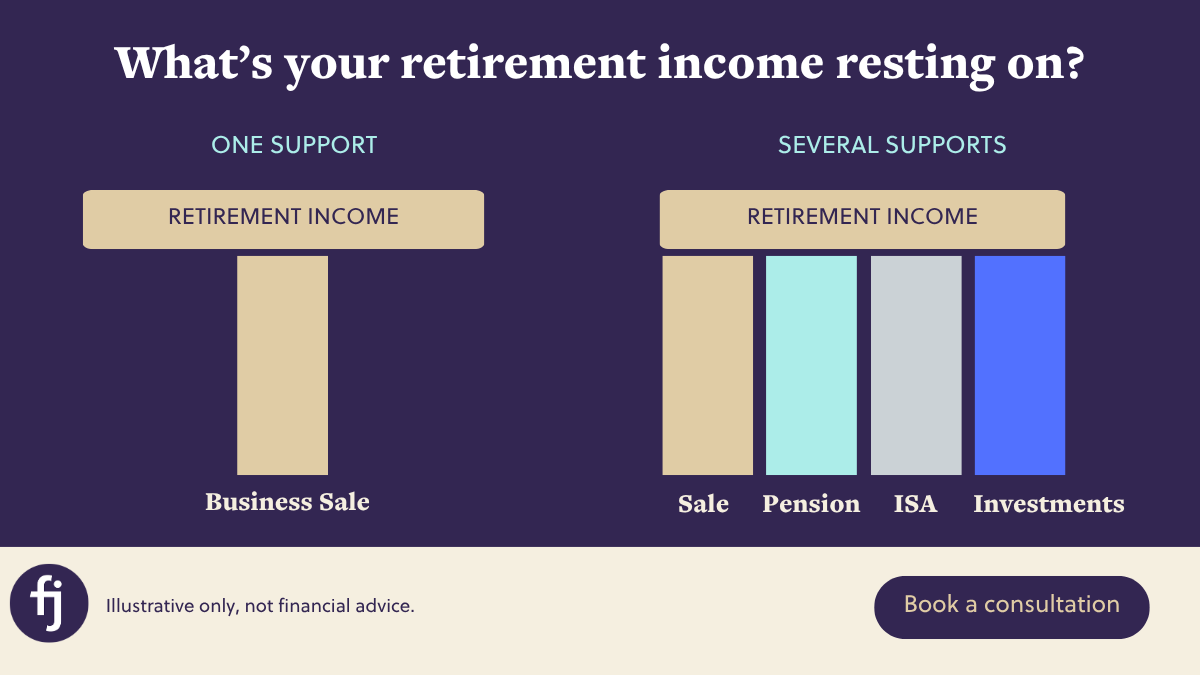
Mark’s £5 million goal had a second part to consider. Almost everything he owned aside from the family home, was tied up inside the business. Plan B didn’t exist if the sale went south, which is a common position for business owners.
What happens if your business sale falls through?
Deals fall through more often than expected. An indicative offer at a strong multiple can shrink considerably by the time due diligence is done. Earn-outs spread the remaining payment over several years and tie it to targets that depend as much on the new owner’s decisions as on yours. Banking your entire future on a single transaction, with a single buyer, on a single day, is a great deal of risk to place on a single decision.
This is also why it pays to build wealth outside the business in the years before any sale, through company pension contributions, ISAs and other investments, so the eventual sale completes your plan rather than being the entire plan. For more on how to do that, see our guide to building personal wealth as a business owner.
How much tax will you actually pay when you sell?
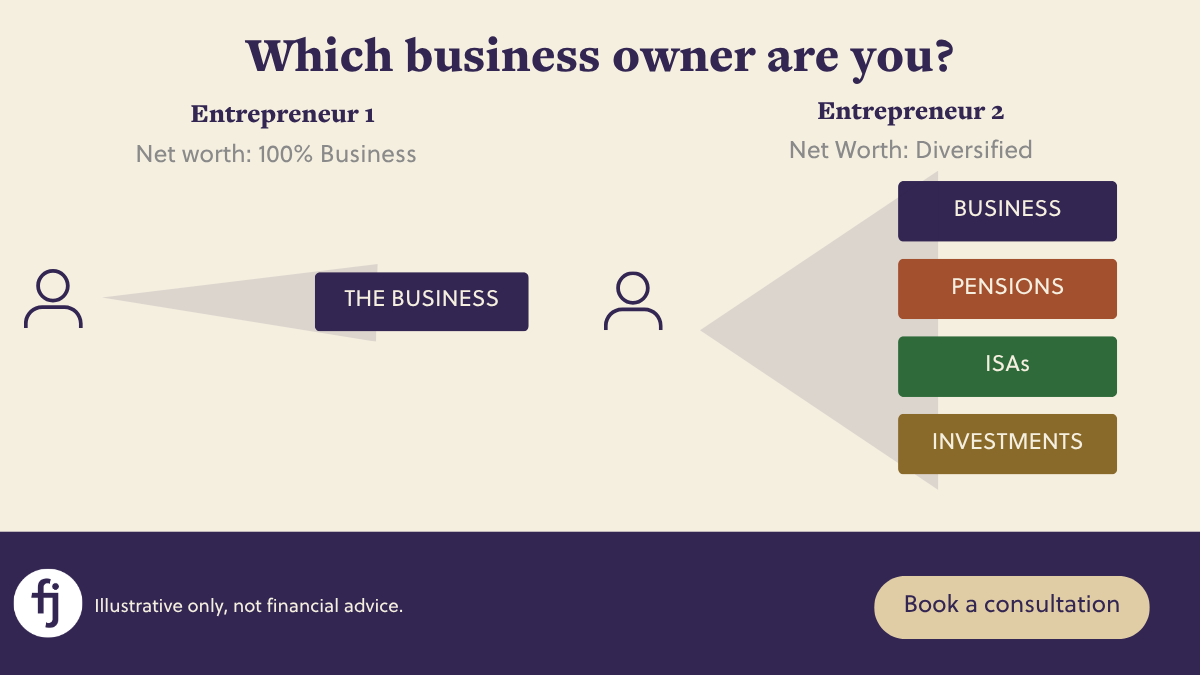
The total sale price from your exit versus the amount that lands in your bank account are not the same. Tax can eat up a significant portion of your gains, and on a large sale, that can potentially run into hundreds of thousands of pounds.
Business Asset Disposal Relief (BADR) is a reduced rate of Capital Gains Tax for people selling their business, business assets, or shares in their company.
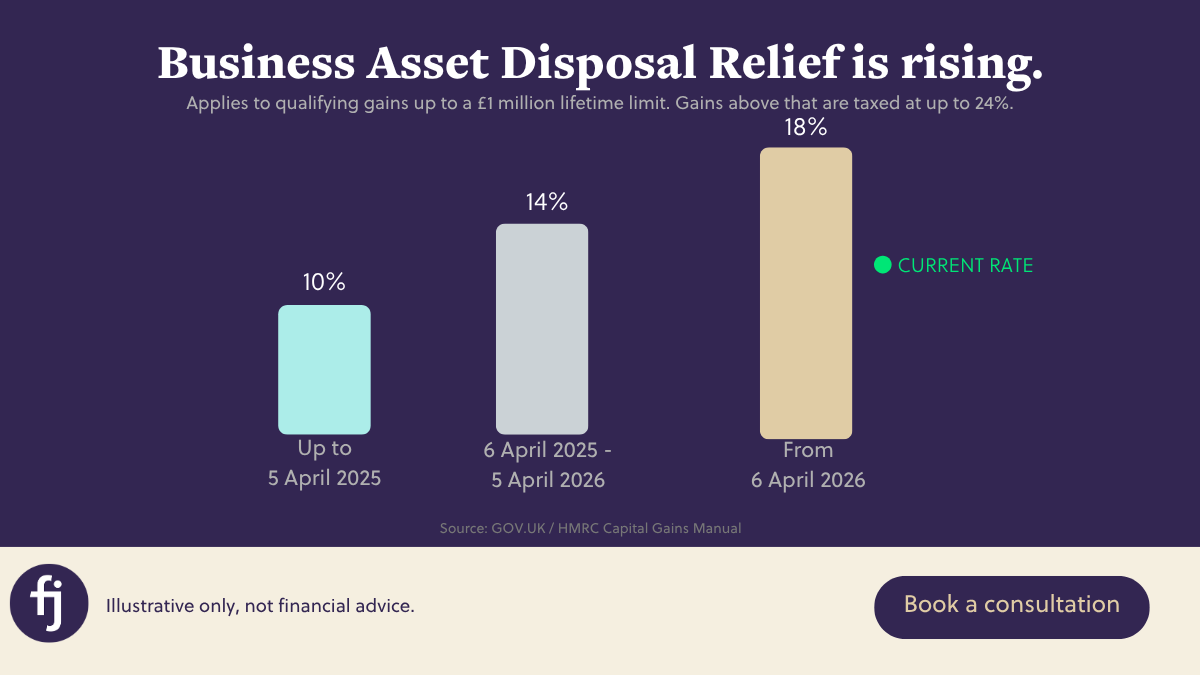
For disposals from 6 April 2026, the rate is 18% on qualifying gains up to a lifetime limit of £1 million. Gains above that limit are taxed at the standard rate, which can be as high as 24%.
Here’s how the rate has changed:
| Period | BADR Rate |
| Before 6 April 2025 | 10% |
| 6 April 2025 to 5 April 2026 | 14% |
| From 6 April 2026 | 18% |
Source: GOV.UK, HMRC Capital Gains Manual.
BADR applies most straightforwardly to selling your shares or your business as a whole. Selling the underlying assets instead works differently for tax, since the company itself is taxed on the gain before anything reaches you personally. The route that applies to you depends on how the deal is structured.
So what does that mean for Mark’s £2.37 million target? Assuming his gain is close to the full sale price, the first £1 million is taxed at 18% and the rest at 24%. To net £2.37 million after tax, Mark would need to sell for roughly £3.04 million, with the tax bill on that sale coming to around £668,000.
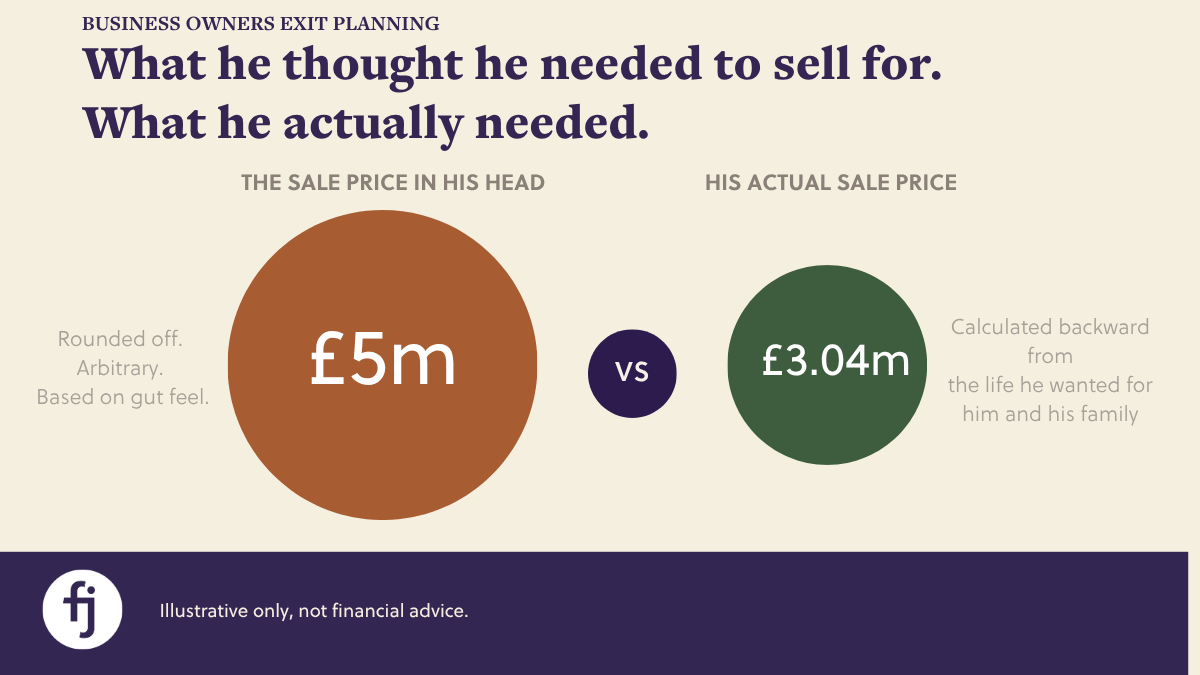
Still nowhere near £5 million. Even after tax is accounted for, Mark’s actual number is 40%, significantly lower than what he’d been assuming for years.
If you’re married and your spouse also holds qualifying shares in the business, you may be eligible for two BADR allowances rather than one. Raise it with your adviser early, as it can significantly affect this figure, and HMRC won’t flag it for you. (Source: GOV.UK, Business Asset Disposal Relief, HS275)
Why you need wealth outside the business, too
Owners who’ve spent years building assets outside the company, through pensions, ISAs and investments, are the ones who get to sell on their own terms. They can walk away from a poor offer. They can wait for the right buyer. They negotiate from strength rather than need.
Mark didn’t have that. His entire net worth minus the house was the business. This meant any buyer who sensed he had to sell could negotiate harder than they should have been able to.
Once Mark had his real number, the plan changed. Rather than waiting for one perfect sale to fund everything, he started building wealth outside the business as well, so the eventual sale would complete the plan rather than be the only thing holding it up.
Mark eventually sold his business for just over £3.1 million. After BADR and CGT, he walked away with around £2.41 million. Combined with his State Pension and a small defined benefit pension from his employed days, it was more than enough to fund the retirement he’d been picturing.
He told us afterwards that the most useful thing we did wasn’t find him a buyer or structure the deal. It was doing the maths that showed him his real number was achievable, years before he thought it would be. That clarity gave him the confidence to stop holding out for £5 million and to take a realistic offer when it came.
Key takeaways
- Start with spending, not the sale price. How much you need to sell for depends on how much you plan to spend each year.
- Use the 25x rule as your starting point. Multiply your annual spending by 25 for a rough net target.
- Adjust for one-offs and other income. Add big lump-sum costs on top. Subtract the State Pension and any other reliable income from your target.
- Your net target isn’t your sale price. Make sure you factor in associated taxes and costs when selling.
- Don’t rely on the sale alone. Build wealth outside the business so you sell on your terms, not out of need.
Talk to Frazer James
If you’re thinking about selling your business and you want to know your number, that’s exactly the kind of work we do. We help business owners across Bristol and the UK work out how much is enough, plan around the tax, and build wealth outside the business so the sale completes the plan rather than being the whole plan.
Book an initial consultation or call us on 0117 990 2602.
This article is for general information only and does not constitute financial, tax or investment advice. Tax rules depend on individual circumstances and may change. Figures reflect rates current at the time of writing. Investments can go up and down in value and you may get back less than you put in. Please request advice before acting. Frazer James Financial Advisers is authorised and regulated by the Financial Conduct Authority.
About The Author

Frequently Asked Questions
How much do I need to sell my business to retire on £100,000 a year?

Is my net retirement target the same as my sale price from my business exit?
Does it matter whether I sell my shares or my business's assets?
Why multiply annual spending by 25?
Does the State Pension really make that much difference?
How much tax will I pay when I sell my business?
What if my business is worth less than my number?
Related news


Get in touch
Schedule a free consultation with one of our financial advisers, or give us call.
0117 990 2602