 Client Login
  Retirement assessment
  Book a call
  0117 990 2602


Modified on: August 2026
How to Reduce CGT on a Business Sale – Before It’s Too Late
How to Reduce CGT on a Business Sale – Before It’s Too Late
You’ve spent years building your business – and the day you finally agree a sale, the first question your accountant asks is: how much of this are you planning to give to HMRC?
That question lands differently when you’re sitting across the table from a buyer who’s just offered you £2 million for something you built from nothing. The fear of a six-figure tax bill is entirely justified. Capital Gains Tax on a business sale can take a significant slice of your proceeds if you haven’t planned ahead – and the painful truth is that most of the strategies that make the biggest difference require action months or years before completion, not days.
This guide covers every major CGT reduction strategy available to UK business owners in 2026. More importantly, it covers the three things most business owners get wrong: the planning timeline, the sale structure, and what to do with the proceeds once the deal is done. If you’re thinking about an exit in the next one to five years and want to keep more of what you’ve built, this is where to start. For business owners who want to explore this in the context of their own situation, our page on financial planning for business owners preparing to sell sets out how we approach exit planning at Frazer James.
Why CGT on a business sale is a financial planning problem, not just an accountancy one
Most business owners think about CGT as an accountancy problem. You sell, your accountant files the return, you pay the bill. But that framing misses the point entirely – and it costs people a lot of money.
The strategies that genuinely reduce your CGT liability on a business sale are not things you can implement on completion day. They require restructuring ownership, making pension contributions, timing disposals across tax years, and sometimes changing the legal structure of the deal itself. All of that takes time. The closer you are to signing heads of terms, the fewer options you have.
We’ve worked with business owners at Frazer James who came to us 18 months before a planned exit with a clear picture of what they wanted to achieve – and the difference in outcomes compared to those who arrived three weeks before completion is stark. Tony , one of our clients, described exactly this shift: “James changed the conversation entirely. I had been fixated on reaching a particular number – without really knowing whether that number was enough, too much, or what it would actually mean for our retirement.” That reframing, from transaction to long-term plan, is where the real value sits.
CGT planning for a business sale is also not just about the tax. It’s about what happens to the money afterwards. Every competitor article you’ll find on this topic stops at the point of sale. This one doesn’t – because the question of what to do with your proceeds is just as important as how much you keep.
How much CGT will you actually pay when you sell your business in 2026?
Capital Gains Tax is charged on the profit you make when you dispose of a business asset. For a limited company owner-director selling their shares, the gain is typically the difference between what you receive for the shares and what you originally paid for them – often a very small amount, which means the gain is close to the full sale price.
Following the October 2024 Budget, CGT rates changed significantly. Basic rate taxpayers now pay 18% on gains, and higher and additional rate taxpayers pay 24%. These rates apply to most asset disposals. According to the Office for Budget Responsibility, the amount collected from CGT is expected to almost double to £25.5 billion by 2029/30 as a direct result of these changes.
For a business sale, however, the most important rate to understand is the Business Asset Disposal Relief rate – currently 18% for disposals on or after 6 April 2026. This is a reduced rate that applies to qualifying gains up to a £1 million lifetime limit. Without BADR, a higher rate taxpayer selling a business for £2 million could face a CGT bill of around £480,000. With BADR applied to the full £1 million lifetime limit, the effective rate on that portion drops to 18%, saving a meaningful amount – but only if you qualify.
The annual CGT exemption currently stands at £3,000 per person. It’s modest, but it can be used strategically – particularly when combined with a spouse transfer before sale, which we cover below.
How much CGT will I pay when I sell my business in the UK?
The exact amount depends on the size of your gain, your income in the year of disposal, the sale structure (share sale vs asset sale), and whether you qualify for Business Asset Disposal Relief. A higher rate taxpayer selling a business for a £1.5 million gain without any reliefs would face a CGT bill of approximately £360,000 at the 24% rate. With BADR applied to the full £1 million lifetime limit, the bill on that first million drops to £180,000, saving £60,000 on that portion alone. Pension contributions, spouse transfers, and earn-out structures can reduce the bill further still.
Business Asset Disposal Relief: what it is, what it’s worth, and whether you qualify
Business Asset Disposal Relief (BADR) – previously known as Entrepreneurs’ Relief – is the single most valuable CGT relief available to business owners selling a qualifying business. It reduces the CGT rate to 18% on gains up to a £1 million lifetime limit for disposals on or after 6 April 2026, as confirmed by HMRC’s guidance on BADR.
To qualify, you must meet all of the following conditions for at least two years before the disposal:
-
You are a sole trader or business partner disposing of all or part of your business, or
-
You hold shares in a personal company (you own at least 5% of the ordinary share capital and voting rights), and
-
The company is a trading company (not an investment company), and
-
You are an officer or employee of the company
The two-year qualifying period is critical. If you sell before you’ve held the shares for two years, or if the company has been classified as an investment company during that period, you lose the relief entirely. This is one of the most common planning failures we see – business owners who restructure their company in the run-up to a sale without realising they’ve inadvertently reset the clock on BADR eligibility.
What is Business Asset Disposal Relief and do I qualify?
BADR is a CGT relief that reduces the tax rate to 18% on qualifying business gains up to a £1 million lifetime limit. You qualify if you’ve owned at least 5% of a trading company’s shares and voting rights, been an officer or employee of that company, and met both conditions for at least two years before the disposal. The lifetime limit applies across all qualifying disposals you make throughout your life – not per transaction. If you’ve previously claimed BADR on an earlier business sale, the remaining allowance is reduced accordingly.
Share sale vs asset sale: why the deal structure is the single biggest CGT lever
If you own a limited company, the structure of your sale – whether the buyer acquires your shares or the company’s underlying assets – has a bigger impact on your CGT position than almost any other single decision. And it’s a decision that needs to be made early, ideally before heads of terms are agreed.
In a share sale, you sell your shares in the company directly to the buyer. The gain is calculated on the difference between your sale proceeds and the original cost of your shares. Crucially, a share sale is the only structure that allows you to claim Business Asset Disposal Relief. It also means the buyer inherits all of the company’s liabilities, which is why buyers often prefer an asset sale.
In an asset sale, the company sells its underlying assets – goodwill, plant and machinery, fixtures and fittings, registered trademarks, and so on – to the buyer. The proceeds sit inside the company, and you then face a second layer of tax when you extract them as a dividend or salary. This double taxation makes asset sales significantly less efficient for sellers in most circumstances.
The practical reality is that buyers often push for asset sales because they avoid inheriting unknown liabilities. Sellers who understand this dynamic can use it as a negotiating lever – accepting a slightly lower headline price in exchange for a share sale structure that preserves BADR eligibility and avoids double taxation. Getting this right requires both legal and financial planning input well before the deal is on the table.
Is it better to sell shares or assets when selling my business?
For most owner-directors of a limited company, a share sale is significantly more tax-efficient. It allows you to claim Business Asset Disposal Relief, avoids the double taxation that arises when sale proceeds are extracted from a company after an asset sale, and typically results in a lower overall CGT bill. The exception is where the company holds significant non-trading assets or has historic liabilities that make a share sale unattractive to buyers. In those cases, the deal structure becomes a negotiation, and the tax cost of an asset sale needs to be factored into the price you accept.
The strategies that only work if you plan ahead (and how far ahead you need to be)
This is the section most business owners wish they’d read earlier. The strategies below are all legitimate and effective – but every single one of them has a minimum lead time. The closer you are to completion, the fewer of them are available to you.
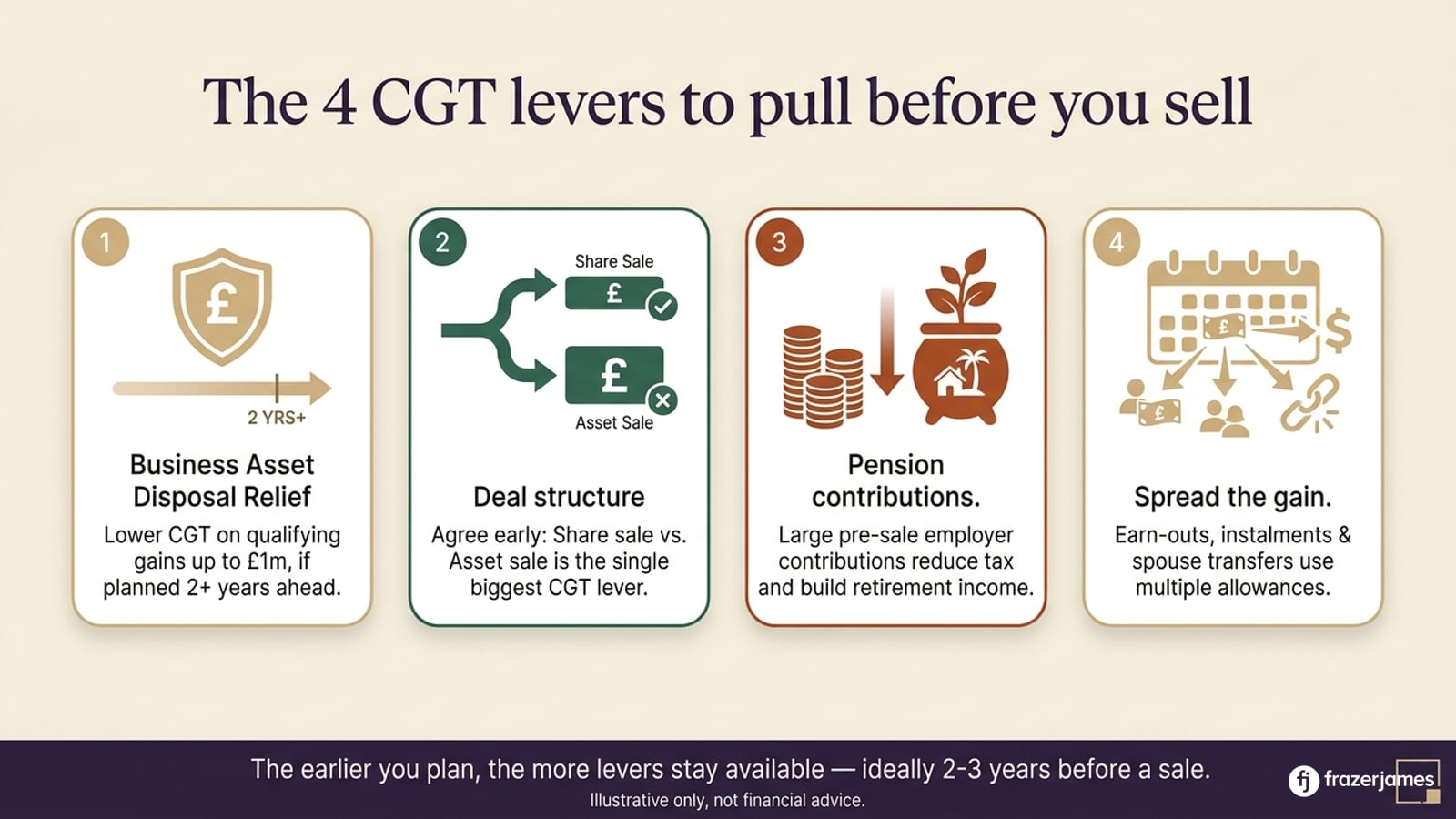
Two years before sale (minimum): Confirm your BADR eligibility and check the two-year qualifying period is intact. If you’ve recently restructured the company, taken on investment, or changed the nature of the business, get this reviewed now. Also consider whether transferring shares to a spouse or civil partner makes sense – transfers between spouses are CGT-free, and a spouse who holds shares can use their own BADR lifetime limit and annual exemption, potentially doubling the tax-efficient amount you can realise.
12 to 18 months before sale: Review your pension position. Employer pension contributions made by the company before the sale can reduce the company’s taxable profits, and personal contributions can reduce your adjusted net income – which affects the CGT rate band you fall into. This is one of the most underused strategies in pre-sale planning, and we cover it in detail in the next section.
Six to 12 months before sale: Consider whether an earn-out structure makes sense. Spreading the gain across multiple tax years can allow you to use the annual CGT exemption more than once and potentially keep gains within a lower rate band. It also has commercial implications, so this needs to be modelled carefully.
Three to six months before sale: Finalise the deal structure, confirm the BADR claim, and ensure any remaining planning is in place. At this stage, the options narrow significantly – but there is still value in making sure nothing has been missed.
Barry and Fiona, a business owner couple we worked with at Frazer James, came to us with a significant surplus of cash in their business and no clear strategy for what came next. By working through the planning timeline well in advance of any exit, we were able to act as their personal financial director – building a strategy that addressed not just the tax on a future sale, but the broader question of financial security beyond the business. The result was a clear plan that gave them confidence at every stage of the process.
Using pension contributions to reduce your CGT bill before the sale completes
Pension contributions are one of the most powerful and most overlooked tools in pre-sale CGT planning. Yet almost none of the articles currently ranking on this topic mention them. Here’s why they matter.
CGT is charged at either 18% or 24% depending on whether your total taxable income and gains in the year of disposal push you into the higher rate band. If your income in the year of sale is relatively low, a larger portion of your gain may fall within the basic rate band and be taxed at 18% rather than 24%. Making a significant personal pension contribution in the tax year of the sale increases your basic rate band, which can shift more of the gain into the lower rate.
Employer pension contributions made by the company before the sale are even more powerful. They reduce the company’s corporation tax liability, they don’t count as income for the seller, and they build up a pension pot that can be drawn tax-efficiently in retirement. For an owner-director approaching a sale, maximising employer pension contributions in the years before exit is one of the most tax-efficient things you can do – provided you have sufficient annual allowance remaining.
The annual pension allowance is currently £60,000 per year, and unused allowance from the previous three tax years can be carried forward. For a business owner who hasn’t maximised pension contributions in recent years, this can represent a very significant pre-sale planning opportunity. Our page on pension contributions as part of your pre-sale tax planning explains how this works in practice.
Can I use pension contributions to reduce CGT on a business sale?
Yes, in two distinct ways. First, personal pension contributions in the tax year of the sale increase your basic rate band, which can reduce the proportion of your gain taxed at 24% rather than 18%. Second, employer pension contributions made by the company before the sale reduce the company’s taxable profits and build your retirement pot without creating a personal income tax liability. Both strategies require planning in advance – ideally 12 to 18 months before the sale completes – and need to be modelled against your specific income and gain figures to confirm the benefit.
Spreading the gain: earn-outs, instalments, and spouse transfers
Not every business sale happens in a single transaction. Earn-outs, deferred consideration, and instalment arrangements are common in deals where the buyer wants to tie part of the price to future performance. From a CGT perspective, these structures can be genuinely useful – but they need careful handling.
An earn-out arrangement, where part of the sale price is contingent on future profits, can spread the CGT liability across multiple tax years. This allows you to use the annual CGT exemption (currently £3,000) in each year, and potentially keep gains within the basic rate band in years where your other income is lower. However, HMRC has specific rules about how earn-outs are valued and taxed, and the interaction with BADR can be complex – particularly where the earn-out is structured as a right to future income rather than a capital payment.
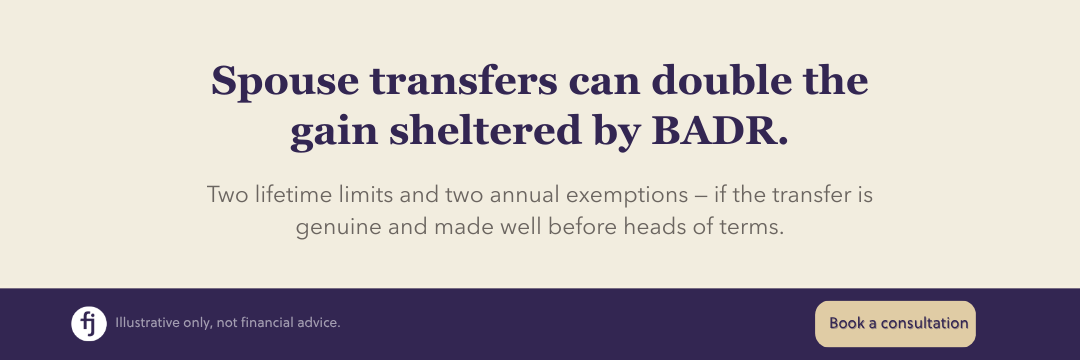
Transferring shares to a spouse or civil partner before the sale is a well-established strategy. The transfer itself is CGT-free between spouses. Your spouse then sells their shares as part of the deal, using their own annual CGT exemption and, if they qualify, their own BADR lifetime limit. This can effectively double the amount of gain sheltered by BADR from £1 million to £2 million, and uses two sets of annual exemptions rather than one. The key requirement is that the transfer must be genuine and completed before heads of terms are agreed – HMRC will scrutinise arrangements that appear to have been made purely to avoid tax immediately before a sale.
Other reliefs worth knowing about include Business Asset Rollover Relief, which allows you to defer CGT when you reinvest the proceeds of a business asset disposal into new qualifying assets, and Gift Hold-Over Relief, which defers CGT when you gift business assets. Investors’ Relief offers a reduced CGT rate for external investors in unlisted trading companies, though this is less commonly relevant for owner-directors. Full details of all available reliefs are set out on the GOV.UK Capital Gains Tax for business guidance pages.
Can I transfer shares to my spouse before a business sale to reduce CGT?
Yes, and it’s one of the most effective strategies available. Transfers between spouses and civil partners are exempt from CGT, meaning you can transfer shares to your spouse before the sale without triggering a tax charge. Your spouse then sells their shares as part of the deal, using their own annual CGT exemption and their own BADR lifetime limit. If both spouses qualify for BADR, the combined lifetime limit is £2 million rather than £1 million. The transfer must be genuine and completed well before the sale is agreed – a last-minute transfer immediately before heads of terms will attract HMRC scrutiny.
What happens to CGT if I sell my business in instalments or via an earn-out?
Where the sale price is paid in instalments or includes an earn-out element, the CGT treatment depends on how the arrangement is structured. If the total consideration is ascertainable at the time of sale, HMRC will typically assess CGT on the full amount in the year of disposal, even if the cash hasn’t been received yet. Where the earn-out is genuinely contingent and unascertainable, it may be taxed as and when the payments are received. The interaction with BADR is particularly important here – you need to ensure the relief is claimed correctly across all tranches of the consideration.
What to do with the proceeds – turning your sale into long-term financial security
Here’s the question every competitor article ignores: you’ve sold your business, you’ve managed the CGT as well as you can, and you’re sitting on a significant sum of money. Now what?
This is the moment where many business owners feel unexpectedly lost. You’ve spent years with your identity and your financial security tied up in the business. Suddenly, that structure is gone. The money is real, but the plan for it isn’t. We see this regularly – successful people who’ve done everything right up to the point of sale, and then find themselves uncertain about what to do next.
Nick and Rachel, clients we worked with at Frazer James, faced exactly this situation. They came to us wanting to explore early retirement – not sure if it was possible, not sure what it would look like. Through careful financial planning, we helped them understand their options, build a clear plan, and ultimately retire early to sail the Mediterranean. The business sale was the starting point, not the end point. The real work was turning those proceeds into a life they’d designed.
The first priority after a sale is usually tax-efficient deployment of the proceeds. This typically involves:
-
Maximising pension contributions in the tax year of the sale, using any remaining annual allowance and carry-forward
-
Using ISA allowances (£20,000 per person per year) to shelter future investment growth from income tax and CGT
-
Considering whether any of the proceeds should be held in a General Investment Account, structured to manage future CGT exposure through annual exemption use and loss harvesting
-
Reviewing inheritance tax exposure – a significant lump sum that was previously sheltered by Business Property Relief (as shares in a trading company) may now be fully exposed to IHT
The IHT point is one that catches many business owners off guard. While you owned shares in a qualifying trading company, those shares were likely exempt from IHT under Business Property Relief. Once you sell and hold the proceeds as cash or investments, that exemption disappears. For business owners with significant personal wealth, this can create a substantial IHT liability that needs to be addressed as part of the post-sale plan.
Investment strategy matters too. Many business owners have spent years with the majority of their wealth concentrated in a single illiquid asset – the business itself. Post-sale, the priority is usually diversification: building a portfolio that generates income and growth without the concentration risk of a single holding. This is where evidence-based investment management, aligned to your specific goals and time horizon, becomes central to the plan.
Liz Grant, who came to us ahead of her retirement, described the shift clearly: “Their assessment, recommendations and advice has given me peace of mind about my financial future and the changes we’ve made to my pension pot investments have given excellent results.” That peace of mind – knowing the proceeds are working as hard as they should be – is what good post-sale planning delivers.
For business owners thinking about how to structure their wealth after a sale, our approach to wealth management after a business sale covers the key considerations in detail. And if you’re at the earlier stage of thinking about what retirement might look like once the sale completes, our retirement planning page sets out how we help clients build a clear picture of what’s possible.
The most important thing to understand is that the sale is not the finish line. It’s the starting point for the next chapter. The business owners who get the most from their exit are the ones who treat the post-sale period with the same seriousness and intentionality they brought to building the business in the first place. If you want to explore what that looks like for your specific situation, speak to a Chartered Financial Planner about your exit – the earlier the conversation, the more options you have.

About The Author

Frequently Asked Questions
This section covers timing your CGT planning, current rates and reliefs, how a business sale interacts with inheritance tax, and reinvestment options.
How long before selling my business should I start tax planning?

What is the CGT rate on a business sale in 2026?
What other CGT reliefs are available when selling a business?
Does selling my business affect my inheritance tax position?
Can I reduce CGT by reinvesting the proceeds into another business?
Related news







Get in touch
Schedule a free consultation with one of our financial advisers, or give us call.
0117 990 2602