 Client Login
 Retirement assessment
 Book a call
 0117 990 2602


How to pay yourself from a limited company.
Salary or dividends, a company pension or profit left in: the tax on each for 2026/27, and turning profit into personal wealth

Are you taking profit efficiently?
Five figures for this tax year, rough is fine. See the tax on what you take and what matters most now.
5 quick questions
Your result
Enter your salary and dividends to see the tax on what you take and your stage.
,
- ,
,
,
What matters most now
Information, not personal advice. A simplified estimate of income tax and National Insurance for 2026/27, England only. Corporation tax is not included.


In this guide · 5 stages · 1 check · 7 calculators · 9 guides · 1 checklist · 1 video
A guide to paying yourself and building personal wealth.
For directors who own their UK company and want to keep more of what it earns. It shows how to pay yourself from a limited company, and what to do with profit you leave in.
Start with the short check above, using rough figures for this tax year. It shows the income tax and National Insurance on what you take, and the stage that matters most now. Each stage has the steps, calculators and guides for it, and a way to talk to an adviser.
- Salary or dividends
- The £100,000 band
- Company pension
- Profit left in
- Protecting it
- Selling, one day
Written for directors of UK limited companies. Figures checked against gov.uk on 22 September 2026. Sole traders and partnerships are taxed differently. Information, not personal advice.


Key figures, 2026/27
The numbers that govern how you are paid.
Sources: gov.uk rates and allowances for 2026/27 and HMRC guidance on employer pension contributions, checked 22 September 2026. Corporation tax is 19% on profit up to £50,000, 25% above £250,000, and an effective 26.5% on profit in between. Scotland sets its own income tax bands.
Compare
Salary or dividends? The four routes, side by side.
These apply to a director who owns the company. The right mix depends on your profit, your other income, and when you need the money.
Salary
Pay yourself through payroll like any employee.
How it is taxed, and what to check
How it is taxedDeductible for corporation tax. Employer National Insurance at 15% above £5,000, plus income tax and employee National Insurance on you.
What to checkSalary counts as earnings for pension purposes and for mortgage lenders. See the salary against dividend calculator.
Dividends
Distribute profit that has already been taxed in the company.
How it is taxed, and what to check
How it is taxedNo National Insurance. Taxed at 10.75%, 35.75% or 39.35% after a £500 allowance, on top of your other income.
What to checkOnly distributable profit can be paid. The rates rose two points in April 2026, which moved the arithmetic for many owners.
Pension contribution from the company
The company pays into your pension as an employer contribution.
How it is taxed, and what to check
How it is taxedUsually deductible for corporation tax. No National Insurance and no income tax now. Taxed when you draw it.
What to checkUp to £60,000 a year plus unused allowance from three earlier years. The allowance tapers above £260,000 of adjusted income. See company pension contributions.
Leave it in the company
Keep profit invested inside the company, or in a company investment account.
How it is taxed, and what to check
How it is taxedCorporation tax has been paid. Growth is taxed in the company, then again when you take it out.
What to checkSurplus cash can affect whether the shares qualify for Business Relief. See inheritance tax for business owners.
Stage 1 · Paying yourself
Salary, dividends, or both.
You decide how you are paid, and the tax on each route changed in April 2026. Dividend rates rose two points, employer National Insurance is 15%, and corporation tax runs at 19%, 25% or 26.5% depending on profit. The arithmetic most owners settled on years ago is worth running again.
 Start here · CalculatorSalary against dividendThe most efficient split for your profit, with corporation tax and both National Insurances included.Open the calculator

 Video · 2 minHow we help business ownersJames Mackay, our Managing Director, explains how we work with business owners and directors. He covers turning business profit into personal wealth, working out how much is enough, and planning an exit.
Read next
 Calculator · opens on this pageDividend tax calculatorThe tax on your dividends at the new 2026/27 rates, band by band.

 Guide · 11 min readTen ways to reduce your tax billThe reliefs and allowances a higher earner can still use, with worked figures.

 ReferenceUK tax brackets and allowancesEvery 2026/27 rate, band and allowance on one page, dividends included.
Next · Stage 2The £100,000 band
Want to talk this stage through? Financial advice for business owners.
Stage 2 · The £100,000 band
Where the tax rate spikes.
Between £100,000 and £125,140 of income the personal allowance is withdrawn, so each extra pound is taxed at 60% before National Insurance. An owner-director has levers an employee does not: the timing of dividends, and contributions paid by the company.
 Start here · CalculatorYour whole tax positionSalary, dividends, savings and rent together, and exactly what a pension contribution changes.Open the calculator
Read next
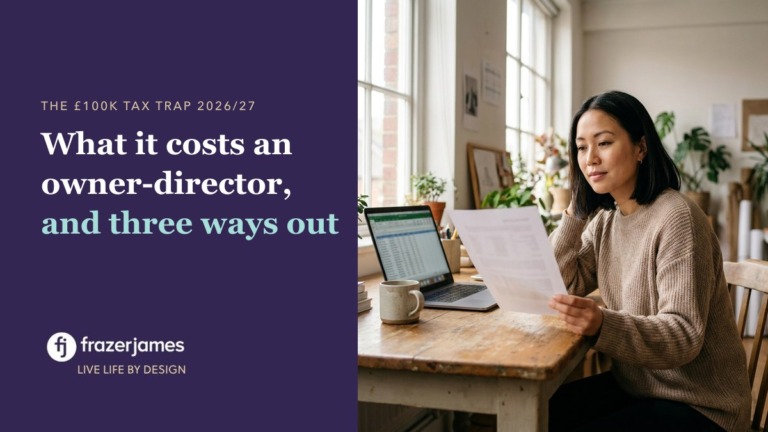 Guide · 13 min readThe £100,000 tax trapWhat income between £100,000 and £125,140 costs an owner-director, and three ways out.
 Calculator · opens on this pageTapered annual allowanceYour allowance if adjusted income passes £260,000, and how to switch the taper off.
Next · Stage 3Money left in the company
Want to talk this stage through? Financial advice for business owners.
Stage 3 · Money left in the company
What to do with it.
Profit you do not need this year has four homes. A pension contribution from the company, investments held inside it, a family investment company, or your own pocket after tax. Each is taxed differently now and treated differently later, including for inheritance tax.
 Start here · CalculatorPension tax relief calculatorWhat a contribution really costs once every layer of relief is counted.Open the calculator
Read next
 Guide · 4 min readPension contributions from your companyHow an employer contribution is treated for corporation tax, and the limits that apply.
 Guide · 15 min readSSAS or SIPP for a business ownerWhich pension suits a company owner, including holding your trading premises.
 Guide · 14 min readFamily investment company or trustTwo ways to pass on wealth from a company, and who each one actually suits.
Next · Stage 4Protecting what the company has built
Want to talk this stage through? Financial advice for business owners.
Stage 4
Protecting what the company has built.
A business that depends on you is exposed if you cannot work. And while trading shares can pass free of inheritance tax, surplus cash inside the company may not. The two questions belong together.
Read next
 Guide · 5 min readIncome protection for the self-employedWhat it covers, what it costs, and the versions a limited company can pay for.
 Guide · 19 min readInheritance tax for business ownersWhat Business Relief covers while you own the company, and what it stops covering.
Next · Stage 5Selling, one day
Want to talk this stage through? Financial advice for business owners.
Stage 5
Selling, one day.
The relief on a sale needs two years of preparation, and the money that arrives is taxed and inherited differently from the shares you held. If a sale is on the horizon, this is where the planning starts.
 Start here · CalculatorBusiness Asset Disposal ReliefThe tax on selling your company at 18%, whether you qualify, and what a second shareholder saves.Open the calculator
Read next
 The firm's view · 15 min readYour business is not a financial planWhy an exit built on one asset leaves owners more exposed than they think.
 Checklist · 15 min readThe exit planning checklistShare sale against asset sale, the tax on each, and what to settle before you sign.
 Calculator · opens on this pageInheritance tax after a saleSale money held as cash does not qualify for Business Relief. See your estate before and after the April 2027 pension change.
Next · When you want a plan of your ownFinancial advice for business owners

Frazer James was founded on a simple belief: advice should be as unique as the clients we serve. Our mission is to empower you with clarity and confidence, helping you achieve the financial freedom you deserve. Whether it’s planning for retirement, growing your investments, or securing your family’s future, we’re here to simplify the complex and build a secure foundation for your success.
Questions on how to pay yourself from a limited company.
What is the most tax-efficient way to pay myself from my limited company?

It depends on your profit level, your other income, and whether you want money now or later. A small salary around the National Insurance threshold, dividends for the rest, and a pension contribution from the company is the common pattern. The April 2026 dividend rise changed the numbers for many owners, so the split is worth recalculating each year rather than assumed.
Can my company pay into my pension, and is it tax deductible?
Yes. An employer contribution is normally an allowable business expense for corporation tax, and it carries no National Insurance. It counts towards your £60,000 annual allowance, and unused allowance from the three previous tax years can be carried forward. Contributions must be justifiable as remuneration for the work you do. Your accountant should confirm the treatment for your company.
What is the £100,000 tax trap?
Between £100,000 and £125,140 of adjusted net income, the personal allowance is withdrawn at £1 for every £2 earned. The effect is a 60% marginal rate on that band before National Insurance. An owner-director can often stay below the band by timing dividends. Alternatively the company can make a pension contribution instead of paying the money out.
Should I take dividends or a bonus?
A bonus is salary, so it attracts employer National Insurance at 15% and employee National Insurance, but it is deductible for corporation tax. A dividend carries no National Insurance but is paid from taxed profit. At 2026/27 rates the answer varies with the corporation tax band and your own tax band. That is why the calculator shows both routes side by side.
Does cash left in the company count for inheritance tax?
Shares in a trading company can qualify for Business Relief, which can remove them from inheritance tax. Cash held beyond what the business needs may be treated as an excepted asset and lose that relief. From 6 April 2026 the 100% relief is capped at £2.5 million of qualifying assets per person, with 50% relief above that.
What is a family investment company?
A company set up to hold investments, usually with parents holding voting shares and children holding shares that carry the growth. It is one way to pass on wealth while keeping control. Whether it suits you depends on the sums involved, your family, and your appetite for running a second company. It is not a substitute for advice on your own position.
Do I need a financial planner as well as an accountant?
They do different jobs. Your accountant deals with the company accounts and tax returns and the tax on how you are paid. A financial planner works on what the money should do for you and your family: pensions, investments, protection, and eventually a sale. The two work best together, and this page is information rather than a recommendation for either.
Before you go further
Who this guide is not for.
We would rather say so now than waste your time.
- You want the tax answer and nothing else.That is your accountant's work, and they should do it.
- You want a product recommendation without a plan behind it.
- You trade as a sole trader or a partnership.Most of this page is about limited companies.
Important information. This page gives information, not personal advice. Tax rules can change, and how they apply depends on your circumstances and your company's. Corporation tax and payroll are matters for your accountant.
The value of investments can fall as well as rise, and you may get back less than you invest. A pension is a long-term investment and cannot normally be accessed before age 55, rising to 57 in 2028.
If you want a recommendation for your own position, that is what our financial planning for business owners is for.
Reviewed by

BSc, MLIBF, PETR, Chartered ALIBF · Co-Founder and Chartered Associate
Chris has spent over a decade in financial planning and specialises in research and technical analysis. He checks every figure and calculation on this page before it is published.

RUNNING A COMPANY AND PAYING MORE TAX THAN YOU NEED TO?
The first conversation is free and there is no obligation. Bring the figures the calculators gave you and we will talk through what they mean for you and your company.