 Client Login
  Retirement assessment
  Book a call
  0117 990 2602


Modified on: August 2026
How should a business owner prepare financially before selling?

Quick Answer: The 24 months before a business sale are when the most consequential personal financial decisions get made, and when the most costly mistakes happen. This checklist covers what to address at each stage: knowing your number before any sale conversation starts, making the most of the pre-sale window, handling the proceeds when they arrive, and preparing for life post-sale.

Ask a business owner approaching exit what their advisers are working on. You will get a detailed answer. Clean financials. Information memorandum. Management accounts. Growth story. Months of preparation.
Ask what they are doing about their own finances. The answer is usually much shorter.
“I’ll sort that out after I’ve sold.”
It is a natural consequence of where attention goes as a deal is being built. But some of the most valuable financial decisions available to an owner approaching exit have hard deadlines. Some close two years before completion. A few are already gone before anyone thinks to look.
Before anything else, there are five questions a business owner planning a sale should be able to answer without hesitation. Most cannot.
- What does the sale need to net, after tax, for you to be financially independent?
- How will you structure the proceeds on the day they arrive?
- What will your monthly income look like six months after completion?
- What are you planning to do with your time in year two?
- Who are you, without the business?
If those questions feel uncomfortable, this guide is for you.

24 to 12 months before exit: decisions that need time
This is the phase when the most options are still available. It is also the one most business owners skip.
What does the sale actually need to achieve?
Most owners carry a target number with no clear logic behind it. It is usually too high, which keeps them working longer than they need to, or occasionally too low, which creates a problem they only discover after the deal is done.
The right number is the one that makes you financially independent: the point at which the proceeds, combined with everything else you hold, generate enough income to cover your life without you needing to earn more. That calculation depends on your lifestyle costs, your existing assets, and how long the money needs to last.
The calculation is covered in our article on to how much you need to sell your business for. The checklist action here: run a proper cash flow model with a financial planner, not a back-of-the-envelope calculation, before any sale conversation begins. It changes almost every decision that follows.
Who should be on your personal advisory team?
The commercial sale has a team: corporate finance adviser, solicitor, accountant. The personal preparation should also be done, and it should not be the same people.
An independent financial planner focused on personal wealth sits separately from your company advisers. Their job is the financial picture on your side of the deal, not the company’s. A specialist tax adviser may also be worth adding if the transaction is complex.
Where your accountant focuses on the company’s tax position, a financial planner looks at how the business interacts with your personal balance sheet: what a sale at different values actually nets after tax, how the proceeds fit with existing pensions and ISAs, what income your portfolio needs to generate from day one, and how everything works together across your lifetime. That joined-up view across business and personal finances is what turns a sale into a plan rather than a transaction.
Get this team in place now. The planning they enable takes time.
Why does personal wealth outside the business matter now?
For most business owners, almost everything sits inside the company. That concentration is the single biggest financial risk as we approach exit. If the deal falls through, or completes at a lower price, or takes two years longer than planned, there is very little else.
ISAs, personal investments, and pension contributions are how you start spreading that risk. None of these requires the business to sell. They build a base that the sale adds to, rather than a base that the sale is. The details on how to do this tax-efficiently is in our guide to business owner wealth planning.
What should your earn-out position be before a buyer puts one on the table?
Most owners reach the earn-out question when a specific buyer raises it under time pressure, with a term sheet in front of them.
That is the wrong time to think about it clearly.
An earn-out is a structure where part of the sale price is paid after completion, contingent on the business hitting financial targets under new ownership. They are common and sometimes appropriate. But once the company changes hands, those targets are often outside your control. Spending two years working for someone else, reporting to a buyer with different priorities, in a business that is no longer yours, can come at a significant personal cost that the headline number doesn’t show.
Work out your position now. What deal structure would actually give you the outcome you want? A clean exit at a lower price, or a higher headline with conditions attached? Having a clear view before negotiations begin puts you in a stronger position than arriving at the question for the first time under pressure.
What protection do you have in place during the sale process?
The period when a business is going through a sale process is one of its most vulnerable. Key person insurance covers the business if you are unable to work during a deal. Shareholder protection covers your co-owners if something happens to one of you before or during completion. Personal income protection and life cover ensure your family is covered separately from any business policies.
Most owners have some of these in place and have not reviewed them for years. Check now, not after the process starts.
24 to 12 months: checklist
| Action | Why now |
| Run a cash flow model with a financial planner | Sets the real target the sale needs to hit after tax |
| Build your personal advisory team | Several planning steps need 12 to 24 months of lead time |
| Start funding personal wealth outside the business | Reduces concentration risk and gives the sale less to do |
| Decide your earn-out position before buyers appear | Avoids arriving at that question for the first time under negotiation pressure |
| Confirm your BADR eligibility | Two-year qualifying conditions must be met before disposal. (Source: GOV.UK, Business Asset Disposal Relief) |
| Check pension funding and carry forward position | Employer contributions are tax-efficient now, before sale restricts options. (Source: GOV.UK, Pension annual allowance) |
| Check State Pension forecast and NI record | If selling before 67, any gaps in NI qualifying years can be filled with voluntary contributions. (Source: GOV.UK, Check your State Pension) |
| Review protection: key person, shareholder, income and life cover | Covers the period when the business and your family are most exposed |

12 to 6 months before exit: structuring the outcome
By this stage, the sale process is well underway. This phase is about ensuring the structure is right before heads of terms are agreed, and stress-testing what different outcomes would actually mean for your personal finances.
Should you sell shares or assets?
Most buyers prefer to buy the trade and assets. Most sellers are better served by selling their shares. The difference is significant and it is worth understanding before any negotiation begins.
In a share sale, you sell your interest in the company. The proceeds flow to you directly and any gain is subject to Capital Gains Tax, potentially at the reduced BADR rate of 18% on the first £1 million of qualifying gains from April 2026. In an asset sale, the company sells and pays Corporation Tax on the gain at up to 25%, and you then face a second tax event when you extract the remaining cash as salary or dividends. Two layers of tax on the same proceeds. (Source: GOV.UK, Business Asset Disposal Relief; GOV.UK, Corporation Tax rates)
Buyers push for asset deals because it limits their exposure to historical liabilities. Sellers should understand the difference before the negotiation starts, not after the term sheet arrives.
The numbers make this concrete. For an additional rate taxpayer in 2026/27, the difference between the two structures is not marginal.
| Share sale | Asset sale | |
|---|---|---|
| Gross proceeds | £1,000,000 | £1,000,000 |
| Corporation Tax at 25% | — | £250,000 |
| BADR at 18% | £180,000 | — |
| Additional rate dividend tax at 39.35% | — | £295,125 |
| Net to owner | £820,000 | £454,875 |
| Difference | Share sale yields £365,125 more |
| Share sale | Asset sale | |
|---|---|---|
| Gross proceeds | £5,000,000 | £5,000,000 |
| Corporation Tax at 25% | — | £1,250,000 |
| BADR at 18% on first £1m | £180,000 | — |
| CGT at 24% on remaining £4m | £960,000 | — |
| Additional rate dividend tax at 39.35% | — | £1,475,625 |
| Net to owner | £3,860,000 | £2,274,375 |
| Difference | Share sale yields £1,585,625 more |
Figures are illustrative, assuming the full consideration represents a chargeable gain and an additional rate taxpayer in 2026/27. Individual circumstances vary. Source: GOV.UK, Business Asset Disposal Relief; GOV.UK, Corporation Tax rates; GOV.UK, Dividend tax 2026/27.
One point worth raising with your tax adviser at the same time: if your spouse or civil partner also holds qualifying shares, they may be entitled to their own £1 million BADR lifetime limit on the same disposal. That means qualifying gains of up to £2 million could be taxed at 18% rather than £1 million. This needs reviewing well before any deal begins.
Why does the director loan account matter before a sale?
If the company owes you money, or you owe the company money, the balance needs to be resolved cleanly before a deal closes. Buyers will find it in due diligence. An unresolved director loan account complicates completion mechanics, creates unexpected tax questions, and occasionally unravels deals in their final stages.
Resolve it now, not in the month before signing.
Why model three sale scenarios rather than one?
Most exit plans are built around a single number: the target price. A more honest approach is to model three.
A realistic case based on what you would probably accept. A conservative case at a materially lower price. And a downside case where the deal takes two years longer than planned, or falls through entirely.
For each scenario, work out the after-tax proceeds, how they combine with your other assets, what income they generate, and whether your life is genuinely fundable from that point. This exercise often produces a surprising result: the realistic case is frequent enough, and the owner has been working towards a number they never needed.
Why draft a proceeds strategy before the money arrives?
The money from a business sale typically arrives in stages. An initial payment at completion. Deferred consideration. Possibly an earn-out over two or three years. Each tranche needs a destination before it arrives, not after.
The common mistake is making large, irreversible investment decisions in the weeks after completion, under a combination of relief, pressure, and the unsettling experience of handling more money than has ever sat in a personal account. A separate but related error is moving from one concentrated position directly into another. Selling a private business then putting too much of the proceeds into a single property, a single investment theme, or another early-stage company recreates the same risk in a different form.
Draft the investment structure now. Which proportion goes to the cash reserve? Which to the ISA? Which to the pension, subject to allowances? Which to a long-term diversified portfolio? Having a plan before the money moves removes the pressure of making those decisions under emotional and time pressure.
12 to 6 months: checklist
| Action | Why now |
| Confirm share sale vs asset sale structure | The tax difference is large; position should be set before negotiation begins |
| Check spouse or civil partner BADR eligibility | Could double the qualifying gains taxed at the reduced rate to £2 million |
| Clear the director loan account | Buyers find it in due diligence; unresolved balances complicate completion |
| Model realistic, conservative and downside sale scenarios | Tests whether you actually need the headline number you have been targeting |
| Draft proceeds investment strategy | Prevents large irreversible decisions being made under post-sale pressure |
| Review estate planning implications, specifically the 2027 pension IHT changes | From April 2027, unused pension funds form part of the taxable estate. If proceeds are going into a pension, understand how this changes the picture. See our full guide. |
| Make final employer pension contributions | Last opportunity to use company profits tax-efficiently before sale restricts options |
| Brief your solicitor and tax adviser on the personal plan | They need to know the structure you want before heads of terms are negotiated |
The final 6 months: protecting what you have built
This is the most emotionally charged phase and the one with the highest risk of expensive mistakes. Excitement and relief can both impair judgment in ways that are difficult to see in the moment.
How much cash reserve do you need before completing?
In the first year after a business sale, spending is almost always higher than expected. There is finally time to do the things that have been deferred for years. Expenses that used to run through the business, the car, the phone, subscriptions, the occasional client lunch, now come out of personal funds. The income that arrived automatically every month has stopped.
Before completion, establish a cash reserve covering twelve to eighteen months of living costs, sitting outside the investment portfolio, accessible without selling anything. This buffer means the long-term portfolio can be structured properly rather than drawn on reactively in year one.
Who needs to know the plan before the deal is signed?
By the time heads of terms are signed, your financial planner, accountant, solicitor and tax adviser should all know the personal financial plan. Not an outline. The plan.
Deals accelerate once they start. There is very little time during due diligence to think clearly about personal structuring. The decisions that need to happen in the days around completion should already be agreed.
Why pause major financial decisions after a sale?
New investment opportunities arrive. Business ventures present themselves. Expensive purchases feel deserved. Almost all of these benefit from a pause.
A simple rule: nothing irreversible for the first six months. The cash reserve exists precisely so that the pause is possible without the investment portfolio being drawn on to fund ordinary spending.
Final 6 months: checklist
| Action | Why now |
| Establish 12 to 18 months of cash reserves | Funds year one without drawing on the long-term investment portfolio |
| Finalise investment structure for business sale proceeds | Every pound should have a destination before completion day |
| Brief all advisers on the personal plan | Deals move quickly; decisions made under pressure are rarely the right ones |
| Resolve remaining liabilities | Director loan, personal guarantees, any outstanding share issues |
| Implement a pause on major financial decisions | Protection against choices made under post-sale euphoria |
| Plan the first 90 days in concrete terms | What does Monday look like after the deal closes? |
What follows after the sale?
This is the section most financial checklists leave out. It is arguably the most important one.
What is the hardest part of selling a business?
Most owners assume that once the financial planning is done, the hard work is over. The proceeds are structured. The investment portfolio is in place. The tax is handled.
What they underestimate is the personal adjustment.
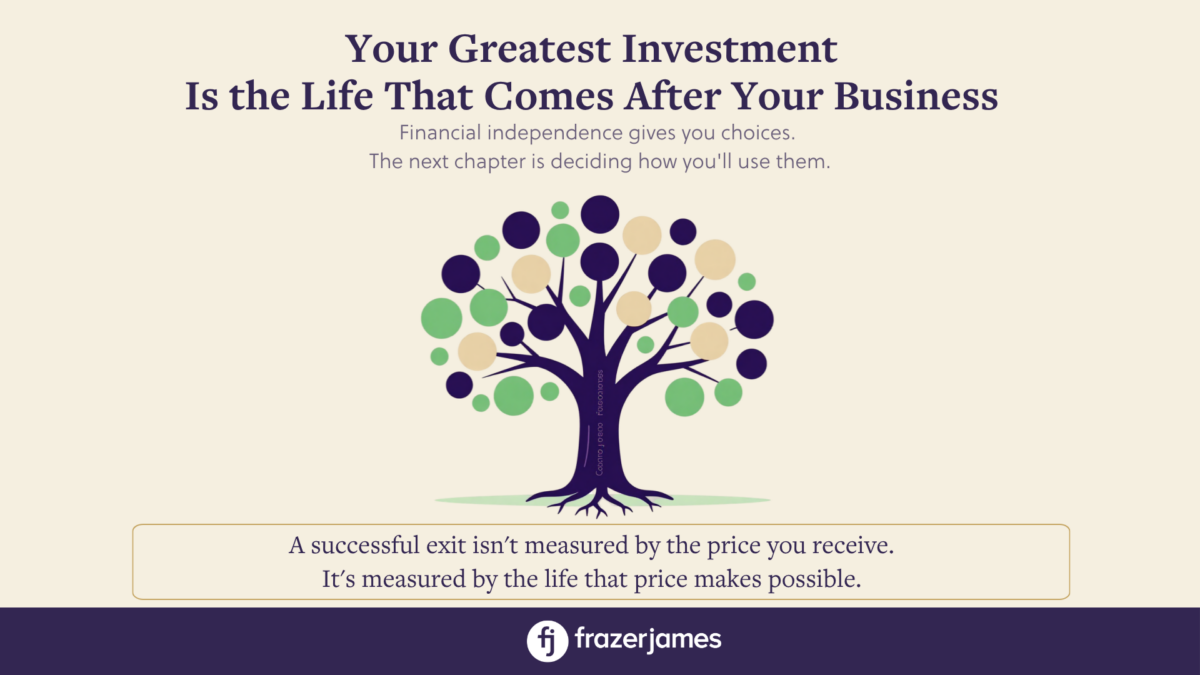
For many business owners, the company has provided more than just an income for a long time. It provided structure: a reason to get up, a set of decisions to make, a team to lead. It provided identity: a shorthand for who they are in rooms full of other people. And it provided purpose: something that genuinely matters beyond the next financial statement.
All of that stops on completion day.
Research from the Yale School of Management found that 60% of entrepreneurs, even six years after selling, had still not found a stable sense of purpose or identity. The same research found that only 20% had planned for life after the sale, and just 22% found that life matched their expectations once they got there. (Source: Wasserstein and Swearingen, Yale School of Management, 2025)
What happens to the people?
One of the things owners least expect to carry after the deal is the weight of what happens to their team.
Most owners have spent years making decisions about the people in their business. Hiring them. Supporting them. Worrying about them in quiet moments. When a sale completes, control over those decisions transfers to someone else. That transition is harder than most owners anticipate, and it can drive poor decisions in the final stages of a deal, accepting worse terms, resisting a buyer who would be good for the business but feels like an outsider, or prolonging the process because letting go of the team feels like abandoning them.
Naming this in advance does not make it easier. But owners who have thought about it clearly tend to make better decisions when it becomes real.
The five questions revisited
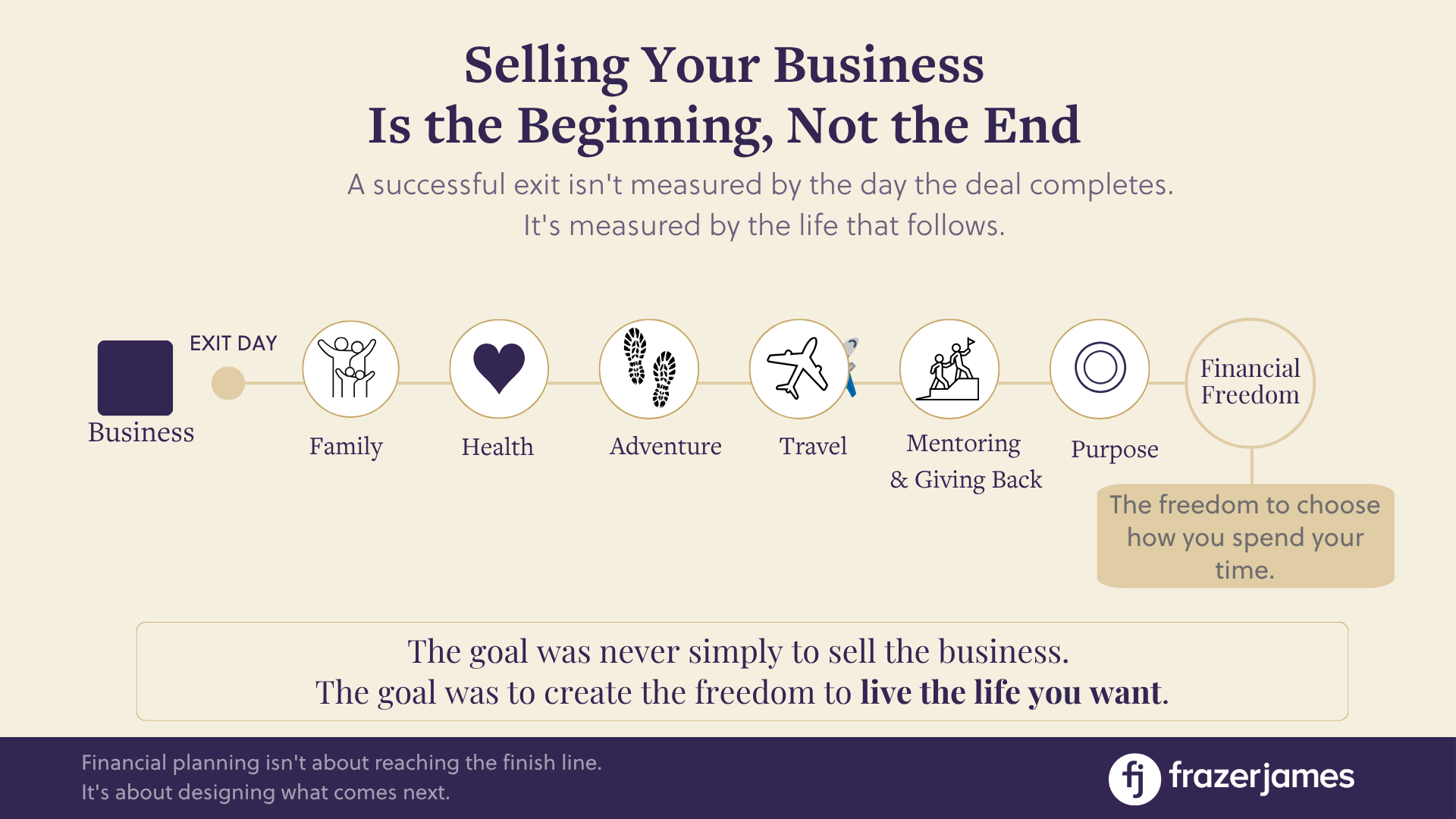
At the start of this guide, five questions were posed. The first three have financial answers. The last two do not.
What will you do with your time in year two? And who are you, without the business?
These are not abstract philosophical questions. They are practical ones that shape financial decisions. The owner who has a clear picture of what their next chapter looks like makes different decisions about the deal structure. They take a different view on the earn-out. They are harder to pressure into accepting the wrong terms because they know what they are moving towards, not just what they are leaving.
The owners who handle an exit best are the ones who can answer all five questions before the deal is done. Financial planning and life planning are not separate projects. They are the same project, approached from different angles.
Key takeaways
This checklist exists because business preparation and personal preparation are not the same thing, and the gap between them is where most of the expensive mistakes happen.
- Some planning windows close before the sale process starts. BADR qualifying conditions, pension carry-forward, and share restructuring all require lead time. Starting at six months before exit, most of the highest-value options close.
- Know your number before you know your buyer. The sale price you need is a personal calculation based on your life and your financial position, not a figure chosen because it sounds like success. Owners who know their number go into negotiations with clarity; owners who don’t go in with a vague target and hope.
- The structure of the deal is as important as the headline price. A clean exit at a lower number can leave you better off, financially and personally, than a higher number tied to an earn-out. Know your position before it becomes a negotiation.
- The proceeds need a plan before they arrive. Decisions made with a large sum in a current account and no clear destination are among the costliest in personal finance. Draft the structure in advance, in the quiet, before the pressure of completion.
- The personal preparation matters as much as the financial one. The owners who handle an exit best are the ones who knew what they were selling towards. Not just financially. The structure, the purpose, the next chapter. Everything else is easier when that question has an answer.
Talk to Frazer James
Most business owners entering a sale process have a strong commercial team around them. The personal financial preparation is usually left to chance, or to afterwards.
We work with business owners in the 24 months before a sale to ensure personal planning keeps pace with business planning: establishing the financial independence number, structuring the pre-sale period, planning for the proceeds, and thinking seriously about what follows.
Book an initial consultation or call us on 0117 990 2602.
This article is for general information purposes only and does not constitute financial or tax advice. Tax rules may change and their application depends on individual circumstances. Independent professional advice should be sought before acting on anything in this article. Figures are correct as at July 2026. Frazer James Financial Advisers is authorised and regulated by the Financial Conduct Authority.
About The Author

Frequently Asked Questions
What should I do financially before selling my business?

When should I start financial planning before a business exit?
What is an earn-out and should I accept one?
What should I do with the proceeds when the sale completes?
How do you prepare for life after selling a business?
How much do I need to sell my business to retire?
How much tax will I pay when selling my business?
Do I qualify for Business Asset Disposal Relief?
Is it better to sell shares or business assets?
Can I put business sale proceeds into my pension?
Related news













Get in touch
Schedule a free consultation with one of our financial advisers, or give us call.
0117 990 2602