 Client Login
 Retirement assessment
 Book a call
 0117 990 2602


Modified on: November 2026
Sequencing Risk: Why the First Five Years of Drawdown Decide Whether Your Money Lasts
Two people retire at 62 with £1.25 million in their pensions. Both take the same income. Over 30 years, their investments earn exactly the same returns. One runs out of money at 82. The other still has more than £500,000 at 95.
The only difference is the order the good and bad years arrived in. This is called sequencing risk, and it is one of the biggest risks you face once you start drawing an income from your pension.
This guide is for people within a few years of retiring. It is for anyone with a pension pot they plan to draw on, rather than swap for a guaranteed income. We show the two retirements side by side, explain why the first few years matter so much, and set out what actually helps.
At a glance
- Sequencing risk is the risk that poor investment returns arrive early in retirement, while you are taking money out.
- Losses early on do far more damage than the same losses later, because you are selling investments while their value is low.
- In our example, a bad start makes the money run out 13 years sooner than steady returns would. With the bad years last, it never runs out.
- No single fix removes the risk. A few simple steps, used together, made the money last 11 years longer in our example.
- Our free pension drawdown calculator lets you test your own figures.
First, two terms you need
Drawdown
Drawdown means leaving your pension invested and taking an income from it as you need it. The pot can keep growing, but it can also fall. Nothing is guaranteed, and the money can run out.
The main alternative is an annuity. An annuity swaps some or all of your pension for a guaranteed income for life. Many people use a mix of the two.
Returns after inflation
All the figures in this guide are in today’s money. That means we take off the effect of rising prices, so £60,000 always buys what £60,000 buys today. The returns are also after investment charges.
A return of 3% a year after inflation and charges is a common long-term planning assumption for a mixed portfolio. It is not a promise, and real returns go up and down from year to year.
What is sequencing risk?
Sequencing risk is the risk that bad investment years come at the worst possible time. For someone drawing an income, the worst time is the first few years of retirement.
If you simply leave a pot invested, the order of returns does not change where you end up. If it falls 18% one year and rises 20% the next, you end up in the same place as if the rise came first.
Once you start taking money out, that stops being true. In a bad year, you have to sell more of your investments to raise the same income. Those investments are gone, so they cannot recover when markets bounce back.
That is why a fall in your first year of retirement can hurt far more than the same fall at 85. By then, you are drawing on a smaller pot, with fewer years left to fund.
Two retirements, side by side
Here is the example in full. It is illustrative only.
- Both retire at 62 with £1.25 million in their pensions.
- Both take £60,000 a year from the pot, in today’s money. That is about 4.8% of the starting pot.
- Over 30 years, both receive exactly the same set of returns. They average 3% a year after inflation and charges.
- Retiree A meets the bad years first. Their investments fall 18%, then 12%, then 6% in the first three years.
- Retiree B gets the same returns in reverse. Their first three years bring gains of 7%, 6% and 3%. The falls come at 89, 90 and 91.
We also show a third person, who earns a steady 3% every single year. Real markets never behave like this, but it is what most simple calculators assume.
| Pension pot at age | Steady 3% a year | Retiree A: bad years first | Retiree B: bad years last |
|---|---|---|---|
| 62 (start) | £1,250,000 | £1,250,000 | £1,250,000 |
| 65 | £1,180,000 | £682,000 | £1,273,000 |
| 70 | £1,050,000 | £589,000 | £1,265,000 |
| 75 | £899,000 | £394,000 | £1,270,000 |
| 80 | £723,000 | £154,000 | £1,242,000 |
| 85 | £520,000 | Run out | £1,158,000 |
| 90 | £284,000 | Run out | £1,127,000 |
| Money runs out at | 95 | 82 | Still £584,000 left at 95 |
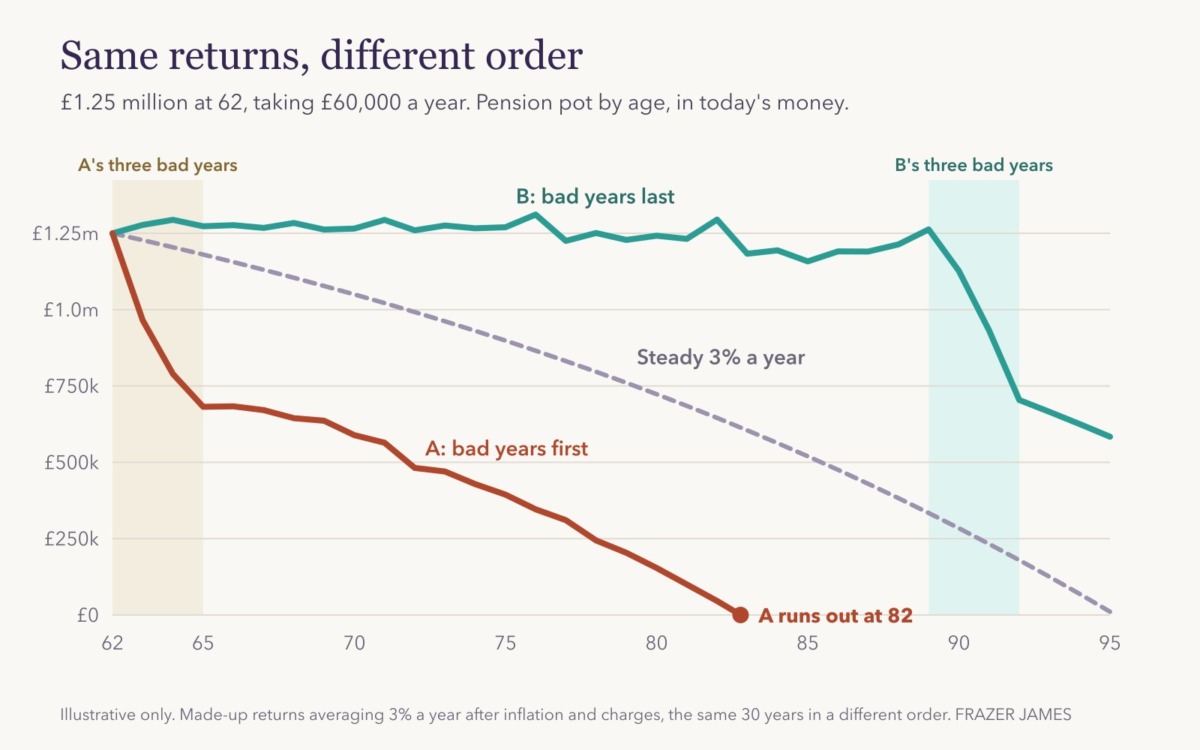
After just three years, Retiree A has £682,000 left. Retiree B has £1.27 million. That gap of about £591,000 opened up while their long-run returns were identical, and A never catches up.
Notice the steady line too. It runs out at 95, which looks comfortable. But it hides the risk completely. A plan that only works if every year is average is not much of a plan.
Why the first five years matter most
Three things make the early years so important.
- The pot is at its biggest. A fall of 18% on £1.25 million is a loss of £225,000. The same fall on £400,000 at 85 is £72,000.
- You are selling at low prices. Each £60,000 you take in a falling year uses up more of your investments. Those units are no longer there for the recovery.
- The rest of your retirement depends on it. A shortfall at 64 has to be funded for another 30 years. A shortfall at 88 has a few years left to fund.
This is why many planners call the five years either side of retirement the risk zone. What happens then often decides the whole outcome.
What actually helps
We tested several common steps on Retiree A’s bad start. Some help more than people expect. Some help less. These are the results, all illustrative only.
1. Take a little less in the early years
If Retiree A takes £50,000 a year for the first five years instead of £60,000, the money lasts to 84 instead of 82. Taking 20% less in the year after each fall has a similar effect.
That may sound small. But it costs very little in lifestyle, and it adds up when combined with the steps below.
2. Let the State Pension take some of the strain
The full new State Pension is £12,548 a year in 2026/27. If Retiree A can draw that much less from the pot once it starts at 67, the money lasts to 89 instead of 82.
Check your own State Pension age and forecast on GOV.UK. It is the closest thing most people have to a guaranteed, inflation-linked income.
3. Use both together
With both steps, Retiree A’s money lasts to 93. That is 11 years more than doing nothing, from the same bad start and the same returns.
4. Cover your essential spending with guaranteed income
Some people use part of their pension to buy an annuity. It pays for essential bills such as food, energy and council tax for life. The rest stays in drawdown for everything else.
Then a bad year in the markets means a smaller holiday, not a missed bill. Whether this suits you depends on annuity rates, your health and your other income.
5. Keep a cash reserve, for the right reason
Many people keep one or two years of spending in cash, so they do not have to sell investments in a falling market.
In our example, a two-year cash reserve on its own made almost no difference to how long the money lasted. Cash earns little after inflation, and refilling it has a cost.
Its real value is calmer decisions. It gives you time to wait, rather than selling in a panic at the bottom.
Try it with your own figures
Our free pension drawdown calculator shows how long your pot could last at the income you want, year by year.
Enter £1,250,000, £60,000, age 62 and 3% growth, and you will see the steady line above run out at 95. Then try your own figures.
The calculator assumes the same return every year, like our steady line. So try a lower growth rate too, such as 1%. That gives you a rough sense of how a poor start could change your answer.
Pension Drawdown Calculator 2026/27
How long will your pension actually last?
One pot, one income, one growth rate. It shows how long the money lasts and nothing else, so the arithmetic stays easy to follow. Other income is deliberately left out.
What the numbers say (before tax)
,
What the pot does, year by year ,
,
Illustrative only, not financial advice. Assumes 3% investment growth a year after inflation and charges. Every figure is therefore in today’s money. The pot grows, then pays out each year. The State Pension and any other income are deliberately excluded, because those amounts differ for everyone and most people have more than one. The 4% figure is a guide rate, not a guarantee, real outcomes depend on the order of good and bad years, not just the average. Tax on withdrawals is deliberately excluded. Beyond the 25% tax-free element, drawdown is taxed as income. For most people that is the single biggest number planning can improve. Talk your figures through with us, the first conversation is free.
Why this matters more from April 2027
From 6 April 2027, most unused pension savings will count towards your estate for inheritance tax. Inheritance tax is the tax your family may pay on what you leave when you die.
Until now, many people took income from other savings first and left their pension untouched for their family. After April 2027, more people are likely to draw on their pensions sooner and harder.
Drawing more from your pension in the early years can make sequencing risk bigger. So it is worth planning both together: how much to take, from where, and in what order.
Talk to a certified financial planner
Within a few years of retiring?
We can model your own retirement through good and bad years, not just an average one. We look at your pensions, your other savings, your tax and your family plans together. Read how we help people planning their retirement, or see our guide to planning for retirement. The first conversation is free, with no pressure to proceed.
Important information
The examples in this guide are illustrative only and are not personal advice. The returns are made up to show the effect of their order. They are not a forecast. All figures are in today's money, after inflation and charges, and ignore income tax.
The value of investments, and the income from them, can go down as well as up. You may get back less than you put in. Past performance is not a reliable guide to the future. You cannot usually take money from a pension until age 55, rising to 57 from 6 April 2028.
State Pension figures are for 2026/27. We checked the figures in this guide on 26 October 2026.
About The Author

About The Author

Frequently Asked Questions
What is sequencing risk?

Does sequencing risk affect an annuity?
How much can I take from my pension each year?
Is a cash reserve worth having?
Does sequencing risk matter while I am still saving?
Related news










Get in touch
Schedule a free consultation with one of our financial advisers, or give us call.
0117 990 2602