 Client Login
 Retirement assessment
 Book a call
 0117 990 2602


Modified on: November 2026
Cash After Selling Your Business: What the April 2027 Savings Tax Rise Really Costs
The Budget on 28 October 2026 raised the tax on savings interest. From 6 April 2027, interest is taxed at 24%, 44% or 49%, depending on your income. Today the rates are 20%, 40% and 45%.
For most people, that costs a few hundred pounds a year. For a business owner holding the proceeds of a sale, it costs more. But as we show below, the tax rise is not the biggest cost of holding a lot of cash.
This guide is for owners who have sold a business, or expect to soon. It also covers owners with cash sitting in their company. We show what the change costs, the two bigger costs that are easy to miss, and the options to look at before April 2027.
At a glance
- From 6 April 2027, tax on savings interest rises by 4 percentage points at every rate. The tax-free Personal Savings Allowance stays the same.
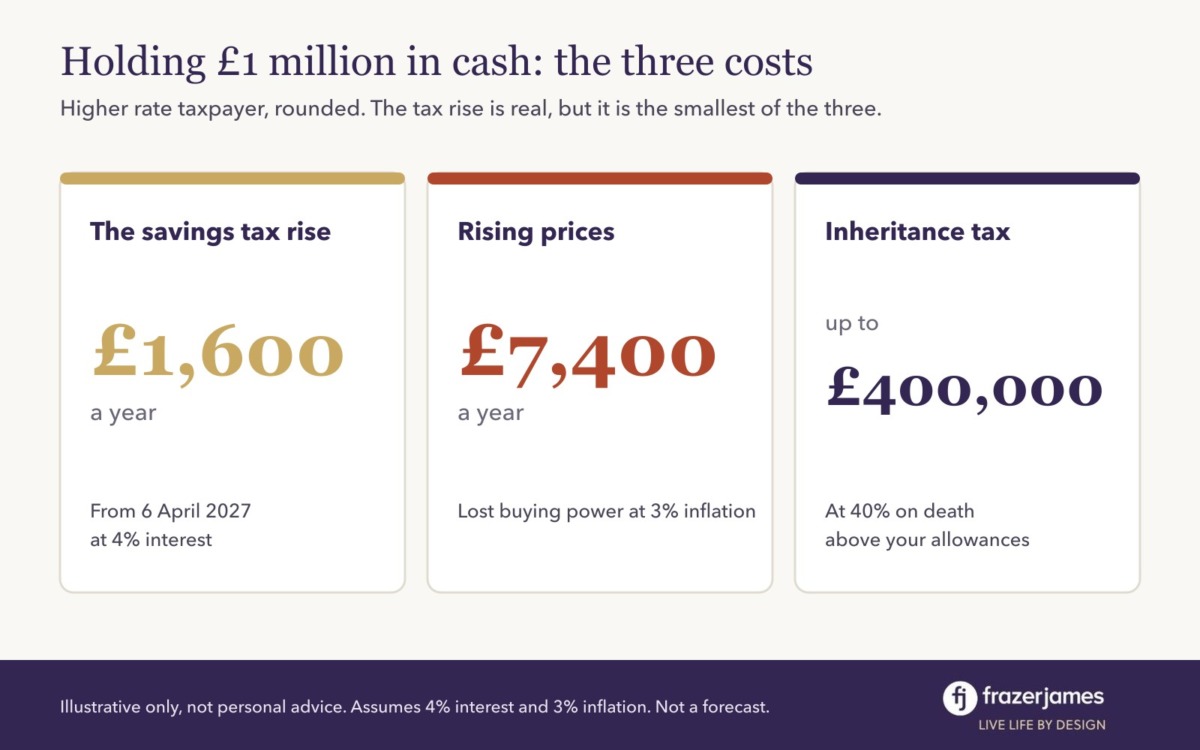
- On £1 million in cash earning 4%, a higher rate taxpayer pays about £1,600 a year more. That is real, but it is not the main problem.
- After tax, cash can lose value to rising prices. It also sits fully in your estate for inheritance tax, often at 40%.
- Cash inside a company is not hit by this rise, because the company pays Corporation Tax. But interest or rent your company pays you is.
- Options include ISAs, pensions, sharing savings with your spouse and tax-free products. The right mix depends on what the money is for.
First, how savings interest is taxed
Interest from bank and building society accounts counts as income. It is added to your other income, such as a salary, pension or rent, and taxed at your rate.
Most people can earn some interest tax-free under the Personal Savings Allowance. It is £1,000 a year for basic rate taxpayers and £500 for higher rate taxpayers. If your income is over £125,140, you pay the additional rate and get no allowance.
Interest inside an ISA or a pension is not taxed at all. That will not change.
What counts as savings interest
The new rates apply to income HMRC treats as savings interest. That includes:
- Interest from bank and building society accounts, including fixed-term and notice accounts.
- Interest from credit unions and from NS&I accounts such as Direct Saver and Income Bonds.
- Interest distributions from unit trusts, open-ended funds and investment trusts. These usually come from bond or cash funds.
- Interest from government bonds, called gilts, and from company bonds.
- The interest part of most annuities you buy with your own money, outside a pension.
- Interest your own company pays you on money you have lent it.
What does not count
- Interest inside an ISA or a pension. It is tax-free.
- Premium Bond prizes and NS&I Savings Certificates. These are tax-free too.
- Dividends, including dividend distributions from funds. These have their own rates, which did not change.
- Gains when you sell gilts or other investments. These come under Capital Gains Tax, not savings tax.
- Rent. It is property income, but it rises to the same new rates in England, Wales and Northern Ireland.
- Salary and pension income. These are taxed as earnings, at rates that did not change.
What the Budget changed
| Your rate | Tax on savings interest now (2026/27) | From 6 April 2027 | Tax on £10,000 of interest now | From April 2027 |
|---|---|---|---|---|
| Basic rate | 20% | 24% | £2,000 | £2,400 |
| Higher rate | 40% | 44% | £4,000 | £4,400 |
| Additional rate | 45% | 49% | £4,500 | £4,900 |
The table ignores the Personal Savings Allowance. The new rates apply across the UK. The same rates will apply to rental income in England, Wales and Northern Ireland.
Tax on dividends and on earnings did not change. The cash ISA allowance stays at £20,000, after an earlier plan to cut it was dropped.
What it costs on the proceeds of a sale
These examples are illustrative only. They assume the cash earns 4% a year and all the interest is taxed at the same rate.
| Cash held | Interest a year | Your rate | Tax now | Tax from April 2027 | Extra a year |
|---|---|---|---|---|---|
| £500,000 | £20,000 | Higher | £7,800 | £8,580 | £780 |
| £1,000,000 | £40,000 | Higher | £15,800 | £17,380 | £1,580 |
| £1,000,000 | £40,000 | Additional | £18,000 | £19,600 | £1,600 |
For a higher rate taxpayer, the first £500 of interest is tax-free, so the tax is on £39,500. That is why the table shows £1,580 rather than £1,600.
So the rise itself costs roughly £1,600 a year on £1 million. That is worth avoiding where you sensibly can. But two other costs are usually far larger.
The two bigger costs of holding cash
1. Rising prices
From April 2027, a higher rate taxpayer keeps 56p of every £1 of interest above the £500 allowance. Cash earning 4% before tax then earns about 2.3% after tax.
If prices rise by 3% a year, that cash is losing value in real terms. On £1 million, the loss of buying power is about £7,400 a year. That is nearly five times the cost of the tax rise. These figures are illustrative only.
2. Inheritance tax
While you owned a trading company, its shares could usually pass to your family free of inheritance tax. That is because of Business Relief, which covers up to £2.5 million per person at 100%.
Once you sell, that protection usually ends the same day. The cash is part of your estate. Above your allowances, it can be taxed at 40% when you die. On £1 million, that could mean £400,000 less for your family.
From 6 April 2027, most unused pensions will count towards your estate too. So the order in which you spend your money matters more than it used to.
Options to look at before April 2027
None of these is right for everyone. Most people keep some cash on purpose, for spending and emergencies. The question is how much, and where the rest should go.
ISAs
You can each put £20,000 a year into ISAs. Interest, dividends and gains inside an ISA are tax-free. A couple can shelter £40,000 between them in every tax year.
Your pension
Before a sale, your company can usually pay into your pension, up to your annual allowance. That is normally £60,000 a year, with unused allowance from the last three years often available too. After the sale, without earnings, you can usually only pay in £3,600 a year with tax relief. This is why timing matters. See our guide to company pension contributions.
Sharing savings with your spouse or partner
Moving money to a spouse or civil partner is usually free of Capital Gains Tax and inheritance tax. If they pay a lower rate of income tax, or have their own Personal Savings Allowance unused, less tax is due on the interest.
Tax-free and lower-tax products
- Premium Bonds. Prizes are tax-free, up to a holding of £50,000 each. There is no guaranteed return. Read our guide to Premium Bonds.
- Government bonds, called gilts. Gains on gilts are free of Capital Gains Tax. The interest is still taxed. Some gilts pay little interest and most of their return as a gain.
- Investing for the long term. Money you will not need for many years can be invested for growth. Gains are taxed at Capital Gains Tax rates, and dividends at dividend rates, neither of which rose in this Budget.
Planning for inheritance tax
Gifts, trusts and some types of investment can reduce inheritance tax over time. Our guide to reducing inheritance tax explains the main allowances. Our inheritance tax calculator shows your estate before and after the April 2027 pension change.
If the cash is still in your company
Many owner-directors keep profits in the company rather than paying them out. Interest the company earns on that cash is taxed at Corporation Tax rates, between 19% and 25%. The savings tax rise does not touch it.
But some payments from the company to you do count as savings or rental income, so they are hit:
- Interest on money you have lent to the company. If the company pays you interest on a director’s loan, it is taxed as savings income from April 2027.
- Rent for property you own personally. If the company rents premises or space from you, that rent is property income and will be taxed at the new property rates.
Dividends did not change. They are taxed at 10.75%, 35.75% and 39.35% in 2026/27 and 2027/28. For some owners, the mix of salary, dividends, interest and pension payments is now worth looking at again. Our profit extraction check is a good place to start.
If you are planning to sell, there is one more reason to look at the cash. A large pile of cash or investments can put the company’s trading status at risk for Business Asset Disposal Relief. HMRC uses a rough guide of 20% of the company’s activities, assets or income.
A simple order of questions
- How much do you need in cash for the next two or three years of spending and emergencies?
- Have you and your spouse or partner used this year’s ISA allowances?
- Can more go into a pension, either before a sale or within your allowance afterwards?
- Who should hold the savings, so the interest is taxed at the lowest rate?
- What should the rest of the money do, and for how long?
- How will your estate be taxed, and who do you want it to go to?
If you have just sold, there is rarely a need to decide everything in the first few months. Read our guide on what to do after you have sold your business.
See your own numbers
Use the calculator below with your own figures. It shows the extra tax from the Budget, and what rising prices take from the interest you keep.
Cost of cash calculator, from April 2027
What is holding this cash really costing you?
The extra tax from the Budget, and what rising prices take from the interest you keep. Change the figures to match your own.
Each year, from 6 April 2027
Enter the cash you hold, the interest rate, inflation and the number of years to see what holding it costs.
After 10 years, interest left in the account
,
Illustrative only, not financial advice. Assumes the interest rate and inflation stay the same every year, and that all the interest is taxed at the rate you choose, after the Personal Savings Allowance (£1,000 at the basic rate, £500 at the higher rate, none at the additional rate). Savings tax rates are 20%, 40% and 45% in 2026/27, and 24%, 44% and 49% from 6 April 2027, across the UK. The starting rate for savings, ISAs and accounts held in joint names are not included. Interest inside an ISA or a pension is not taxed. Talk your figures through with us, the first conversation is free.
To see what your family could pay in inheritance tax, try our inheritance tax calculator.
Talk to a certified financial planner
Sold your business, or about to?
If you have sold a business, or expect to, we can help you decide what the money needs to do, and where it should sit. That includes income, tax, pensions and inheritance tax, planned together. Read about our financial planning for business owners, see our guide to business exit planning, or book a free consultation. The first conversation is free, with no pressure to proceed.
Important information
This guide gives information, not personal advice. The examples are illustrative only. They assume a 4% interest rate and 3% inflation, and are not a forecast.
Tax rules can change, and how they apply depends on your circumstances. Scotland sets its own rates of income tax on earnings, but the new savings rates apply across the UK.
The value of investments can fall as well as rise, and you may get back less than you invest. Premium Bonds have no guaranteed return. We checked the figures in this guide against the Budget documents and HMRC’s notes on 29 October 2026.
About The Author

About The Author

Related news






Get in touch
Schedule a free consultation with one of our financial advisers, or give us call.
0117 990 2602