 Client Login
 Retirement assessment
 Book a call
 0117 990 2602


Modified on: October 2026
Gifts Out of Surplus Income: How to Pass On Your Pension Free of Inheritance Tax After April 2027
Are you looking for ways to reduce your inheritance tax liability? If you receive more income than you spend, there is a valuable exemption that you can use to legally reduce it. Gifts made from your spare income are free of inheritance tax from the day you make them. There is no seven-year wait, and no upper limit.
It is called gifting out of surplus income. HMRC’s name for it is the “normal expenditure out of income” exemption. It has been part of inheritance tax law since 1984, but few people use it well.
From April 2027, it matters a lot more. That is when most unused pensions start to count towards your estate for inheritance tax. For many people with large pensions, leaving the pension to the children will no longer be the tax-free plan it was. Taking an income from it and giving away what you do not need may work better.
This guide is for people who are retired, or close to retiring, with a large pension and a comfortable income. We explain the three tests HMRC applies, what counts as income, and how the sums work after April 2027. We also show how to keep the records your family will need.
Budget watch
The Budget is on 28 October 2026. Some commentators have suggested a cap on this exemption. Nothing has been announced, and the same idea came to nothing in 2024 and 2025. We will update this guide on 29 October 2026.
At a glance
- Regular gifts made from your spare income are free of inheritance tax straight away. There is no cash limit.
- Three tests apply. The gifts must be part of a regular pattern, come from income rather than savings, and leave you enough to live on as normal.
- Regular withdrawals from a pension count, generally including regular tax-free cash. So do dividends, rent and interest. Profit left inside your company does not.
- From 6 April 2027, most unused pensions count towards your estate. Drawing an income and giving away the surplus can leave your family with more.
- Nothing is claimed while you are alive. Your executors claim it after your death, so the records you keep now are what make it work.
First, a few terms you need
Inheritance tax is a tax on what you leave when you die. Most people can leave £325,000 free of the tax. This is called the nil-rate band. Anything above it is usually taxed at 40%.
The residence nil-rate band is an extra £175,000 you can use if you leave your home to your children or grandchildren. A married couple or civil partners can pass unused allowances to each other. Together, they can leave up to £1 million free of inheritance tax.
Your estate is everything you own when you die. That includes your home, savings, investments and possessions. From April 2027, it will include most unused pensions too.
Drawdown means leaving your pension invested and taking money out as you need it. The money you take out is taxed as income, apart from any tax-free cash.
How gifting out of surplus income works
Most gifts you make are not taxed at the time. But if you die within seven years, they can be added back to your estate. This is known as the seven-year rule.
Gifts out of surplus income are different. If they pass HMRC’s three tests, they leave your estate as soon as you make them. They are never added back, however soon you die. And there is no limit on how much you can give this way.
That makes it one of the most valuable allowances in inheritance tax. It suits people whose income is more than they need, year after year.
The three tests HMRC applies
The law sets three conditions. Your gifts must meet all three.
1. The gifts are part of your normal spending
“Normal” means normal for you, not for the average person. HMRC looks for a regular pattern. It considers how often you give, how much, who receives the gifts and why.
The gifts do not have to be the same amount each time, or go to the same person. A single gift can count if it is clearly the first of a planned series. A letter setting out your plan helps to show this.
2. The gifts come from income, not savings
The money must come from your income after tax. Gifts from savings, investments or the sale of an asset do not count.
Income you do not spend does not stay income for ever. HMRC usually treats it as savings once it has been building up for two years. So gift your surplus within a year or two of receiving it.
3. You can still live as you normally do
After making the gifts, you must have enough income left to keep up your usual standard of living. If you have to dip into savings to pay your normal bills, the test fails. The exemption may then cover only part of the gifts.
HMRC looks at this year by year, using tax years that end on 5 April. Where income goes up and down, it can look across several years together.
What counts as income, and what does not
| Type of money | Counts as income for this exemption? |
|---|---|
| Salary, bonus or self-employed profits | Yes |
| Regular income from pension drawdown | Yes. Take a regular amount, not ad hoc sums |
| State Pension and final salary pensions | Yes |
| Dividends paid to you by your company | Yes |
| Rent and interest | Yes |
| Regular tax-free cash, taken in stages alongside your drawdown income | Generally yes. Industry guidance treats regular tax-free cash payments as income, but HMRC has not explicitly confirmed it |
| A one-off tax-free lump sum from your pension | Treat it as savings to be safe. A single large sum looks like capital, not regular income |
| Withdrawals from an investment bond | No. They are a return of your own capital |
| The capital part of a purchased annuity | No |
| Profit kept inside your company | No, until it is paid to you |
If you own a business, the last row matters. Profit sitting in your company is not your income. Once it is paid to you as salary or dividends, it is. So a regular dividend can fund regular gifts. A large one-off dividend paid to fund a single gift is harder to defend as normal. Our guide to inheritance tax planning for business owners covers the wider picture.
Why April 2027 changes the sums for your pension
Until now, a pension has been one of the best things to leave behind. It usually sat outside your estate for inheritance tax. So many people spent their other savings first and left the pension untouched.
From 6 April 2027, that changes. Most unused pensions will count towards your estate. If your estate is above the tax-free amounts, your pension could lose 40% to inheritance tax.
If you die aged 75 or over, there is a second tax. Whoever inherits the pension pays income tax on what they take out, at their own rate. We explain the age-75 rule in what happens to your pension when you die. That is charged on what is left after inheritance tax.
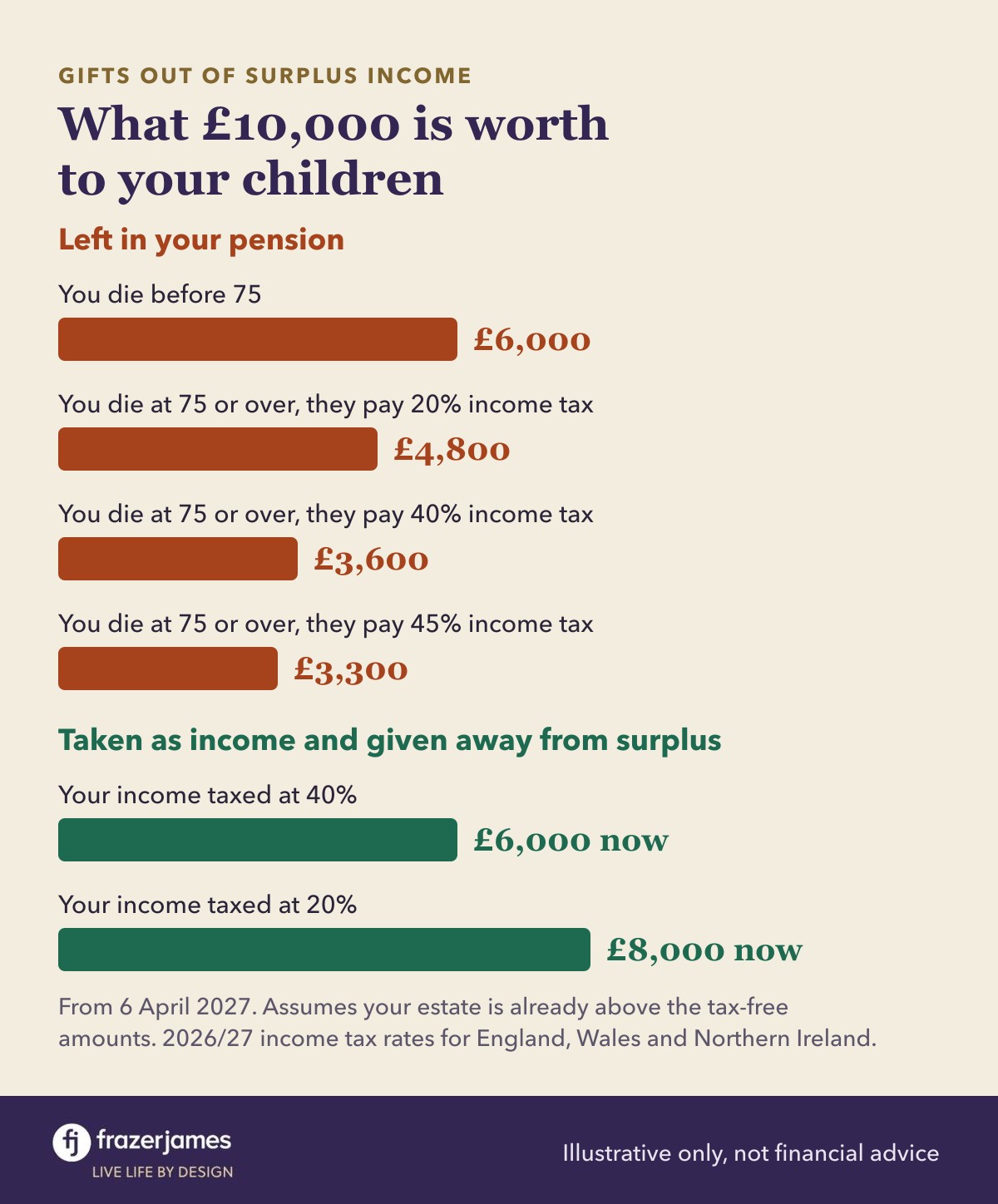
What £10,000 is worth to your children
This compares £10,000 left in your pension with £10,000 taken out as income and given away. It assumes your estate is already above the tax-free amounts.
Show the workingsTap to open
What we assume: your estate is already above the tax-free amounts, so your pension faces 40% inheritance tax. We use 2026/27 income tax rates for England, Wales and Northern Ireland, with no investment growth. The gifts meet HMRC’s three tests.
Left in the pension, you die before 75: inheritance tax takes 40% of the £10,000, which is £4,000. Your children receive £6,000. They pay no income tax on it.
Left in the pension, you die at 75 or over: the same £6,000 is left after inheritance tax. Your children then pay income tax on it as they take it out. At 20%, they keep £4,800. At 40%, they keep £3,600. At 45%, they keep £3,300.
Taken as income and given away: you pay income tax on the £10,000 first. At 40%, you have £6,000 left to give. At 20%, you have £8,000. The gift is free of inheritance tax straight away, so your children receive all of it, now.
The pattern is clear. Income taxed at 20% and given away beats leaving the money in the pension in every case. Income taxed at 40% matches it before 75, and beats it after. And your family has the money while you are here to see it used.
The £2 million trap
There is a second effect, and it catches many people by surprise. The extra £175,000 for your home starts to shrink once your estate is worth more than £2 million. You lose £1 of it for every £2 above that figure.
From April 2027, your pension counts towards that £2 million. An estate that was well below it can suddenly be above it.
Take a widow whose late husband left her his unused allowances. She has a home worth £750,000, £400,000 in savings and ISAs, and £1.1 million in pensions. She leaves everything to her two children.
| Before April 2027 | From April 2027 | |
|---|---|---|
| Estate for inheritance tax | £1,150,000 | £2,250,000 |
| Home allowance (two lots of £175,000) | £350,000 | £225,000 |
| Total tax-free amount | £1,000,000 | £875,000 |
| Inheritance tax | £60,000 | £550,000 |
While her estate is between £2 million and £2.7 million, every £10,000 she gives away saves £6,000 in tax, not £4,000. That is 40% on the gift, plus the allowance she wins back.
Surplus Income Gifting Checker 2026/27
How much could you give from surplus income each year?
Enter your income and what you spend in a normal year. See the surplus you could give away free of inheritance tax, and roughly how much tax that could save your family.
Based on income tax rates in England, Wales and Northern Ireland, 2026/27
What the numbers say
Enter your income and what you spend in a normal year to see your surplus.
,
What giving it away could save
,
,
Illustrative only, not financial advice. Income tax uses 2026/27 rates for England, Wales and Northern Ireland, with interest taxed as ordinary income, so the tax shown can be a little high. Gifts only qualify if they are regular, come from income and leave you enough to live on as normal. Income you do not spend for two years is usually treated as savings. The saving assumes your home goes to your children or grandchildren, the nil-rate band is £325,000 and the home allowance is £175,000, reduced by £1 for every £2 your estate is worth above £2 million. From 6 April 2027, most unused pensions count towards your estate. Values are held level, with no growth. Rules checked on GOV.UK on 18 October 2026, and due to be checked again after the Budget on 28 October 2026.
Worked example: a retired business owner with £1.1 million in pensions
Let us go back to the widow above. She is 66 and sold her business six years ago. She has already taken her tax-free cash. She spends about £42,000 a year, after tax.
- Her State Pension and a small final salary pension pay £14,000 a year.
- She sets up drawdown of £70,000 a year from her pension.
- Her total income is £84,000. Income tax on that is £21,032.
- That leaves £62,968 after tax. Take away her spending of £42,000, and her surplus is £20,968.
She writes a short letter setting out her plan. Then she sets up standing orders worth £20,000 a year. Part goes into her two children’s pensions. The rest goes into Junior ISAs for her three grandchildren.
Over ten years, that moves £200,000 out of her estate. Every gift is free of inheritance tax from the day she makes it. At 40%, that is £80,000 less tax for her family. While her estate is above £2 million, the saving is higher.
There is a trade-off. She pays more income tax now than if she left the pension alone. Our guide to cutting tax on your retirement income shows how to keep that bill down. That only makes sense because the pension would otherwise face 40% inheritance tax, plus income tax after 75. The case is strongest for income taxed at 20%, and for people who expect to live past 75.
One more point. Taking taxable income from drawdown starts a lower limit on what you can pay into pensions, of £10,000 a year. This is called the money purchase annual allowance. If you or your employer are still paying in, check this before you start.
These examples are illustrative only. They use 2026/27 income tax rates for England, Wales and Northern Ireland. Values are held level, with no investment growth.
What people use surplus income for
- A child’s or grandchild’s pension. You can pay into someone else’s pension. They usually get tax relief on it too. For a child with no earnings, up to £2,880 a year can go in, topped up to £3,600.
- Junior ISAs. Up to £9,000 a year can go into a Junior ISA for each child under 18.
- School or university fees. Regular payments towards a grandchild’s fees are a common pattern.
- Help with a mortgage or rent. A set monthly sum towards a child’s housing costs.
- Life insurance in trust. Some people use surplus income to pay the premiums on a policy that will help pay the inheritance tax bill.
Gifts to a husband, wife or civil partner are already free of inheritance tax. So this exemption is mainly about gifts to children, grandchildren and others.
How to set it up, and the records your family will need
Nothing is claimed while you are alive. After your death, your executors claim the exemption on HMRC form IHT403. They must show your income, your spending and your gifts, year by year. If the records are missing, the claim can fail. The gifts then fall back under the seven-year rule.
- Write a letter of intent. Say what you plan to give, to whom, how often, and that it comes from surplus income. Sign and date it, and keep a copy with your will.
- Make the gifts regular. A standing order is the clearest evidence of a pattern.
- Keep a yearly record. For each tax year, note your income after tax, your normal spending and your gifts. Keep the bank statements that back it up.
- Keep the money separate. Paying income into one account and making gifts from it makes the link easy to show.
- Review it every year. If your income falls or your spending rises, adjust the gifts. Do not dip into savings to keep them going.
Here is what one year of the widow’s record could look like. Form IHT403 asks your executors for the same details, year by year.
| Tax year | Income after tax | Normal spending | Surplus | Gifts made |
|---|---|---|---|---|
| 2027/28 | £62,968 | £42,000 | £20,968 | £20,000: £5,000 each into two children’s pensions, £3,333 each into three Junior ISAs |
Can you claim for gifts you have already made? If past gifts were regular, came from income and left you enough to live on, your executors can still claim for them. What you cannot do is turn one-off gifts into a pattern after the event.
Who this is for, and when to get advice
This is for people who have a lasting surplus of income over spending. That usually means a good pension income, rental income, or dividends from a business you still own. It suits estates that are likely to pay inheritance tax, especially once pensions count from April 2027.
It is not for anyone who would need savings to cover their own living costs. Nor is it a home for a one-off large gift. Those fall under the seven-year rule.
The hardest part is knowing how much surplus you really have, now and in later life. A cashflow plan shows your income and spending year by year, into your nineties. It is at the heart of planning a retirement on £1 million or more. It also becomes the evidence your executors will need.
Talk to a certified financial planner
Retired, or close to it, with more income than you need?
We can show you how much you could safely give each year, and in what order to draw on your money. We look at your pensions, savings, business and estate together. Read how we help people planning their retirement and business owners. The first conversation is free, with no pressure to proceed.
Important information
The examples in this guide are illustrative only and are not personal advice. They use 2026/27 rules and income tax rates for England, Wales and Northern Ireland. Scotland has different income tax bands. Inheritance tax rules and allowances can change, and how they apply depends on your circumstances.
The value of a pension or investment can go down as well as up. You cannot usually take money from a pension until age 55, rising to 57 from 6 April 2028. The Financial Conduct Authority does not regulate tax or estate planning.
We checked the rules in this guide against GOV.UK and HMRC’s Inheritance Tax Manual on 20 October 2026. We will check them again after the Budget on 28 October 2026.
About The Author

About The Author

Related news






Get in touch
Schedule a free consultation with one of our financial advisers, or give us call.
0117 990 2602