 Client Login
 Retirement assessment
 Book a call
 0117 990 2602


Modified on: October 2026
MPAA Explained: Take Money From Your Pension Without Cutting What You Can Pay In

Do you plan to take some money from your pension while you, or your company, are still paying in? Then one rule matters more than most. Take the money the wrong way, and the most you can pay into your pensions each year falls from £60,000 to £10,000.
That rule is called the money purchase annual allowance, or MPAA. Once it applies, it applies for the rest of your life. There is no way to reset it.
This guide is for business owners and company directors who are within a few years of retiring. Many want to start drawing on their pensions while their companies keep paying in. Done one way, that costs nothing. Done another way, it can cost tens of thousands of pounds in lost pension payments and corporation tax savings.
This article explains what triggers the MPAA, what does not trigger the MPAA, and how to take money from your pension without losing your full pension allowance.
At a glance
- For most people, the most that can go into pensions each year with tax relief is £60,000. This is the annual allowance.
- Take taxable money out of a pension in certain ways, and a £10,000 annual limit applies. That is the Money Purchase Annual Allowance (MPAA).
- Taking income from a drawdown, or taking lump sums straight from your pension, triggers it.
- Taking only your tax-free cash does not trigger it. Nor does buying a lifetime annuity that cannot go down.
- Payments from your employer or your own company count towards the £10,000, as well as your own.
Budget update
Last updated 20 October 2026, before the Budget on 28 October. We will check this page again after the Budget and update it if the rules change.
First, two terms you need
The annual allowance
The annual allowance is the most that can be paid into your pensions in a tax year with tax relief. It includes what you pay, and what your employer or company pays. For most people, it is £60,000. A tax year runs from 6 April to the following 5 April.
If more than that goes in, you pay a tax charge on the extra. This is called the annual allowance charge. It is taxed at your highest rate of income tax, so it takes back the tax relief.
Very high earners can have a lower allowance. Unused allowance from the last three tax years can usually be added to this year’s. This is called carry forward.
Money purchase pensions
A money purchase pension is a pot of money that builds up from payments in and investment growth. It is also called a defined contribution pension. Most workplace pensions, personal pensions and SIPPs work this way. A SIPP is a self-invested personal pension.
The other main type is a defined benefit pension, often called a final salary pension. It pays an income based on your salary and years of service, not on the size of a pot.
What is the money purchase annual allowance?
The money purchase annual allowance is a lower limit on what can go into money purchase pensions. It is £10,000 a year. It starts once you take taxable money out of a money purchase pension in certain flexible ways. HMRC calls this “flexibly accessing” your pension.
Three things make it more serious than it first looks.
- It covers everyone’s payments. What your employer or your own company pays in counts towards the £10,000, as well as what you pay.
- Carry forward does not help. You cannot use unused allowance from earlier years to pay more than £10,000 into money purchase pensions.
- It lasts for life. Once it starts, it cannot be undone, even if you stop taking money out.
The rule exists to stop people drawing money out and paying it straight back in, to get tax relief twice. But it also catches people who simply want to start drawing on their pension while they are still working.
If you are also building up a final salary pension, that is tested against a separate limit of £50,000. This is called the alternative annual allowance.
What triggers the MPAA
The MPAA starts on the day you first take money out in any of these ways.
- Income from flexi-access drawdown. Drawdown means leaving your pension invested and taking money out as you need it. Taking any income from it triggers the MPAA. Moving money into drawdown on its own does not.
- A lump sum straight from your pension. This is often called an uncrystallised funds pension lump sum, or UFPLS. A quarter of each payment is usually tax-free. The rest is taxed as income.
- An annuity that can go down. An annuity is a guaranteed income for life that you buy with your pension. One whose payments can fall, outside a few set cases, triggers the MPAA.
- A pension from a small scheme. This applies when fewer than 11 other people take a pension from the same money purchase scheme.
- An older drawdown plan. Capped drawdown was set up before April 2015. Taking more than its limit, or switching it to flexi-access drawdown and then taking income, triggers the MPAA.
Your pension provider must send you a statement within 31 days to say the MPAA now applies. You then have 91 days to tell any other pension scheme you are still paying into. If you do not, you could face a penalty.
What does not trigger the MPAA
- Taking only your tax-free cash. Most people can take a quarter of their pension tax-free, up to a total of £268,275. You can take it and move the rest into drawdown. As long as you take no income, the MPAA does not start.
- A lifetime annuity that cannot go down. A level annuity, or one that rises each year, does not trigger it.
- Cashing in a small pot. You can usually take up to three personal pensions worth £10,000 or less each as a cash lump sum. Small workplace pots have their own rules.
- A final salary pension. Taking an income from a defined benefit pension does not trigger it.
- A pension you inherit. Taking money from drawdown you inherited from someone else does not trigger it.
Why this matters most to business owners
For a business owner, a company pension payment is often the most tax-efficient way to take money out of the business. The company can usually deduct it from its profits before corporation tax. No income tax or National Insurance is due on it.
Many owners plan to pay £40,000 to £60,000 a year in until they sell or step back. At the same time, they want to start using their pension. They may want to work fewer days, help a child buy a home, or clear a mortgage.
If they take that money the wrong way, the company can only pay in £10,000 a year from then on. The rest has to come out as salary or dividends, which are taxed.
The same applies to employed directors and senior professionals. If you and your employer pay in more than £10,000 a year, the MPAA would force you to cut back or pay a tax charge.
Worked example: £30,000 a year, three ways
Take an owner-director aged 58. Their pensions are worth £1.25 million. Their company pays £60,000 a year into their pension. They plan to sell the business and stop work at 61.
From now on, they want an extra £30,000 a year so they can work three days a week. Here are three ways to get it.
Way 1: lump sums from the pension. They take £30,000 a year straight from their pension. £7,500 is tax-free and £22,500 is taxed as income. The first payment triggers the MPAA.
Way 2: tax-free cash only. Each year, they move £120,000 of their pension into drawdown. They take the £30,000 of tax-free cash that comes with it, and leave the other £90,000 invested. They take no income, so the MPAA does not start.
Way 3: money from outside the pension. They take the £30,000 from savings, or from the company as extra salary or dividends. The pension is not touched.
| Over three years | Way 1: lump sums | Way 2: tax-free cash only | Way 3: outside the pension |
|---|---|---|---|
| Does the MPAA start? | Yes | No | No |
| Most the company can pay in each year, without a charge | £10,000 | £60,000 | £60,000 |
| Paid into the pension over three years | £30,000 | £180,000 | £180,000 |
| Income tax on the £30,000 a year | Due on £22,500 a year | None | Depends how it is taken |
| What it uses up | £22,500 of tax-free cash | £90,000 of tax-free cash | Savings or company profit |
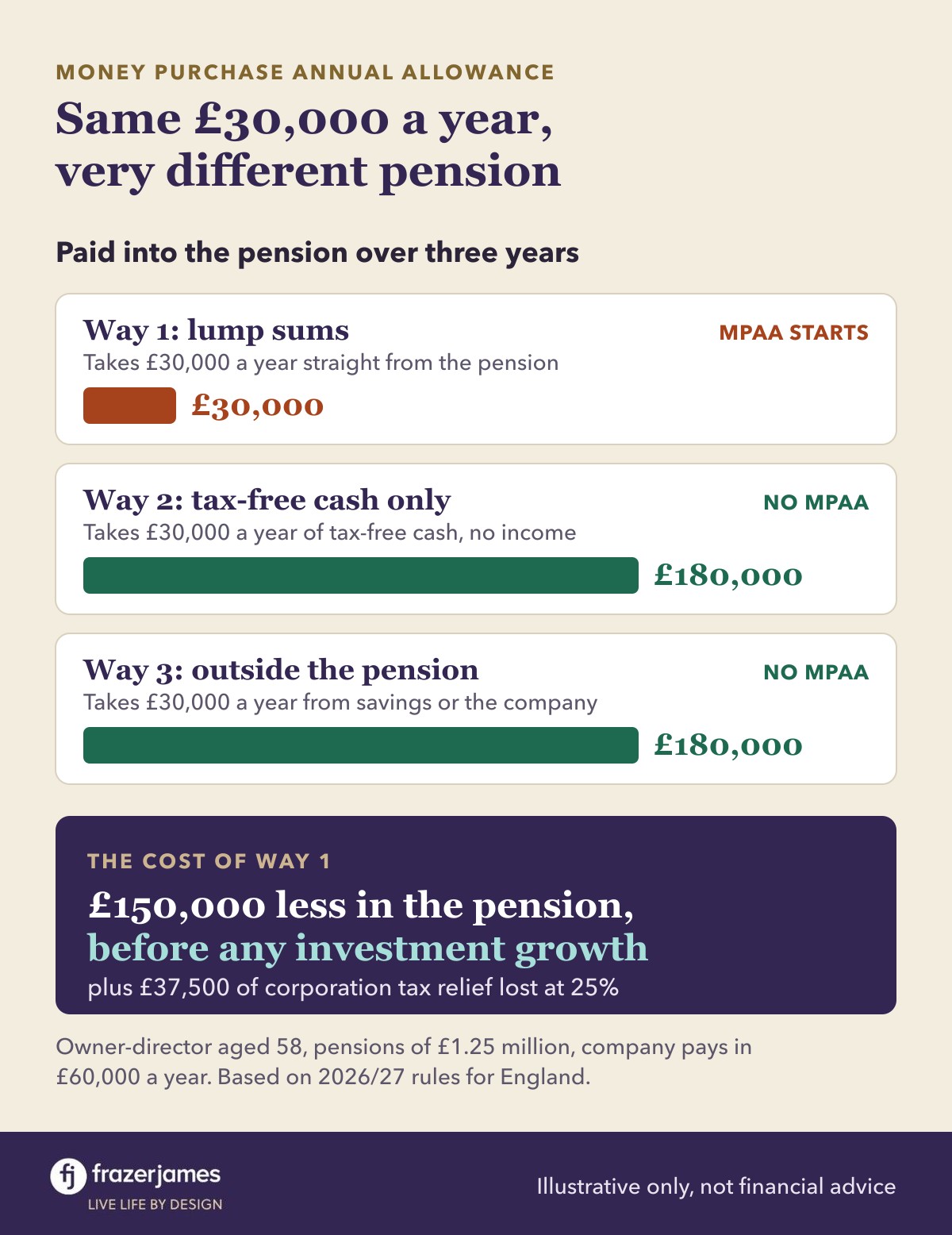
Way 1 cuts what the company can pay in by £50,000 a year. Over three years, that is £150,000 less going into the pension, before any investment growth.
The company also loses the corporation tax relief on that £150,000. At the 25% main rate, that is £37,500. And the £150,000 still has to come out of the company some other way, as salary or dividends that are taxed.
Way 2 gives the same £30,000 a year, and all of it is tax-free. The company keeps paying in £60,000 a year. The trade-off is that £90,000 of tax-free cash is used now, rather than later.
Way 3 keeps every option open. It suits owners with cash in the business or savings they would spend anyway. Our salary vs dividend calculator shows the cost of taking more from the company.
A point to watch with Way 2. Tax-free cash must not be used to pay much more into a pension than you normally would. This is called recycling, and the tax charge can be up to 55%. Here the company keeps paying what it always paid, so it is not recycling. Our guide to taking your tax-free cash explains the rules.
Already triggered it? What happens next
Take a senior manager aged 56 on a salary of £90,000. They pay £18,000 a year into their workplace pension, and their employer adds £7,000. That is £25,000 a year.
Last year, they took £20,000 from an old personal pension to help their daughter buy a home. It came as one lump sum: £5,000 tax-free and £15,000 taxed. That one payment triggered the MPAA.
From then on, only £10,000 a year can go into their money purchase pensions without a charge. In a full tax year, they pay in £15,000 more than that. At their 40% rate, the charge is £6,000 a year.
There was a better way. If the old pension was worth at least £80,000, they could have moved £80,000 into drawdown. Then they could take £20,000 of tax-free cash only, and leave £60,000 invested. The MPAA would not have started.
If you have already triggered the MPAA, three steps help.
- Tell your other schemes. You have 91 days from your provider’s statement to tell any scheme you are still paying into.
- Add up what goes in. Include what you, your employer and any company pay into money purchase pensions each year. Carry forward cannot cover anything above £10,000.
- Decide how to handle the extra. You could cut payments to £10,000 a year, or accept the charge. Some employers may pay the difference as salary instead. Take advice before you choose.
Timing matters in the year it starts
In the tax year you first trigger the MPAA, only payments made after that day count towards the £10,000. Payments made earlier in the same tax year are tested against the separate £50,000 limit instead.
So for a business owner, the order of events matters. Say the company pays £50,000 into your pension in May. In June, you take your first drawdown income. The May payment counts against the £50,000 limit, so there is no charge.
Only payments made after your first income count towards the £10,000 that year. From the next tax year, the £10,000 limit applies to everything paid in. Have the timing checked before you rely on it.
Check whether your plan would trigger the MPAA
Money Purchase Annual Allowance Checker 2026/27
Would your plan trigger the MPAA?
Choose how you plan to take money from your pension, and enter what goes in each year. See whether the £10,000 limit would start, and what it could cost you.
Based on pension rules and tax rates in England, 2026/27
What the numbers say
Enter what you, or your employer or company, pay in each year to see whether the MPAA would start.
,
If the MPAA starts, you can either
,
,
Illustrative only, not financial advice. Based on pension rules and income tax rates in England for 2026/27. The money purchase annual allowance is £10,000 and the standard annual allowance is £60,000; very high earners can have a lower allowance. The tax charge shown is a rough guide: it is worked out at your highest rate of income tax, and the real charge depends on your full income. In the tax year the MPAA starts, only payments made after that day count towards the £10,000. Carry forward cannot be used against the MPAA. Rules checked on GOV.UK on 13 October 2026.
Choose how you plan to take money from your pension, and enter what you and your company or employer pay in. The checker shows whether the MPAA would start and what it could cost you.
What to do before you take money from your pension
- Work out what you need, and when. A clear figure for each year makes it easier to choose the right source.
- Check what is paid in now. Add up what you, your employer and your company pay into money purchase pensions each year.
- Look at tax-free cash first. If you have tax-free cash left, taking it on its own does not start the MPAA.
- Use other money where it makes sense. Savings, ISAs and money in the company may be better to spend first.
- Time the company’s payment. If you will trigger the MPAA, have the company pay in for the year before your first income.
- Check older pensions. Small pots, older drawdown plans and protected tax-free cash all have their own rules.
- Think about inheritance tax. From April 2027, most unused pensions will count towards your estate for inheritance tax. That changes which money is best to spend first. Our guide to the pension inheritance tax changes explains more.
Who this is not for
If you have stopped paying into pensions, or you pay in less than £10,000 a year, the MPAA makes little difference to you.
This guide is also not for anyone looking for a way to draw money out and pay it back in for extra tax relief. That is what the rule is there to stop.
Talk to a certified financial planner
Own a company, or a director close to retiring?
We can help you plan how to draw on your pensions. We look at your pensions, your company and your tax together, and show you the order that works best. Read how we help business owners and people planning their retirement. The first conversation is free, with no pressure to proceed.
Important information
The examples in this guide are illustrative only and are not personal advice. They use 2026/27 rules and income tax rates for England, Wales and Northern Ireland. Scotland has different income tax bands.
A company can usually deduct its pension payments from its profits when they are made wholly and exclusively for the business. Tax rules can change, and how they apply depends on your circumstances. The value of a pension can go down as well as up. You cannot usually take money from a pension until age 55, rising to 57 from 6 April 2028.
We checked the rules in this guide against GOV.UK and HMRC’s Pensions Tax Manual on 13 October 2026. We will check them again after the Budget on 28 October 2026.
About The Author

About The Author

Related news









Get in touch
Schedule a free consultation with one of our financial advisers, or give us call.
0117 990 2602