 Client Login
 Retirement assessment
 Book a call
 0117 990 2602


Modified on: October 2026
Selling Your Business Before April 2027: Is Beating the BADR Cut Worth It?

The Budget on 28 October 2026 halved the most important tax relief for business owners who sell. From 6 April 2027, Business Asset Disposal Relief will cover £500,000 of gains in your lifetime, down from £1 million.
If you were planning to sell in the next year or two, you now face a question. Should you try to sell before April 2027, or carry on as planned?
This guide is for owners of UK trading companies who may sell soon. We show what missing the date really costs and what HMRC’s new rules say about deals that straddle it. We also show why rushing can cost more than it saves.
At a glance
- Business Asset Disposal Relief taxes the first part of your gain at 18% instead of 24%. The limit falls from £1 million to £500,000 for sales on or after 6 April 2027.
- For one owner with a gain of £1 million or more, the cut costs up to £30,000. For a couple who both qualify, it costs up to £60,000.
- Signing before 6 April 2027 is not enough on its own. HMRC’s new rules can still apply the lower limit if the sale completes after that date.
- Accepting a lower price to sell quickly can easily cost more than the £30,000 you save.
- Our free Business Asset Disposal Relief calculator now asks when your sale completes, so you can see both answers.
First, the relief in plain English
When you sell shares in your company for more than you paid, the profit is called a gain. You pay Capital Gains Tax on it.
Most owners selling a company pay Capital Gains Tax at 24%, because a large gain takes them into the higher rate band. Everyone also gets a tax-free allowance of £3,000 of gains each year.
Business Asset Disposal Relief lowers the rate to 18% on qualifying gains. It used to be called Entrepreneurs’ Relief. It has a lifetime limit, which means it covers a set amount of gains across all the sales you ever make.
To qualify on a share sale, you normally need to meet three conditions for the two years before the sale:
- You hold at least 5% of the company’s ordinary shares and voting rights, with a 5% share of its profits and assets.
- You are a director or an employee of the company.
- The company is a trading company, not mainly an investment business.
Any relief you have claimed in the past counts towards the lifetime limit. If you used some of it on an earlier sale, you have less left.
What the Budget changed
The 18% rate stays the same. The lifetime limit is what changes.
| Sale completes | Lifetime limit | Rate on gains within the limit | Rate above the limit |
|---|---|---|---|
| Before 6 April 2027 | £1,000,000 | 18% | 24% |
| On or after 6 April 2027 | £500,000 | 18% | 24% |
HMRC estimates about 13,000 people a year will be affected. Those are the owners with the larger gains, including many of the owners we work with.
What missing the date costs
These examples are illustrative only. They assume the whole gain is taxed at the higher rate, and that no relief has been claimed before.
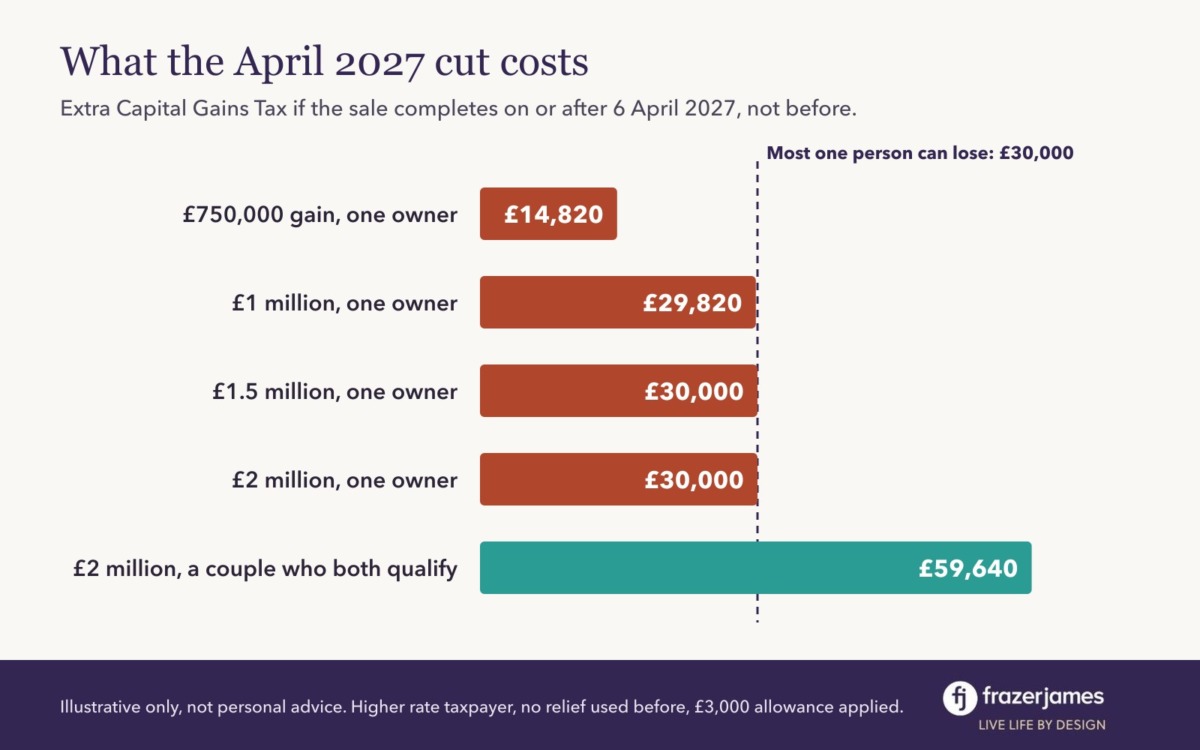
The extra tax stops growing at £30,000 per person. That is because the cut only moves £500,000 of gain from 18% to 24%. Six percentage points on £500,000 is £30,000.
So the most a single owner can lose is £30,000. That matters, but it is a fixed figure. It should be weighed against everything else in the deal.
The new rules for deals that straddle the date
Normally, for Capital Gains Tax, a sale happens on the day the contract becomes unconditional. That is the point at which nothing is left that could stop the deal. It is not always the day the money arrives.
That raised an obvious idea. Could you sign a contract before 6 April 2027 and complete later, but keep the £1 million limit?
HMRC published its detailed rules on 29 October 2026. In short, it has closed that door for most people:
- If you sign an unconditional contract before 6 April 2027 and it completes on or after that date, the £500,000 limit applies by default.
- You can keep the old limit only if you show the contract was not entered into to get a tax advantage from the timing.
- If the buyer is connected to you, such as a family member or a company you control, the test is stricter. The contract must be for wholly commercial reasons.
- If your gain is over £100,000, you must make a statement to HMRC to use this exception.
There are also rules for share swaps and company reorganisations that happen around the date. These are technical, and your accountant should check them against your deal.
The practical message is simple. To be sure of the £1 million limit, plan for the sale to complete before 6 April 2027, not just to be signed.
Why rushing can cost more than it saves
That leaves about five months. For most company sales, that is very tight. Buyers need time to check the business, raise money and agree the legal terms.
A buyer who knows you are racing a tax deadline has more power in the negotiation. Here is the risk in numbers, again illustrative only:
- On a £1.5 million sale, a price cut of just 2% is £30,000. That wipes out the whole tax saving for one owner.
- Taking more of the price later, through an earn-out or a loan note, may not help. Payments that depend on future results can be taxed differently, and may not get the relief at all.
- A rushed process gives you less time to plan the things that often matter more than £30,000. Those include your pension, how the money is invested afterwards and inheritance tax.
Selling early also means selling on this year’s profits. If the business is growing, waiting a year could add far more to the price than £30,000.
When selling before April 2027 can make sense
Bringing a sale forward is most likely to be worth it when:
- You already have a serious buyer, and talks are well advanced.
- The price and terms would be the same whether you complete in March or in June.
- You and your spouse or partner both qualify, so the saving is up to £60,000.
- You were going to sell soon anyway, and the business is not growing fast.
It is least likely to be worth it when you have no buyer yet, or the business is growing quickly. It is also unlikely to pay if a fast sale would mean a weaker price or worse terms.
Five things to do now, whatever you decide
1. Check you qualify, and for how long
Every condition must have been met for the two years up to the sale. Check your shareholding, your role and the company’s trading status now. Our five-question exit readiness check takes two minutes.
2. Look at the cash in the company
A large pile of cash or investments can put the company’s trading status at risk. HMRC uses a rough guide of 20% of the company’s activities, assets or income. Above that, the relief can be lost entirely, which costs far more than the Budget cut.
3. Consider a pension payment from the company before the sale
While you still own the company, it can usually pay into your pension. The payment is normally allowed against Corporation Tax, and there is no National Insurance on it.
Here is a simple illustration. £100,000 left in the company and paid out to you as part of the price is worth about £76,000 after tax at 24%. Paid into your pension instead, it is £100,000 in your pension.
The annual allowance for pension savings is £60,000. You can usually carry forward unused allowance from the three previous tax years, if you were in a pension scheme then. Very high earners may have a lower allowance. Our carry forward calculator shows how much you have.
Once the company is sold, you lose this option. Without earnings, you can then only pay in £3,600 a year with tax relief.
4. Check whether your spouse or partner qualifies
Each person has their own lifetime limit. A couple who both qualify can have two limits. But your spouse must also have met every condition for two years before the sale.
If they do not already qualify, it is too late to fix for a sale before April 2027. It is not too late for a sale in 2029.
5. Plan for the day after the sale
While you own a trading company, its shares can usually be left to your family free of inheritance tax. Once you sell, the cash is part of your estate and can be taxed at 40%. From April 2027, most unused pensions join your estate too.
Planning for this starts before the sale. Read our guide to inheritance tax for business owners.
What about the new Founders’ Relief?
The Budget also announced a new Founders’ Relief from 6 April 2027. It would tax up to £10 million of gains at 10%.
It is aimed at a small number of fast-growing companies. As proposed, the company would need turnover of at least £10 million and at least 15 full-time staff, among other tests. HMRC expects about 400 businesses a year to qualify.
If your company might fit, the rules are still being consulted on until 30 November 2026. For a fast-growing company, waiting until after April 2027 could even be better. Read our guide to Founders’ Relief.
See your own numbers
Our free Business Asset Disposal Relief calculator shows the tax on your sale both ways. Choose “Before 6 April 2027” and then “On or after 6 April 2027” to see the difference for your gain. It assumes your £3,000 tax-free allowance is already used on other gains.
It also shows what a second qualifying shareholder saves. Our business valuation calculator gives a rough value first, if you do not know your likely gain.
CGT on Selling Your Business · 2026/27
How much tax will you pay when selling your company?
Business Asset Disposal Relief at the 18% rate, the lifetime limit for your sale date, and what a second qualifying shareholder changes.
Capital gains tax on the sale
,
Illustrative only, not financial advice. Uses 2026/27 figures. Business Asset Disposal Relief is 18% on up to £1 million of qualifying lifetime gains per person, or £500,000 for sales completing on or after 6 April 2027. Gains above the limit are taxed at the 24% higher rate. The figures assume your £3,000 annual exempt amount has already been used elsewhere. Assumes you pay tax at the higher or additional rate, and that each qualifying person has a full unused lifetime limit. It also assumes the conditions are met. Broadly, that means two years owning at least 5% of the shares and voting rights, while an employee or office holder. Ignores earlier claims against the lifetime limit, EMI share rules and Investors’ Relief. Talk the sale through with us before terms are agreed, the first conversation is free.
Talk to a certified financial planner
Thinking of selling in the next few years?
If you may sell in the next few years, we can look at the timing alongside everything else the sale has to do for you. That includes your pension, your income afterwards and inheritance tax. Your accountant and solicitor handle the deal itself. Read about our financial planning for business owners, see our guide to business exit planning, or book a free consultation. The first conversation is free, with no pressure to proceed.
Important information
This guide gives information, not personal advice. The examples are illustrative only and assume the whole gain is taxed at the higher rate. Tax rules can change, and how they apply depends on your circumstances and the terms of your sale.
Tax on a business sale is work for your accountant, and the legal terms are work for your solicitor. Founders' Relief is a proposal and may change before it becomes law.
The value of investments can fall as well as rise, and you may get back less than you invest. We checked the figures in this guide against the Budget documents and HMRC's notes on 29 October 2026.
About The Author

About The Author

Related news











Get in touch
Schedule a free consultation with one of our financial advisers, or give us call.
0117 990 2602