 Client Login
 Retirement assessment
 Book a call
 0117 990 2602


Modified on: October 2026
Founders’ Relief: The New 10% Capital Gains Tax Rate, and Who Will Actually Qualify

The Budget on 28 October 2026 announced a new tax relief for people who sell a company they founded. It is called Founders’ Relief. It would tax up to £10 million of gains at 10%, from 6 April 2027.
That sounds like very good news for business owners. For a few, it is. But the proposed rules are narrow, and the government expects only about 400 businesses a year to qualify.
This guide explains what Founders’ Relief is, the tests your company would have to pass, and what it could save. It also covers what to do if, like most owners, your company will not qualify. The rules are still proposals, and we will update this page when they are final.
At a glance
- Founders’ Relief is a proposed new rate of 10% Capital Gains Tax on selling shares in a company you helped to found.
- It would cover up to £10 million of gains in your lifetime, for sales on or after 6 April 2027. Companies set up before that date can still qualify.
- As proposed, the company needs turnover of at least £10 million and at least 15 full-time staff. It must also pass two of three growth and innovation tests.
- You must have held at least 25% of the company when it started, and held your shares for at least five tax years.
- Most owner-managed companies will not qualify. For them, Business Asset Disposal Relief still applies, but its limit falls to £500,000 from April 2027.
First, what Capital Gains Tax is
When you sell shares for more than you paid, the profit is called a gain. You pay Capital Gains Tax on it. Most owners selling a company pay 24%, because a large gain takes them into the higher rate band.
Today, the main relief for business owners is Business Asset Disposal Relief. It taxes qualifying gains at 18% instead of 24%. Its lifetime limit is £1 million, falling to £500,000 for sales from 6 April 2027.
Founders’ Relief would sit alongside it, with a lower rate and a much higher limit. It is aimed at founders of fast-growing, innovative companies.
What Founders’ Relief is for
The government says the relief is for founders, and significant early investors, of high-growth, innovative UK companies.
Its aim is to encourage people who have already built successful businesses. The government believes they can create even more UK jobs and growth in future.
The date that matters is the date you sell. Your company does not have to be set up after 6 April 2027. You must have held your shares for at least five tax years, so most companies that qualify will have been set up well before then.
The details are still being decided. You can read the proposals, and respond to them, in the government’s Founders’ Relief consultation until 30 November 2026.
How it compares with Business Asset Disposal Relief
| Founders’ Relief (proposed) | Business Asset Disposal Relief | |
|---|---|---|
| Rate | 10% | 18% |
| Lifetime limit | £10 million | £1 million, then £500,000 from 6 April 2027 |
| Starts | Sales on or after 6 April 2027 | Available now |
| Who it is for | Founders and early investors in high-growth, innovative companies | Owners and employees with at least 5% of a trading company |
| Status | Proposal, out for consultation until 30 November 2026 | Law |
The limits are linked. Any Business Asset Disposal Relief or Investors’ Relief you claim from 6 April 2027 reduces your £10 million Founders’ Relief limit.
The tests your company would have to pass
These are the conditions in the government’s proposals, published on 28 October 2026. They may change after the consultation.
Tests for you
- Your founding stake. You held at least 25% of the company’s ordinary shares when it started trading, or when it began preparing to trade.
- How long you held your shares. At least five tax years before the sale.
- Where you lived. You were resident in the UK for tax purposes for at least five tax years in a row before the sale.
The proposals look at your stake when the business started. They do not set a minimum stake at the time you sell. Early investors who held 25% at the start can qualify, as well as founders.
Tests for the company
- It is a trading company, or the parent of a trading group, without a large non-trading side.
- It has had a substantial presence in the UK for its last five accounting periods.
- It still carries on the trade it was set up for, with no major change in what it does.
- It had turnover of at least £10 million and at least 15 full-time equivalent staff. This is measured in the accounting period ending in the year before the sale.
- It is not in a sector excluded from the Enterprise Investment Scheme, such as land dealing, financial services or property development.
Two of three growth and innovation tests
- Fast sales growth. Turnover grew by an average of 25% a year over three accounting periods in a row, within the ten years before the sale. Turnover must have been at least £10 million before the growth started.
- Fast growth in staff. Full-time equivalent staff grew by an average of 25% a year over three accounting periods in a row, within the ten years before the sale. There must have been at least 15 staff before the growth started.
- Research and development. The company spent at least £1.5 million on qualifying research and development in the three years before the sale. It must also have claimed the tax relief for it.
To give a sense of scale, growth of 25% a year from £10 million takes turnover to about £19.5 million in three years.
What it could save
These examples are illustrative only. They assume the gain is taxed at the higher rate and that no relief has been claimed before. They use the proposed rules, which may change.
| Gain on the sale | No relief (24%) | Business Asset Disposal Relief, from April 2027 | Founders’ Relief, as proposed |
|---|---|---|---|
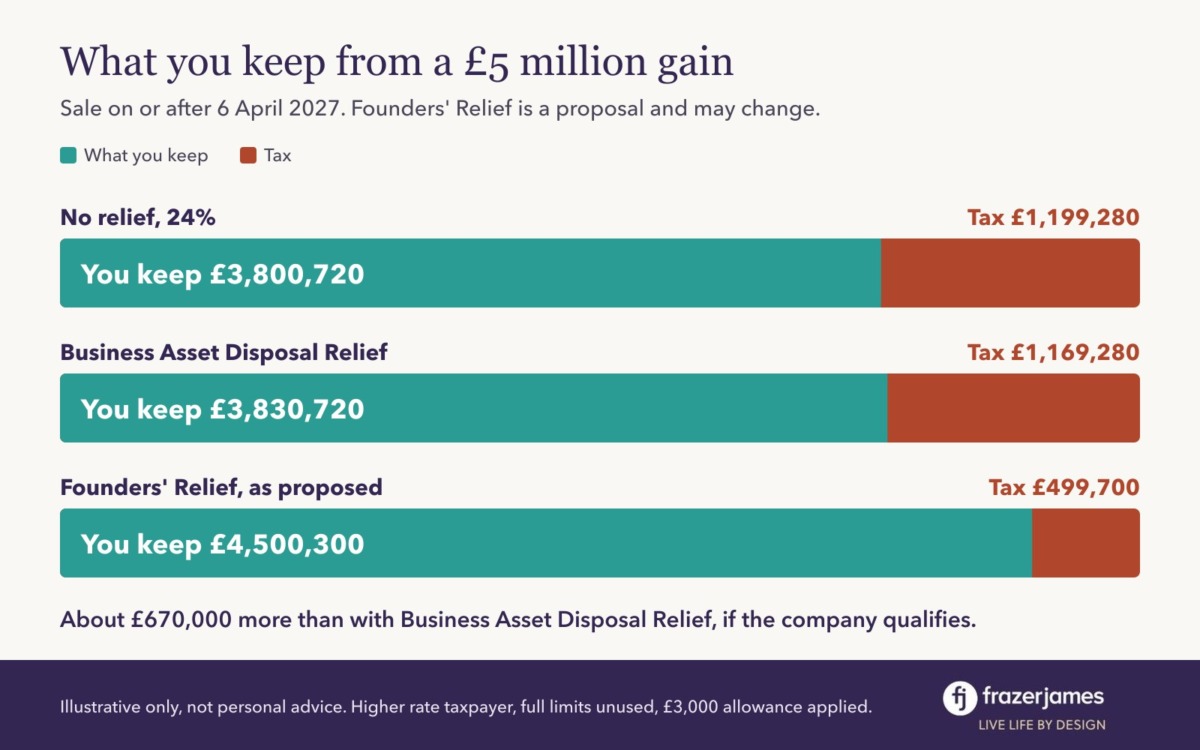
| £5,000,000 | £1,199,280 | £1,169,280 | £499,700 |
| £12,000,000 | £2,879,280 | £2,849,280 | £1,479,280 |
On a £5 million gain, Founders’ Relief would save about £670,000 compared with Business Asset Disposal Relief. That is why the qualifying tests matter so much.
On the £12 million gain, the first £10 million is taxed at 10%. The remaining £2 million is taxed at 24%.
A quick check: could your company qualify?
If you answer no to any of these, Founders’ Relief is unlikely to apply as currently proposed.
- Did you own at least 25% of the company when it started trading?
- Will you have held your shares for at least five tax years when you sell?
- Have you lived in the UK for at least the last five tax years?
- Is turnover at least £10 million, with at least 15 full-time staff?
- Can the company show two of these: 25% a year sales growth, 25% a year staff growth, or £1.5 million of claimed research and development?
- Is it a trading company outside property, land and financial services?
Why most business owners will not qualify
Many successful owner-managed companies fall well short of these tests. A consultancy with £4 million of turnover and 20 staff fails on turnover. A profitable engineering firm with steady growth of 8% a year fails the growth tests.
A company that grew fast six or seven years ago, and has since levelled off, may still pass. The growth tests look back over ten years. That is worth checking with your accountant.
If your company does not qualify, Business Asset Disposal Relief is still there. But its limit halves for sales from 6 April 2027. For one owner with a large gain, that costs up to £30,000. Read our guide to selling your business before April 2027.
If you might qualify
- Timing matters in the other direction. Founders’ Relief only applies to sales on or after 6 April 2027. Selling early to beat the Business Asset Disposal Relief cut could mean missing a much bigger relief.
- Get the company’s figures checked. Ask your accountant to test the last ten years of turnover, staff numbers and research and development claims against the proposed rules.
- Watch for changes. The consultation closes on 30 November 2026. The final rules will be set in the Finance Bill. We will update this page when they are published.
- Think beyond the tax. A large sale changes everything else: your income, your pension and your inheritance tax. Planning for that starts before the sale.
See your own numbers
Our free Capital Gains Tax calculator works out the tax on a gain at 2026/27 rates. Our Business Asset Disposal Relief calculator shows the tax on your sale before and after April 2027.
Founders’ Relief is not in our calculators yet, because the rules are still proposals. We will add it once they are final.
CGT on Selling Your Business · 2026/27
How much tax will you pay when selling your company?
Business Asset Disposal Relief at the 18% rate, the lifetime limit for your sale date, and what a second qualifying shareholder changes.
Capital gains tax on the sale
,
Illustrative only, not financial advice. Uses 2026/27 figures. Business Asset Disposal Relief is 18% on up to £1 million of qualifying lifetime gains per person, or £500,000 for sales completing on or after 6 April 2027. Gains above the limit are taxed at the 24% higher rate. The figures assume your £3,000 annual exempt amount has already been used elsewhere. Assumes you pay tax at the higher or additional rate, and that each qualifying person has a full unused lifetime limit. It also assumes the conditions are met. Broadly, that means two years owning at least 5% of the shares and voting rights, while an employee or office holder. Ignores earlier claims against the lifetime limit, EMI share rules and Investors’ Relief. Talk the sale through with us before terms are agreed, the first conversation is free.
Talk to a certified financial planner
Building a company you may sell one day?
If you are planning to sell a growing company, we can look at the timing alongside everything the sale needs to do for you. Your accountant handles the tax tests, and your solicitor handles the deal. Read about our financial planning for business owners, see our guide to business exit planning, or book a free consultation. The first conversation is free, with no pressure to proceed.
Important information
This guide gives information, not personal advice. Founders' Relief is a proposal. Its rules may change before it becomes law, and it may not be introduced in this form.
The examples are illustrative only. Tax rules can change, and how they apply depends on your circumstances and the terms of your sale. Tax on a business sale is work for your accountant.
The value of investments can fall as well as rise, and you may get back less than you invest. We checked the figures in this guide against the government's proposals on 29 October 2026.
About The Author

About The Author

Related news










Get in touch
Schedule a free consultation with one of our financial advisers, or give us call.
0117 990 2602